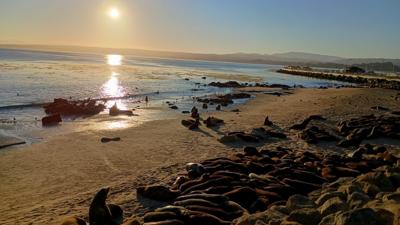

It is a sight—and a smell, and a sound—to behold. Hundreds of sea lions have gathered in Monterey Bay, and when they're not swimming and hunting for fish, are resting on small beaches in the city of Monterey.
That includes San Carlos Beach at the base of the Coast Guard Pier, which Parks & Recreation officials closed off to human visitors on Monday morning, Aug. 19. It also includes smaller coves in Monterey Harbor, including spots adjacent to the well-traveled Recreation Trail, where city officials have installed barriers to keep people from getting too close to the wildlife.
"We want folks to keep a safe distance, not try to draw their attention," says Giancarlo Rulli of the Marine Mammal Center. He emphasizes the importance of keeping a safe distance—ideally 50 yards, although in close quarters like along the Rec Trail, it can be an arm's length away—and even when you are close, avoid trying to get a sea lion's attention. The same holds true if you are recreating in the water on a kayak or paddleboard, etc.
"Just give these animals a break, and reduce their stress level," Rulli says. "If a sea lion approaches you, especially in the water, do not engage with the animal, and calmly exit. It’s amazing to have these animals in our backyard and enjoy these animals from a safe distance."
That sea lions live in Monterey Bay is not new, but this seasonal surge in the population—even while it's now happening for the third year in the row around this time—is relatively unpredictable.
"The entire continental shelf off of California is their migrating grounds," Rulli says. That means unlike other marine mammal species with more predictable north/south patterns, California sea lions go wherever the going is good—specifically for them, that means fish.
They are generally clustered in Southern California around the Channel Islands for breeding in the spring, and afterward, males begin migrating. They'll go wherever the fishing is good, for a vast area—that entire continental shelf, from northern to southern California. That means their concentration in Monterey Bay is a good sign that fish populations are thriving.
"Sea lions are coastal foragers," Rulli says. "They eat largely the same seafood that we do. They have a world-class supermarket in their backyard, which is Monterey Bay National Marine Sanctuary."
They are opportunistic eaters and follow the fish, meaning it's hard to predict how long they'll stay. In 2022 they arrived in early September. In 2023, they arrived in July and stayed for about six weeks.
The sea lions in Monterey are mostly males, and are adults or subadults, or teenagers. There are thousands in local waters at the moment, but they represent just a fraction of the roughly 250,000 California sea lions throughout the state.
After springtime breeding season, the animals travel looking to replenish their energy supply (by eating plentifully) and resting, which is part of why Rulli advises against stressing them out.
It's also the law—the Marine Mammal Protection Act prohibits harassment of these animals—and it's for humans' safety as well as the animals' safety, Rulli adds. "These are large animals, they can be unpredictable, and they can be territorial," he adds. "They are wild. Take that photo, but do so from a safe distance."
If you see a sea lion—or any other marine mammal—in distress, the Marine Mammal Center encourages you to call them to report it (the hotline is 415-289-7325). Rulli notes that a response may not come immediately; depending on the potential disruption to other resting animals, they may be unable to immediately rescue a sick or injured animal. It also needs to be safe for people to access the animal.
There has been some rough news for sea lions in California lately, with domoic acid poisoning on the coast of San Luis Obispo and Santa Barbara counties, but that has not been occurring north of SLO. The sea lions in Monterey Bay are largely healthy males migrating for healthy schools of fish—positive ecological indicators all around.
"It is a remarkable thing to be able to see," Rulli says, "and to have such charismatic marine mammals in our backyard."


(0) comments
Welcome to the discussion.
Log In
Keep it Clean. Please avoid obscene, vulgar, lewd, racist or sexually-oriented language.
PLEASE TURN OFF YOUR CAPS LOCK.
Don't Threaten. Threats of harming another person will not be tolerated.
Be Truthful. Don't knowingly lie about anyone or anything.
Be Nice. No racism, sexism or any sort of -ism that is degrading to another person.
Be Proactive. Use the 'Report' link on each comment to let us know of abusive posts.
Share with Us. We'd love to hear eyewitness accounts, the history behind an article.