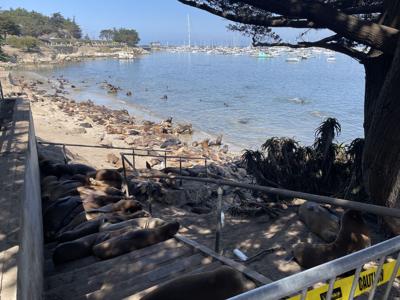

The booming, cacophonous choir of barking, burping, and baritone squealing shocks the ears from hundreds of feet away, as the wind carries an aroma of wild marine life. The eyes have been warned of the presence of sea lions, though, it’s not until one reaches the new barricade perimeter around the shores near Monterey’s Fisherman’s Wharf that the scale of this natural event becomes apparent.
Hundreds—if not more than a thousand—of sea lions, ranging from white to brown to gray, from old to young, fat to slender (relatively speaking), are partying along the beach. Some are screaming at each other, others are lunging their blubbery necks at one another in hopes of scoring a pindown. Some lay resting, their bodies packed as tightly as sardines, while others lay piled up peacefully, spilling out against the protective fence. The count is doubled if it includes the hundreds of sea lions recreating in the water.
If sea lion culture has an equivalent of MTV’s Spring Break, it is unfolding along these rocky Peninsula shores and attracting a steady gallery of smartphone-bearing spectators snapping selfies and evidence to send to friends. The event has prompted public announcements from the city of Monterey for people to maintain a safe distance—50 feet—from the colony of marine mammals.
“It's good to remember that we humans are sharing this space with other species,” one announcement/warning from the city read. “Marine mammals, including sea lions, are protected under the Marine Mammal Protection Act. People who harass, feed, capture, or kill any marine mammal could face a hefty fine or even jail time.”
The marine mammals are, in fact, on a break between breeding and mating seasons. Pregnant female sea lions arrive on the shores of the Channel Islands in Southern California after a foraging trip around March and April to give birth. After the pups are born, around May and June, the males make their way to the islands and search for females to mate with during the early summer months. To close out the mating season, the sea lions then make their way back north on a search for food. Where food is plentiful, the sea lions will stop, rest and forage.
Giancarlo Rulli, spokesperson with the Marine Mammal Center, says, for some of the sea lions, this could be a final stop before heading back down south to give birth to a new set of pups. Rulli says with its proximity to the deep sea and the upwelling that brings cold, nutritious water from the ocean’s depths to the surface, the Monterey Bay is an ideal rest stop for sea lions on the birthing, breeding, foraging cycle.
Helping ocean productivity has been La Niña, which has impacted the northern hemisphere since 2020 and is expected to remain through the end of the year, which would make it the 21st century’s first “triple-dip” La Niña. The weather phenomenon carries its greatest impact during the winter, strangling the potential for rainfall. However, it also brings a cold ocean—contrary to the warm waters brought on by El Niño. A cold ocean is, often, a productive ocean.
“When the fish disperse, we will see the sea lions disperse,” Rulli says. However, no one knows when that will be.
Rulli says the Marine Mammal Center is on standby to help the sea lions out of stressful situations, such as the one who became entangled in a monofilament fishing line around its neck. He says these types of rescues can be complex, sometimes requiring an “acoustic dart” that is shot at the sea lion, sedates them, and then sends out an acoustic tracking signal so the rescue team can locate the animal if it goes out of sight.
The public plays an important role in saving animals in danger. Rulli says if you see a sea lion or other marine mammal in precarious circumstances, try to take a picture with your phone and call the Marine Mammal Center’s hotline at (415) 289-7325.


(0) comments
Welcome to the discussion.
Log In
Keep it Clean. Please avoid obscene, vulgar, lewd, racist or sexually-oriented language.
PLEASE TURN OFF YOUR CAPS LOCK.
Don't Threaten. Threats of harming another person will not be tolerated.
Be Truthful. Don't knowingly lie about anyone or anything.
Be Nice. No racism, sexism or any sort of -ism that is degrading to another person.
Be Proactive. Use the 'Report' link on each comment to let us know of abusive posts.
Share with Us. We'd love to hear eyewitness accounts, the history behind an article.