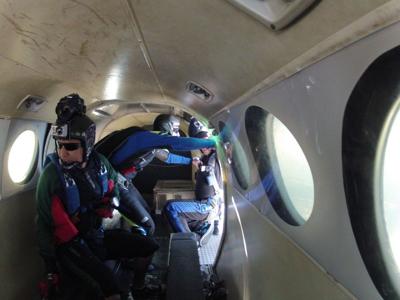

Skydive Monterey claims the highest tandem skydiving drop point on the planet, 18,000 feet up.
Now the Marina Municipal Airport-based company is being sued over a parachute the plaintiff alleges opened too high, precipitating a tailspin, his crash landing and injury.
That man, Gerardo Flores, filed the lawsuit in Monterey County Superior Court Monday, March 10.
The jump took place Aug. 8, 2012.
The biggest question isn't whether media reports—that he hit the ground at 40 mph, that he spent two weeks unconscious in the hospital, and that a parachute inspection revealed damaged velcro—are sensational.
It is whether the crash was the fault of the chute or that of the jumper's.
The resounding response from Skydive Monterey Bay—and the greater skydiving community—is that Flores is at fault, and should be more thankful than litigious.
•••
Flores jumped solo on that Aug. 8 day in Marina, having earned certification to do so.
He was on his 30th jump, which turns out to be a key detail.
The incident generated a small but intense burst of attention regionally and nationwide, at least in part due to the fact he filmed the incident himself with a handheld GoPro.
The footage is dramatic.
But the use of a camera not only makes for great TV and YouTube. It also also breaks skydiving regulations for new jumpers. Distracting devices like cameras are reserved by use for far more experienced jumpers: Two hundred jumps is the unofficial minimum, 500 a number used by other professionals.
•••
Inspector Wilbert Robinson of the Federal Aviation Association filed a report on the incident.
"Main Chute appeared to have deployed prematurely, while he was on his back, as he performed what appeared to be a barrel roll," the report reads. "He then lost consciousness as he descended to the ground."
The report continues from mid-barrel roll: "The hand deploy pilot chute prematurely deployed out of its pouch which appeared to cause the unintentional deployment of the main parachute at 13,000 feet."
There appears another tricky part with the incident—and, consequently, that account.
As with the camera, Flores wasn't cleared to perform those sorts of maneuvers. Rolls are another much more advanced technique reserved for seasoned professionals.
At least that's what Skydive Monterey Bay CEO and chief safety officer Jackie Behrick, who has completed more than 8,000 jumps, contends.
She says Flores fibbed when asked about what he would attempt during pre-jump safety checks, saying he'd execute some down-facing steering moves called "tracking" and later try some "canopy work" guiding the rig with the chute deployed.
"He was only cleared to belly fly," Behrick says. "When he declared his maneuvers for the flight, it was tracking and canopy work, so I told him to pull his chute high [to allow more canopy training]. When the chute came out, I thought, 'I said high, not that high.'
"He declared a routine and was completely lying to my face."
Those moves, she adds, led to the problems with the chute and its entanglement, as did the use of a camera.
The camera seems a bigger sin in her eyes, especially after she and other jumpers saw footage he had posted on an earlier jump and confronted him.
"We sat him down and gave him literature backing it up: Regulations prevent this. We are not allowed to do this."
Skydive Monterey Bay cameraman Juan Juarez was a friend and fellow jumper who also spoke to him about it.
"That's what pisses me off," he says. "We actually talked about it before: You're not supposed to be wearing a camera, and especially not in your hand. He nodded his head up and down."
"He knows he can't take it with him," Behrick says. "I can't believe he's trying to sue, a grown man that chose to disregard our guidance and regulation. I thought he knew better."
•••
FAA Inspector Robinson looked over the parachute on Aug. 14, 2012, along with a parachute rigger examiner Allen Silver at Silver Parachute Sales & Services in Hayward, Calif.
"The container showed signs of wear and tear that appeared beyond serviceable limits," the report continues. "The material on the flap of the reserve container was worn on numerous parts of the cover.
"The main parachute closing flap velcro was completely worn."
Behrick's reply: It makes sense it was messed up after the jump. His ill-advised maneuvers led to damage, and for all she knows the paramedics who reached him on the ground cut up the rig.
Flores' lawyer, Oakland personal injury attorney David A. Kleczek, disagrees.
"The parachute was a piece of garbage beyond serviceable limits," he says, "with intentional modifications that don't meet muster."
Before she was aware of a lawsuit, Behrick issued a statement that the accident was due to diver error, not improperly checked or maintained equipment.
That statement was quoted by United Press International as follows:
“Prior to Gerardo’s jump, the gear was certainly in proper working order..."In summary, improper use by the jumper caused a minor incident of pre-deployment of his main parachute, to which he again responded incorrectly. New jumpers must appreciate the true distractive nature of an extra piece of equipment (i.e. camera). He never executed positive control of his descent. This would be like texting while driving…at terminal velocity. He did not have his 'eyes-on-the-road' so to speak. His experience has not been taken lightly by myself or my peers. Jumper’s ability to disregard instructors and flight crews at ours or any facility is disheartening, let alone scary.
"We are glad he is doing well. We wish he and his family well. It’s too bad jumpers feel like they need to take chances in an extreme sport that is thrilling in its own respects. Skydiving: no extra risks necessary."
Kleczek thinks she—and a wider jump community blasting Flores for his irresponsibility, even lampooning him with a parody video—place blame incorrectly.
"They're looking at Gerardo as a villain," Kleczek says. "It's not a critique of skydiving as a whole, but a critique of Skydive Monterey Bay. [The skydive community] should be saying Skydive Monterey Bay is giving all of us a bad name by renting out that parachute."
He adds there would likely be no lawsuit without the FAA report.
"If the report said the parachute was in perfect working condition, I don't think we would present a case," he says. "It all goes back to the parachute, above all else."
As far as the barrel roll, Kleczek says that was part of training administered by SDM themselves.
"Their training course specifically calls for him to practice barrel rolls," he says.
Marina Fire Department responded to the emergency call in 2012. Flores was then evacuated by California Shock Trauma Air Rescue (CALSTAR) helicopter to a San Jose hospital.
The United States Parachute Association recorded 19 fatal skydiving accidents in the U.S. out of roughly 3.1 million jumps.
"That’s 0.006 fatalities per 1,000 jumps," the website reads, "nearly the lowest rate in the sport’s history!"


(0) comments
Welcome to the discussion.
Log In
Keep it Clean. Please avoid obscene, vulgar, lewd, racist or sexually-oriented language.
PLEASE TURN OFF YOUR CAPS LOCK.
Don't Threaten. Threats of harming another person will not be tolerated.
Be Truthful. Don't knowingly lie about anyone or anything.
Be Nice. No racism, sexism or any sort of -ism that is degrading to another person.
Be Proactive. Use the 'Report' link on each comment to let us know of abusive posts.
Share with Us. We'd love to hear eyewitness accounts, the history behind an article.