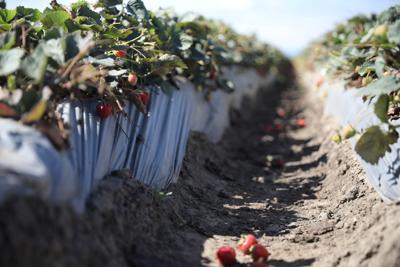

A group of county and state agencies, farmers and pesticide application companies landed a significant legal victory in a written decision from Monterey County Superior Court Judge Thomas Wills.
The ruling was issued on Aug. 25, a little over a month after attorneys for all of the parties made their case in court. A coalition of groups seeking to challenge pesticide usage—Pajaro Valley Federation of Teachers, Californians for Pesticide Reform, Safe Ag Safe Schools, Center for Farmworker Families, Monterey Bay Central Labor Council—sued the California Department of Pesticide Regulation and Monterey County Agricultural Commissioner.
The lawsuit, filed in April 2024, came after the groups had filed appeals over permit approvals to apply pre-planting fumigants on six Monterey County farms. While the issue in one sense focused quite narrowly—on six applications that had already long since happened—the consequence for a ruling that might upend the normal procedure in grower applications for permission to use pesticides held potentially significant implications.
"As surely as night follows day, the issue of Commissioner-level permit issuance review and documentation will continue to be challenged if not resolved presently, and the court accordingly exercises its discretion to rule on the issues presented," Wills wrote.
The plaintiffs took issue with the process by which grower applications to ag commissioners for a permit to apply pesticides are processed and approved. They questioned whether a sufficiently rigorous analysis had been conducted, and argued there was a less than adequate assessment of alternatives.
Wills took into account some of the real-world constraints: agriculture is happening in fast-changing weather and pest conditions, meaning time is short and ag commissioners and their staff must make fast decisions without extensive environmental review (but do conduct site-specific analysis for safety and compliance with label requirements); the only realistic alternative to the pesticides at issue in the appeals would have been no comparably effective pesticide; and the impracticality for ag commissioners to issue extensive written findings in each approved pesticide application permit.
If a written analysis was required, Wills wrote, "for every permit issued, the task would be Sisyphean. The [DPR] director noted in her decision on the administrative appeal that, in the year 2022 alone, county agricultural commissioners issued 22,460 restricted use permits."
Wills found that the process is compliant with the California Food and Agriculture Code as adopted by the state Legislature, and was unpersuaded by the plaintiffs' arguments.
"We are disappointed the court didn’t agree with the ways in which we’re experiencing the shortcomings of California’s laws on toxic fumigants and other pesticides in Pajaro Valley," plaintiffs' representatives said in a statement.


(0) comments
Welcome to the discussion.
Log In
Keep it Clean. Please avoid obscene, vulgar, lewd, racist or sexually-oriented language.
PLEASE TURN OFF YOUR CAPS LOCK.
Don't Threaten. Threats of harming another person will not be tolerated.
Be Truthful. Don't knowingly lie about anyone or anything.
Be Nice. No racism, sexism or any sort of -ism that is degrading to another person.
Be Proactive. Use the 'Report' link on each comment to let us know of abusive posts.
Share with Us. We'd love to hear eyewitness accounts, the history behind an article.