
In life, Gordon Smith was never afraid to push back against the powers that be, willing to wage activist battles against superstructures like the U.S. military.
In death, he similarly strove to control the narrative, with a plan for his death weeks before it came. He wrote his own obituary, leaving a blank line for the date (Tuesday, June 13, 2023). He had suffered for years from inclusion-body myositis, a rare degenerative disease that affects the muscles, impacting his ability to do even basic tasks.
Speaking just a week-and-a-half prior to his death, he told the Weekly: "I don't want to live flat on my back in diapers. I'm not going through that."
Smith was 73. The Vietnam War veteran lived in Monterey for 45 years.
He described himself as a "good troublemaker."
Smith was born in Minnesota on March 1, 1950. His family moved to San Francisco when he was 5 months old; in his teens, they moved to the Sacramento area, where he learned to ride motorcycles starting at an age too young to legally get a driver's license.
In Smith's telling, he was an iconoclast from an early age, and it was only through a circuitous route that he joined the military. He'd been busted for cannabis possession during his sophomore year of college, he wrote, and a judge agreed to dismiss the charges if Smith enlisted. He did, and within a year, was deployed to Vietnam.
There, he was assigned to 834th Air Division at Bien Hoa. He was a mission controller at “Rocket Alley" moving C-7s, C-123s and C-130s tactical cargo planes. Their mission was to move “beans, bullets and bodies from the Delta to the DMZ,” according to Smith's obituary.
He joined the group Vietnam Veterans Against the War while he was still stationed there. He was awarded the Air Force commendation medal, an honor that he refused to accept.
After serving in Vietnam, Smith returned to California where he attended CSU Sacramento, then became a solar technology instructor at Monterey Peninsula College and worked as a contractor. He built his own passive-solar house in Monterey, right near Bi-Rite Market.
His involvement in local politics and government started small—in 1984 he founded the Villa Del Monte Neighborhood Association after securing federal block grant funds for construction of sidewalks and gutters.
In his later years, Smith was outspoken against war, but he writes that it took a long time for him to even discuss his own experience at war.
"He never wrote home about Vietnam or talked to his family about it," Smith wrote. "He did not talk much about Vietnam for 14 years. He got involved in veterans’ politics in 1984 when his then-girlfriend encouraged him to see [a traveling display version of the Vietnam War memorial wall] that was temporarily on display in Monterey. The experience set him on a meaningful journey of working with and for veterans. With 12 other veterans he cofounded the Vietnam Veterans of Monterey County and joined several other veteran groups that took him around the world."
That work including building medical clinics in Vietnam, despite warnings from the U.S. State Department. He broke ground in 1989 on a plot of land in Vung Tau for a clinic. Subsequent efforts to deliver medical supplies to Vietnam and Cambodia continued over years.
In 1990, Smith launched the Monterey chapter of Veterans for Peace.
His peace-related advocacy converged with local government involvement in 1991 and 1998 when he led protests against including tanks in Monterey's Fourth of July parade. (Their success became a precedent, and military tanks were no longer included.)
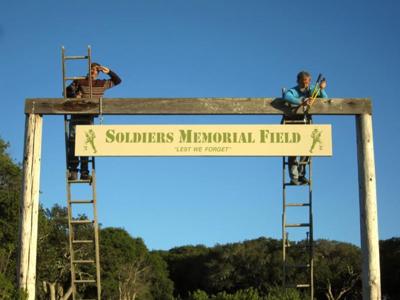
In more recent years, Smith was known for his conservation-related activism around Fort Ord, where he helped install a sign denoting "Soldiers Memorial Field" near 8th and Gigling, at the site of a since-failed development concept called Monterey Downs.
Smith was an early members of the group Keep Fort Ord Wild, and on his own initiative, cut, maintained and named recreational trails. Smith advocated to federal policymakers to get the former Fort Ord designated as a national monument (part of it was, in 2012) and he traveled to Washington, D.C. where he met then-president Barack Obama.
Beyond his relentless activism, Smith loved to have fun. He traveled to 51 countries and all 50 U.S. states; he surfed and hiked in locations across the planet. He built his own social communities in various realms that interested him, from the Portola Poker Palace Players (a group of card players who met in his home); Vietnam Veterans Longboard Society (surfers); the Merry Bikester Literary Society (motorcyclists); the Easy Street Seniors 9-Ball Tournament (billiards); the Flash Mob Posse (mountain bikers); and the Veterans Wild Fort Ord (hikers, mountain bikers and runners).
"One thing he learned during 30 years of hosting poker nights," Smith wrote in his obituary, was this: "You got to know when to hold ‘em and know when to fold ‘em."


(0) comments
Welcome to the discussion.
Log In
Keep it Clean. Please avoid obscene, vulgar, lewd, racist or sexually-oriented language.
PLEASE TURN OFF YOUR CAPS LOCK.
Don't Threaten. Threats of harming another person will not be tolerated.
Be Truthful. Don't knowingly lie about anyone or anything.
Be Nice. No racism, sexism or any sort of -ism that is degrading to another person.
Be Proactive. Use the 'Report' link on each comment to let us know of abusive posts.
Share with Us. We'd love to hear eyewitness accounts, the history behind an article.