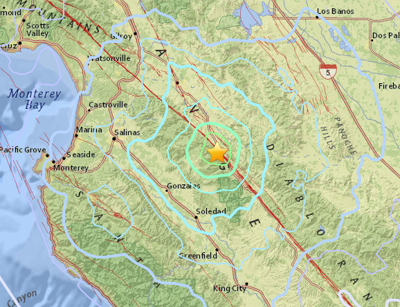

A swarm of earthquakes in Monterey County has got people buzzing about what's next for the San Andreas fault.
For the uninitiated, a "swarm" of such shudders is the geological term for a pattern of many earthquakes arriving in a relatively short period of time in a relatively small area.
But is it a precursor to something bigger?
State experts think it was more along the lines of the San Andreas Fault blowing off some steam.
The swarm got started at 11:31am on Nov. 13, when a 4.6 quake rolled through the county.
It was centered 14 miles northeast of Gonzales in the Gabilan Range, above Pinnacles National Park, at a depth of 3.8 miles.
Dr. John Parish, the State Geologist of California and head of the California Geological Survey said in an email Nov. 13 it was "very near—if not on—the main trace of the San Andreas Fault."
The depth of the quake was shallow—most California quakes are 6-10 miles deep—and could indicate that the quake was on a smaller splay fault related to the San Andreas.
More lexicon lessons from the state Geological Survey help there: Splay faults are subsidiary faults that branch from the main fault.
As to whether the Nov. 13 quake was a precursor to something bigger, he said that's always a possibility, but the probability diminishes over time.
If it had been a foreshock to a larger quake, it would have happened within approximately two days.
"If we’d had a cluster of magnitude 4 earthquakes within a few hours of each other, we’d be a lot more concerned," he said at a meeting this week of earthquake experts called COSMOS, the Consortium of Organizations for Strong Motion Observation Systems, in Burlingame.
Dozens of quakes hit the region this week, but not in the tight clusters Parish mentioned.
Most of the quakes were too small to be felt, except for four notable occasions.
On Nov. 14, two quakes hit in the same area as the 4.6 quake.
There was a 3.2 quake followed five minutes later by a 3.8 quake around 9:15am.
Both were even shallower than the quake the day before.
Two days later on Nov. 16, two more quakes struck that same are again, both registered at 3.2, and both were under six miles deep.
Unsettling, yes, but, to reiterate the theme: Is the Big One in the offing?
"We’ve plotted all of the earthquakes along the plane of the fault, and it appears to be normal stress release rather than an indicator of anything foreboding," he said.
"That being said, large, damaging earthquakes along the San Andreas Fault are to be expected, and it’s in the public’s best interest to be prepared."
Such is life on the Pacific Rim.
Editor's note: An earlier version of this post referred to Pinnacles National Park as Pinnacles National Monument. Congress voted to designate it as a national park in 2012. It was signed into law by President Barack Obama in 2013.


(0) comments
Welcome to the discussion.
Log In
Keep it Clean. Please avoid obscene, vulgar, lewd, racist or sexually-oriented language.
PLEASE TURN OFF YOUR CAPS LOCK.
Don't Threaten. Threats of harming another person will not be tolerated.
Be Truthful. Don't knowingly lie about anyone or anything.
Be Nice. No racism, sexism or any sort of -ism that is degrading to another person.
Be Proactive. Use the 'Report' link on each comment to let us know of abusive posts.
Share with Us. We'd love to hear eyewitness accounts, the history behind an article.