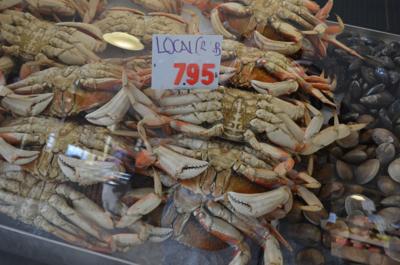

The California Department of Fish and Wildlife (CDFW) announced Jan. 5, 2026 as the opening date for the commercial Dungeness crab fishery along the Central Coast (zones 3, 4 and 5). Recreational crabbing will open statewide on the same day.
The announcement comes as good news, though with limitations intended to give whales more time to migrate to calving grounds off Mexico and Central America. The fishery will open to commercial fishers with a 40 percent gear reduction to minimize whale entanglements.
The opening also comes after the holiday season, consistent with the past seven years. Historically, winter markets have been the most profitable period for the Dungeness crab fishery, which once ran from about Nov. 15 to July 15. In recent years, the season has been shortened because of migrating whales and, at times, domoic acid contamination. The average closure date has shifted earlier, primarily into April, May and June, as whales return in the spring.
While there is no calendar date yet for the fishery’s closure, ropeless crab traps—which allow fishers to deploy a “pop-up” buoy using Bluetooth signals rather than leaving a rope suspended in the water—continue to show promise as a way to extend the season during periods of high whale activity. Ropeless crab gear manufacturer Sub Sea Sonics has been authorized for the first time to allow its use by all fishers with a Dungeness crab permit following a fishery closure after April 1, 2026.
“You could essentially double the length of the crab season with the pop-up gear being authorized,” says Geoff Shester, a senior scientist for Oceana. “It allows you to further reduce risk to the whales at the time that seems to be the most problematic for the fishery, and allows people to stay on the water fishing. That's sort of the sweet spot.”
Many whale species use local waters as feeding grounds, and not all have struggling populations. Whale presence varies by year and food availability, for example, better krill populations can push certain species into deeper waters.
However, several species that feed off Monterey County’s coastline—particularly the Central American population of humpback whales—are listed as endangered under the U.S. Endangered Species Act. That population is the primary limiting factor in fishery management because it is recovering more slowly than other groups, according to Shester.
“It's the Mexico population that is the [population] that's doing much better, and is explaining the increase in whales that we're seeing,” Shester says. “We're not seeing that level of increase for the Central American population. California, and to some extent, Oregon, is the main spot for those whales to feed.”
In 2025, four humpback whales were confirmed entangled in California Dungeness crab gear, with five additional humpbacks entangled in unidentified gear. Whale entanglements increased nationwide in 2024, with 95 whales entangled in U.S. waters. About 75 percent of whale entanglements are fatal, according to the National Oceanic and Atmospheric Administration.
"We’ve seen again and again that if there’s too much fishing gear in the water when whales are around, we’re likely to see horrific entanglements. Thankfully, the state just authorized the use of whale-safe pop-up fishing gear for the spring, so we can avoid conflicts when whales return at the end of the season,” said Ben Grundy, an oceans campaigner at the Center for Biological Diversity. “Now we just need officials to OK the gear for the entire season to make these delayed openings a thing of the past.”


(0) comments
Welcome to the discussion.
Log In
Keep it Clean. Please avoid obscene, vulgar, lewd, racist or sexually-oriented language.
PLEASE TURN OFF YOUR CAPS LOCK.
Don't Threaten. Threats of harming another person will not be tolerated.
Be Truthful. Don't knowingly lie about anyone or anything.
Be Nice. No racism, sexism or any sort of -ism that is degrading to another person.
Be Proactive. Use the 'Report' link on each comment to let us know of abusive posts.
Share with Us. We'd love to hear eyewitness accounts, the history behind an article.