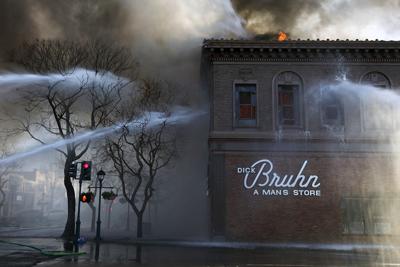

New details have emerged regarding the quick spread of the Dick Bruhn building fire two months ago in Oldtown Salinas—and some of those details are disconcerting.
Salinas Fire officials said Thursday there was a delay before anyone called 911 to report heavy smoke coming from the now-destroyed building, which in part contributed to the fire's spread.
Neither a Kehoe employee who was inside the building with six family members—including a baby and two teenagers—nor passers-by immediately called authorities after the fire broke out after 2:30pm Feb. 13.
In fact, one of the teenagers snapped a photo of the fire from inside the building and posted it with the app Snapchat as conditions worsened, before firefighters received a call. The worker and his family told investigators they were touring the building when the fire broke out near the former uniform counter.
According to an account of the events provided by Salinas Fire Marshal Sam Klemek, the worker, 44-year-old Eduardo Gonzales, and his family entered the building so he could give them a tour. He left them to turn on the electrical panel, then the group continued to the upper floor. Once upstairs, they began to notice smoke.
Gonzales returned to the electrical panel to turn it off and the family exited the building through the alley entry. By that time, debris was coming through holes in the floor.
He called a member of the Kehoe family (Gerry Kehoe is the building's owner) to notify them about the fire and called 911. It is unclear, though, who he called first: one account had him calling Kehoe first, while another had him calling 911 first.
Gerry Kehoe told the Weekly two months ago the worker was there only to deliver a couch and that nothing else was inside the building except for some personal items. However, investigators found the fire was accelerated by the storage of combustible construction materials and flammable liquid stored in the garage area of the building.
In addition, a large hole cut in the roof during unpermitted construction work at the building acted as a chimney that drew flames upward, leading to a total collapse of the roof.
Although the exact cause of the fire has yet to be determined, fire officials maintain it was accidental and not arson. Klemek says determining a fire's origin is often like medical diagnostics—a process of elimination—and in this case, faulty wiring can't be eliminated as the cause.
Gonzalez told investigators that at one point there was a can of flammable liquid near the seat of the fire, which he moved. But other construction material throughout the building was also cited as the fuel of the massive fire.
Investigators additionally found the electrical systems in the building were in varied states of age and disrepair. Another contributing factor to the fast spread of the fire was the worker holding a door open to “let the smoke dissipate.” These two factors added oxygen into the building, feeding the flames.
The smoke was so heavy that the 8-month-old baby and two other members of the worker’s family suffered from smoke inhalation. They did not seek medical treatment.
The five-alarm fire took two days to put out and the damage to the building has been estimated at between $2 million-$3 million. The damage to neighboring businesses continues to be calculated, but considering the 300 block of Main Street was closed for six days, the loss of business is presumed to be costly.
Another issue at hand is the disposal of debris left from the fire. Officials says the Kehoe family is “facing some challenges” in regards to finding a landfill that will take the waste.
The Monterey Peninsula Landfill, which is prohibited from accepting waste deemed hazardous, has already declined to take the building’s demolition debris.
In a letter to Kehoe employee Averi Dunn, Monterey Regional Waste Management District senior engineer David Ramirez writes it is the district's understanding the waste in the Kehoe building contains friable asbestos, lead-based paint, fluorescent bulbs and printed circuit boards.
"As a Class III site, which is permitted to accept non-hazardous solid waste and prohibited from accepted hazardous waste, the Monterey Peninsula Landfill cannot accept the co-mingled demolition debris materials from the project," Ramirez writes.
Ramirez then suggests three other locations that might take the waste, with proper permitting and protocols in place, including the Salinas Valley Solid Waste Authority landfill or Johnson Canyon Road; the Altamont Landfill in Altamont; and the Kettleman Hills facility in Kettleman City.
The Monterey County District Attorney’s Office continues to investigate the possible illegal removal and dumping of asbestos from the building, prior of it burning, during weeks of unpermitted construction at the building in 2013 and 2014.
Fire officials say fines and legal action are not currently being considered against the Kehoe family.


(0) comments
Welcome to the discussion.
Log In
Keep it Clean. Please avoid obscene, vulgar, lewd, racist or sexually-oriented language.
PLEASE TURN OFF YOUR CAPS LOCK.
Don't Threaten. Threats of harming another person will not be tolerated.
Be Truthful. Don't knowingly lie about anyone or anything.
Be Nice. No racism, sexism or any sort of -ism that is degrading to another person.
Be Proactive. Use the 'Report' link on each comment to let us know of abusive posts.
Share with Us. We'd love to hear eyewitness accounts, the history behind an article.