

A year ago, when officials from the California Department of Pesticide Regulation visited Salinas for a public workshop on rules about pesticide use near schools, teachers from Ohlone Elementary School in Pajaro wore hazmat suits and gas masks to make their point.
They sought 1-mile buffer zones and advanced notifications before pesticides were applied to nearby fields.
Francisco Rodriguez, a special ed teacher and president of the Pajaro Valley Federation of Teachers, lays out their ideal goal: “That fumigants are banned completely.” But he and fellow North County teachers know that’s an unrealistic request.
Instead, working with the nonprofit Center for Community Advocacy and the union umbrella group the Monterey Bay Central Labor Council, the teachers union and Monterey County Agricultural Commissioner Eric Lauritzen have agreed to try out something new.
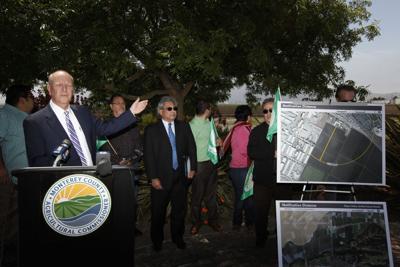
The new plan: The ag commissioner’s office will notify schools five days before fumigations occur on farm fields within a quarter mile, roughly the length of four football fields.
The pilot program, effective May 10, will apply to three North County schools: Hall Elementary, Ohlone Elementary and Pajaro Middle, all islands amid farm fields.
With more than 65 schools in Monterey County within a quarter mile of fields, and more than 165,000 pesticide applications a year, the pilot program could expand widely.
Lauritzen’s office already requires farms to report scheduled fumigations at least five days in advance.
The new step is that Lauritzen will alert a school official at each of those three schools, who in turn will notify students, parents, teachers and staff.
Those notifications could take take the form of fliers sent home, or automated phone calls. As part of the pilot program, and using a $75,000 grant from the state DPR, the ag commissioner’s office will build a website and launch a community engagement group.
While the mechanics of the school-side notification are still to be hashed out and the website to be be built, Lauritzen announced the pilot program Tuesday and said it takes effect immediately.
Members of the Center for Community Advocacy and labor leaders joined Lauritzen in celebrating the accord.
"This ag commissioner took a bold step forward," Labor Council Director Cesar Lara said. "I'm proud. In many ways, Monterey County has led the way."
CCA Executive Director Juan Uranga encouraged reporters to focus not on the details of how notifications will actually happen, but the success of the talks between opposing parties.
"There was a lot of arguing going back and forth, one group alleging the other didn’t care about children, which to me sounds insane," Uranga said of the early dialogue. "There was just a lot of shouting going on."
Things have changed immensely over the course of months of discussion, leading to what union members, CCA members and the ag commissioner hopes might become a blueprint for the state of California.
DPR is still at work on writing regulations pertaining to pesticide use and notification near schools, in a slower public process, and hopes to release regulations in 2017.
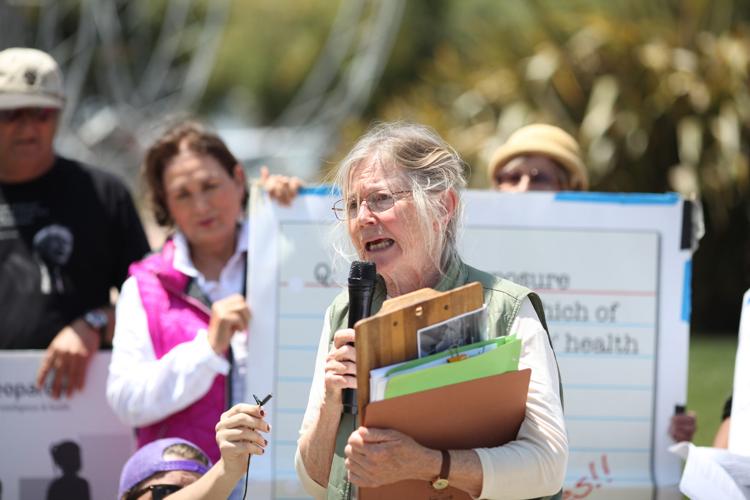
Immediately after the ag commissioner's laudatory press conference ended on Tuesday afternoon, activists with the group Safe Ag Safe Schools began a separate press conference outside Lauritzen's offices.

Retired public health nurse Carole Erickson speaks at a press conference held outside the ag commissioner's office by the group Safe Ag Safe Schools.
Numerous speakers called for more significant reductions, or all-out bans, on fumigants and other classes of pesticides.
"It's a wonder any of us are healthy," said Dr. Ann Lopez, director of the Center for Farmworker Families, citing the volume of pesticides used in agriculture.
Safe Ag Safe Schools activists also cite a new report released April 27 by the nonprofit Center for Race, Poverty & the Environment, showing that Latinos continue to bear the greatest health burden associated with pesticides.
There's a long history there: Ohlone Elementary, one of the three in the pilot program, had an air monitor installed in 2012 to track the presence of three pesticides in the air.
That was the result of a 2011 settlement between Latino families and the U.S. Environmental Protection Agency, originally filed in 1999. One of the original plaintiffs, identified in court papers only as Angelita C., was a Pajaro mother of a student at Ohlone.
In their new report, attorneys at the Center on Race, Poverty & the Environment raise concerns about how effective the EPA's treatment of Angelita C.'s complaint about racial disparity really was.
Her complaint focused on methyl bromide.
In the subsequent 12 years before the parties settled, many growers transitioned away from methyl bromide—which is being phased out by international treaty—and started using other fumigants.
"EPA knew of the fumigants that replaced methyl bromide but kept its investigation focused solely on methyl bromide," says Brent Newell of CRPE.
"EPA should have investigated fumigants it knew replaced methyl bromide because the facts changed during its 12-year investigation."
That case has been appealed, and a decision in federal court is currently pending.


(0) comments
Welcome to the discussion.
Log In
Keep it Clean. Please avoid obscene, vulgar, lewd, racist or sexually-oriented language.
PLEASE TURN OFF YOUR CAPS LOCK.
Don't Threaten. Threats of harming another person will not be tolerated.
Be Truthful. Don't knowingly lie about anyone or anything.
Be Nice. No racism, sexism or any sort of -ism that is degrading to another person.
Be Proactive. Use the 'Report' link on each comment to let us know of abusive posts.
Share with Us. We'd love to hear eyewitness accounts, the history behind an article.