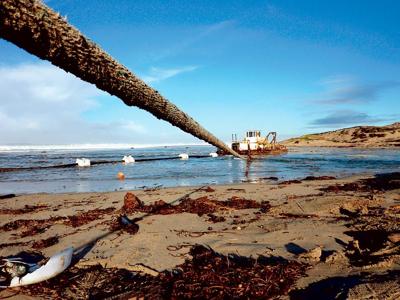

In a letter sent March 17, the California Coastal Commission informed Cemex that it must shut down its sand mining operation in Marina, or face formal cease and desist and restoration order proceedings as well as administrative penalties.
Sent by Acting Executive Director John Ainsworth, the letter states that the Cemex operation lacks a coastal development permit, as well as other permits, and is therefore illegal.
Retired Naval Postgraduate School professor Ed Thornton, a coastal engineer and longtime critic of the mining operation, says shutting the mine down will have major implications.
"On average, there will be an accretion of the shoreline," he says. "That’s what my calculations say."
Thornton, who's fought to shut down the mine at the Cemex property for 30-plus years, is reluctant to speak of the letter as a victory, but is cheered by the news.
And despite the fact that the mine—which draws sand from a lagoon on the beach in Marina—had been in operation for over a decade before the Coastal Act was ratified in 1976, Ainsworth writes that the operators of the mine at that time should have obtained a coastal development permit before the act went into effect in 1977.
Additionally, Ainsworth writes, the operators of the mine over the years (Cemex bought it in 2005) were remiss in not obtaining a use permit from the county, or an "after-the-fact" permit from the city of Marina, which was incorporated in 1975.
The letter also states that the operation is violating the Coastal Act by degrading sensitive habitat in the dunes surrounding the dredge pond, is reducing the width of the beach and is potentially impacting lateral access.
Ainsworth outlines six different sections of the Coastal Act being violated by the operation, as well as five different sections of Marina's Land Use Policy. Broadly speaking, these sections include access, dredging, shoreline processes, protection of environmentally sensitive habitat areas and minimization of adverse impacts.
At the end of the letter, Ainsworth writes: "We remain open to working with you to resolve the violations of the Coastal Act on the property, and we remain committed to working with you to achieve that end."
Cemex has until April 6 to respond to the letter with a "statement of defense" form, in which the company can either admit or deny the allegations made in the letter, as well include facts that may "exonerate or mitigate" their responsibility for the alleged violations.
The letter also informs the company, which is based in Monterrey, Mexico, that a majority vote by the agency's commissioners will authorize the commission to levy a series of fines that amount to several thousands of dollars a day for each Coastal Act violation occurring on the property.
The letter is the culmination of a Coastal Commission enforcement investigation that began about six years ago, and which overcame its final hurdle March 15 when Marina City Council voted unanimously to authorize the commission to enforce Marina's Local Coastal Plan.
The mine has long been scrutinized for its impact on local coastal erosion, especially in the face of ever-increasing sea level rise. On top of that, the U.S. Geological Survey finds that southern Monterey Bay has the highest level of coastal erosion in the state.
At a coastal erosion hearing today in Moss Landing, which was held by Assemblyman Mark Stone, D-Scotts Valley, the mining operation was referred to by Thornton as "the elephant" in the room.
Lisa Haage, the Coastal Commission's chief of enforcement, also attended today's hearing. When asked, after the hearing ended, if she expects Cemex to litigate the issue to court, she said she honestly didn't know what to expect.
"We've offered to sit down and talk," she said.
For his part, Thornton—who sat next to Haage at today's hearing—is happy the issue has finally come to a head, and that the fight he's championed for 30 years appears to be wrapping up.
"I was very pleased by the whole thing."


(3) comments
The CEMEX plant is easily the most highly degraded site along the Monterey Bay and its devastating effects are felt up and down the coast. Why has it taken so long for this monstrosity to be terminated.
Too bad the Coastal Commission (CCC) never brought down the hammer on the Santa Cruz County Board of Supervisors in 2009 in connection with the violation of Santa Cruz County CCC approved "Local Coastal Plan" which then in 2009 unconditionally prohibited any ground water overdrafting in any Santa Cruz aquifers and then also required immediate cessation and any other necessary remedial measures to stop any overdraft ... unique in the state of California (please see/review: www.begentlewiththeearth.org )
Why has the Cemex Sand Plant issue taken SO LONG to investigate?
Sent a letter to Monterey County Weekly (that was published in your paper) as well as Monterey County years ago urging the Coastal Commission to investigate the Cemex Sand Plant RE: Sand Removal, but nothing ever happened ...until 2016!
Why was Cemex legally allowed to continue removing sand from our shoreline for decades? Hope Cemex Sand Plant will finally be shut down ASAP!
Welcome to the discussion.
Log In
Keep it Clean. Please avoid obscene, vulgar, lewd, racist or sexually-oriented language.
PLEASE TURN OFF YOUR CAPS LOCK.
Don't Threaten. Threats of harming another person will not be tolerated.
Be Truthful. Don't knowingly lie about anyone or anything.
Be Nice. No racism, sexism or any sort of -ism that is degrading to another person.
Be Proactive. Use the 'Report' link on each comment to let us know of abusive posts.
Share with Us. We'd love to hear eyewitness accounts, the history behind an article.