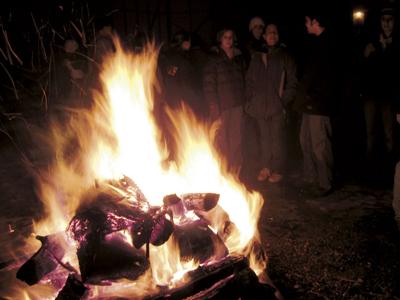

When Carmel resident Alexis Delehanty appealed the city's plan to reign in beach fires, she was fighting against a plan to try out 26 fire rings on the beach.
She filed her appeal in April with the California Coastal Commission, arguing the fire rings would cause a tripping hazard, get washed out to sea, and diminish the beach's rustic beauty.
“Scarring the beach with fire pits should not be the first line of action,” she wrote.
A lot has happened since April, and Friday afternoon, Delehanty found herself arguing in favor of the fire rings, urging the California Coastal Commission to approve the very plan she once appealed.
Also unexpected: Carmel city officials, who once embraced fire rings as a pilot plan to limit the number of fires burning simultaneously, were there to ask the Coastal Commission not to approve the city's own pilot plan.
From their perspective, a lot had changed, too.
At Carmel's request, the Monterey Bay Unified Air Pollution Control District installed air quality monitors that showed air quality was even worse than anyone realized.
Faced with hundreds of fires blazing away at a time during Fourth of July, Carmel City Council passed a temporary moratorium stopping fires on weekends and holidays last August.
They then extended that moratorium for a year and buttressed it Dec. 1 when the City Council voted 3-2 to declare beach fires a public nuisance.
City officials proposed something new: propane-powered fire pits, paid for by the city. In addition, beachgoers would be allowed to bring their own propane-powered devices to the beach.
The debate over how to rein in beach fires is a major public policy challenge. The California Coastal Commission is charged with protecting access and low-cost recreation on the coast.
But up and down the coast, fires have become a problem. The frequency and density can lead to high levels of smoke, posing public health consequences.
The Coastal Commission weighed in Friday on Carmel's beach fire situation at a meeting in Monterey.
"The science is in, the debate’s over. Wood smoke is a carcinogen," said Commissioner Mary Shallenberger.
"It’s an unhealthy recreation. We, the commission, need to find healthy ways to allow people access to the coast."
When it comes to public access, Shallenberger said, policymakers need to ask for whom. "Who doesn’t have access to the beach because their lungs will not permit them to even walk on the sidewalk?"
Shallenberger voiced the collective concerns of about two dozen Carmel residents who spoke out in favor of banning wood fires, and experimenting with propane instead.
They wore T-shirts that said, "Clean Air / Clean Beach / Clean Ocean / Clean Up."
Commissioner Dayna Bochco said she was interested in working with the city on the propane option, but with a moratorium in place for now, she wanted to see the fire ring pilot implemented instead, while they work on the propane fireplaces.
"I don’t think the city has a program; The propane thing is not a program yet," Bochco said.
Bochco made a motion to approve the recommendation by Coastal Commission staff, which was to implement Carmel's own dated policy to put 26 fire rings on the beach, but that motion was defeated by a 4-5 vote.
Without the Coastal Commission's approval of the plan for 26 fire rings, the status quo is allowed to stand.
But there's the rub: The status quo, according to Carmel City Council, is a moratorium on beach fires.
But that moratorium is illegal, in the eyes of Coastal Commission staff members.
T"he city’s moratorium is un-permitted," said Dan Carl, director of the California Coastal Commission’s Central Coast district. "What’s allowed on the beach in Carmel is unlimited fires on the sand."
(Carl's take is that scenario—unlimited fires directly on the sand—is a clear problem posing health, aesthetic and environmental risk, and that something should be done. Where he differed is his view of what to do. He advocated for the fire ring pilot, which the city opposes.)
Even so, the Coastal Commission is unlikely to crack down on Carmel for enforcing its ban.
“This would be a low priority for enforcement,” said Charles Lester, executive director of the Coastal Commission.


(0) comments
Welcome to the discussion.
Log In
Keep it Clean. Please avoid obscene, vulgar, lewd, racist or sexually-oriented language.
PLEASE TURN OFF YOUR CAPS LOCK.
Don't Threaten. Threats of harming another person will not be tolerated.
Be Truthful. Don't knowingly lie about anyone or anything.
Be Nice. No racism, sexism or any sort of -ism that is degrading to another person.
Be Proactive. Use the 'Report' link on each comment to let us know of abusive posts.
Share with Us. We'd love to hear eyewitness accounts, the history behind an article.