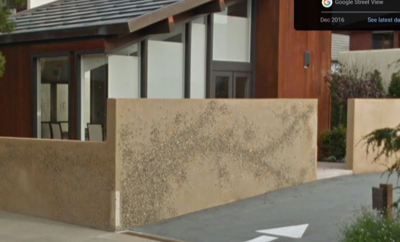

A decorative concrete wall outside of an annex of a now defunct-bank in Carmel is historic and must remain where it is, the Carmel City Council voted 4-0 on Tuesday, Sept. 12. It's another setback for Monaco developer Patrice Pastor, who wanted to move the wall so he could move ahead on building his proposed building next door.
Not only does the wall stay, but the design of Pastor's multi-use building, currently proposed at 15,351 square feet, will have to be modified, after the council said it will have to be further set back from the wall and the street, so that it can be better seen by the public.
Pastor's company, Esperanza Carmel, has been attempting to develop the JB Pastor Project, named for Pastor's father, along Dolores Street, behind the Seventh and Dolores restaurant, since he purchased the restaurant building and an adjacent property in 2020. Part of his plan involved demolishing the annex of the bank that once occupied the restaurant space, along with a building next to it facing Dolores.
The old bank building and its annex, used as a community room, were less than 50 years old and did not qualify as historic structures, but the Carmel Historic Resources Board stood in Pastor's way for two years. In October 2022 the buildings turned 50. The board voted to add them to the historic resources list in January.
Pastor cried foul and appealed to the the City Council, which rejected it and placed the buildings on the list in April, meaning the old community room would have to stay.
Pastor's company agreed to build around the community room, but then a new problem arose because the new 15,351-square-foot structure would block the view of a decorative, stamped-concrete wall outside of the annex building, created by the "father of stamped concrete," Brad Bowman of Carmel Valley. Bowman invented a way to stamp decorative patterns and incorporate stones into panels for installation onto exterior walls. It's a process that became popular with developers of commercial buildings in the 1970s.
The Historic Resources Board voted in July to allow Esperanza Carmel to relocate the wall and it seemed Pastor was a step closer toward developing the project—until Carmel councilmembers Karen Ferlito and Alexandra Dramov appealed the HRB decision.
They argued that the wall must stay where it is, using standards from the U.S. Secretary of the Interior, regarding the preservation of historic character of properties and avoiding the removal of "distinctive materials," as well as new construction not destroying historic features.
The rest of the council agreed with their assessment, minus Councilmember Bobby Richrds who recused himself. Mayor Dave Potter said they weren't discriminating against the developer. He called it a sensitive piece of property in the heart of the village, worthy of protection.
"I do not want to have anybody to think that anybody else would not get the same [critique]," Potter said. "It's a good process and I'm sorry it took so long but that's the nature of the beast here in Carmel."
In addition, the council said Esperanza Carmel has to fix the wall after a crew installing story poles to show the dimensions of the proposed building nailed a support for one of the poles into the top of the concrete wall.


(0) comments
Welcome to the discussion.
Log In
Keep it Clean. Please avoid obscene, vulgar, lewd, racist or sexually-oriented language.
PLEASE TURN OFF YOUR CAPS LOCK.
Don't Threaten. Threats of harming another person will not be tolerated.
Be Truthful. Don't knowingly lie about anyone or anything.
Be Nice. No racism, sexism or any sort of -ism that is degrading to another person.
Be Proactive. Use the 'Report' link on each comment to let us know of abusive posts.
Share with Us. We'd love to hear eyewitness accounts, the history behind an article.