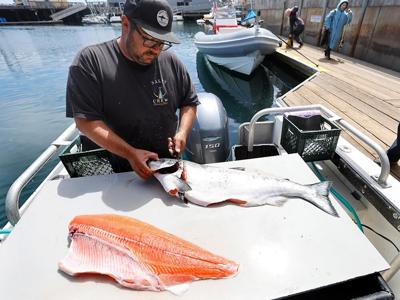

The California Department of Fish and Wildlife announced that Monterey Bay—part of the Central Coast region, which spans from Pigeon Point south to the Mexico border—will open to recreational salmon fishing on April 11. For the first time in four years, the region is also expected to reopen to commercial fishing sometime in May.
It’s highly anticipated news following years of consecutive closures tied to low population counts. The commercial fishing season for Chinook has been closed since 2022, and the recreational fishing window, while open last year for the first time since 2022, was limited to short periods in June, July and September.
Regional harvest guidelines for sport fishing set a maximum of 21,000 Chinook salmon total—also known as King Salmon. Fishing dates and guidelines for commercial salmon fishing have not yet been released.
“We're still on a quota-based fishery, meaning there’s a total harvest limit, so when we reach that number, it's gonna end,” says Tim Obert, a fisherman based in Santa Cruz who serves on a number of salmon groups, including the California Salmon Council and the California Advisory Committee for Salmon and Steelhead Trout.
He adds that many expect people to travel from outside the area to fish, but locals will hopefully also have opportunities to participate in the Northern California fisheries which may open later in the season.
“We’re all in the same pool,” he says. “The more participation there is, the fewer fishing days we’ll all have on the water. But there’s not much you can do about that.”
The reopening is a result of improved Sacramento River fall-run Chinook (SRFC) and Klamath River fall-run Chinook (KRFC) stocks, according to Stephen Gonzalez, CDFW communications manager.
Fishery managers have seen a high return of salmon jacks—male salmon that return to spawn a year or two early—which serve as an early indicator of stock health and a key metric for setting harvest quotas.
“Say a bunch of fish return but none of them are jacks—then that becomes a constraining factor,” Obert says. “Jack returns were around 67,000 fish, which is equivalent to the last five years combined.”
Fishing for Chinook salmon is limited because other salmon populations, such as the California Coastal Chinook and the Southern Oregon/Northern California Coho, are threatened and protected by law.
Because these protected salmon primarily inhabit Northern California waters, fishing is more restricted there but “allows for more fishing opportunities in southern management areas,” says Gonzalez.
As part of a broader plan called California Salmon Strategy for a Hotter Drier Future, which aims to protect native salmon from extinction, officials will be closely monitoring catch numbers, especially in a year that is unusually hot and dry.
“It’s going to be a madhouse, people are really excited to go fish,” Obert says. “We used to catch a lot of salmon, and I won't get close for years to come, if ever, to catching what I used to be able to catch. But it’s really important to see fisheries move on and become sustainable.”


(0) comments
Welcome to the discussion.
Log In
Keep it Clean. Please avoid obscene, vulgar, lewd, racist or sexually-oriented language.
PLEASE TURN OFF YOUR CAPS LOCK.
Don't Threaten. Threats of harming another person will not be tolerated.
Be Truthful. Don't knowingly lie about anyone or anything.
Be Nice. No racism, sexism or any sort of -ism that is degrading to another person.
Be Proactive. Use the 'Report' link on each comment to let us know of abusive posts.
Share with Us. We'd love to hear eyewitness accounts, the history behind an article.