
In 1988, when HIV/AIDS were still new, John XXIII Ministry started providing basic services to infected patients in Monterey. In 2009, the nonprofit changed its name from John XXIII to Central Coast HIV/AIDS Services (CCHAS)and inherited what was left of the defunct Monterey County AIDS Project.
On June 30, the region's only HIV/AIDS-focused organization will close for good.
"We’ve had many funding sources dry up," CCHAS Executive Director Kim Keefer says.
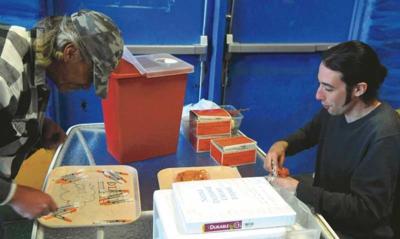
The nonprofit provides a number of services to the estimated 620-650 people living with HIV in Monterey County. That includes making HUD-funded housing payments for 13 families, allowing them to meet their monthly rent payments in locations all over the county; a needle exchange program serving a half-dozen clients in Seaside; and a much bigger needle exchange program in Salinas' Chinatown neighborhood, where CCHAS accepted 78,000 used needles last year.
Services also include keeping 130 patients enrolled in the California AIDS Drug Assistance Program, through which qualifying patients get their costly meds paid for by the state.
A San Luis Obispo-based nonprofit hopes to help fill in the gaps that CCHAS is leaving behind.
San Luis Obispo County AIDS Support Network (which is in the process of changing its name to the Access Support Network) is working on securing an office space and negotiating contracts to provide services to CCHAS' clients, without an interruption.
In particular, they hope to be able to keep enrollment in the Drug Assistance Program going smoothly: Without CCHAS or another service provider filling in, the nearest open enrollment location for those patients is in Santa Cruz. (Natividad Medical Center offers enrollment as well, but only to patients who receive care at their clinic.)
Strangely, Keefer says, CCHAS might be a victim of its own success, when it comes to treating HIV and AIDS patients.
A decade ago, CCHAS got about $170,000 a year from the Hospice Giving Foundation. Last year, they got just $20,000.
"There’s fewer end-of-life services, and reduced need for hospice," Keefer says. "People are living longer."
Fewer people are dying, and fewer are getting infected, which she thinks has reduced the sense of urgency for prospective donors.
And as people with HIV continue living relatively health lives thanks to advanced treatments, individual donations have shriveled up as well, totaling just $8,400 last year.
"That doesn't even pay our rent," Keefer says.
The reduced donations might also be due in part to a 2010 lawsuit, brought by then-Attorney General Jerry Brown. The state argued that the Monterey County AIDS Project, which dissolved before CCHAS launched, had misspent $2.8 million meant to go toward services for clients.
Private donations declined after that, former CCHAS Director Tom Melville told the Weekly in 2012, as the state prepared to ink a final redistribution of funds.
Corrections: An earlier version of this story had several inaccuracies. The name of the region's first HIV/AIDS outreach service was John XXIII Ministry, not St. John XVIII Ministry, and it was based in Monterey, not Salinas; CCHAS accepted 78,000 needles last year, not distributed that many; and housing payments are made directly to landlords, not distributed as vouchers, as previously stated.


(0) comments
Welcome to the discussion.
Log In
Keep it Clean. Please avoid obscene, vulgar, lewd, racist or sexually-oriented language.
PLEASE TURN OFF YOUR CAPS LOCK.
Don't Threaten. Threats of harming another person will not be tolerated.
Be Truthful. Don't knowingly lie about anyone or anything.
Be Nice. No racism, sexism or any sort of -ism that is degrading to another person.
Be Proactive. Use the 'Report' link on each comment to let us know of abusive posts.
Share with Us. We'd love to hear eyewitness accounts, the history behind an article.