
For the second year in a row, winter storms and flooding impacted the local agriculture industry, Monterey County’s largest.
The annual crop report, released on Tuesday, July 16 by the Monterey County Agricultural Commissioner’s Office, shows a 6-percent dip in total production value in 2023 compared to 2022, a reflection of a challenging year for many farmers. Planting and harvesting schedules were delayed due to flooding in the Pajaro Valley and parts of the Salinas Valley.
In February of that year, farmers reported $336 million in damage; at the time, Ag Commissioner Juan Hidalgo anticipated gross production losses could reach 15 percent compared to 2022. With that in mind, the 6-percent drop—gross production was $4.4 billion, compared to $4.6 billion in 2022—is good news.
“The prices and demand for our commodities really made a big difference in helping to close that gap, at least to some extent,” Hidalgo says.
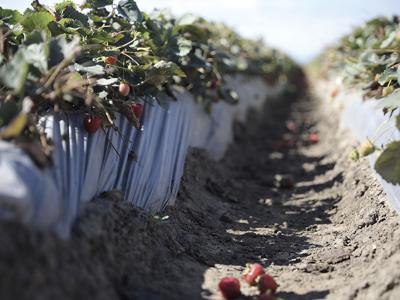
For a third year in a row, strawberries were reported as the top crop in Monterey County with a value of $903.8 million (down $55 million from the previous year). Leaf lettuce and head lettuce claimed second and third place respectively, at $782.1 million and $493.5 million. (Combined, lettuces are the highest-value crop in the lettuce v. strawberry battle, but they are tracked as separate line items.)
A wet winter benefited wine grape production, which increased in value by 12 percent in 2023. At $194.6 million, grapes were the sixth-most valuable crop, ahead of celery and spinach.
Cannabis remained in fifth place. Revenue for cannabis increased by 28 percent compared to 2022 with $362.6 million. However, the number of licenses for cannabis decreased by nearly half and the number of acres in cultivation was reduced from 74.6 to 41.3.
Hidalgo says his team continues exploring the expansion of the ag pass program, which grants growers access to their lands in case of an emergency. It means even when disasters like fires or floods limit access, they can get to acreage to keep livestock, crops and equipment alive and maintained, minimizing economic losses.
You can read the crop report in its entirety here.


(0) comments
Welcome to the discussion.
Log In
Keep it Clean. Please avoid obscene, vulgar, lewd, racist or sexually-oriented language.
PLEASE TURN OFF YOUR CAPS LOCK.
Don't Threaten. Threats of harming another person will not be tolerated.
Be Truthful. Don't knowingly lie about anyone or anything.
Be Nice. No racism, sexism or any sort of -ism that is degrading to another person.
Be Proactive. Use the 'Report' link on each comment to let us know of abusive posts.
Share with Us. We'd love to hear eyewitness accounts, the history behind an article.