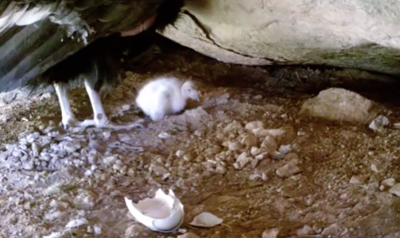

Condor chicks have been hatching in the wild since 2007.
That hadn't been captured on camera until now—and that's not the only remarkable thing to happen in the wilds of Big Sur this summer.
The second happened concurrently with the hatching of the chick, and transformed a tragedy into an amazing tale of cooperation.
Here's the background: One of the oldest condors in the small but growing flock that's carefully conserved by the Ventana Wildlife Society died this summer, apparently due to lead poisoning, though that's not been officially confirmed.
(Learn more on VWS's efforts to protect the iconic birds from lethal bullets with the award-winning piece, "Plight of the Condors: The endangered Big Sur scavengers are stalling on the edge of recovery. Ventana Wildlife Society is gunning for their survival—with bullets.")
The male died halfway into the nesting process.
That could've been a death sentence for his offspring.
Condor parents raise their babies in pairs because the little fuzzball can't regulate its own temperature for the first 30 days or so of its life. While one hunts, the other keeps the baby warm and protected from predators.
The amazing video reveals a second female—herself a widow who had to raise a chick without a male—swooping in to help care for the fledgling.
"It shows the altruism in the flock," VWS Senior Wildlife Biologist Joe Burnett says.
He's also observed birds released from the rehabilitation taken care of by members of the wild flock, regurgitating food for the less experienced scavengers.
"It goes back to how resilient the birds are," he says. "They’re survivors."
The cave where the video was filmed lays about 60 feet up on an exposed cliff face in remote coastal canyon in Big Sur. The area proves both extremely steep and rugged, with the nest cliff jutting out of a massive redwood grove. The cave itself is about 4 feet tall and about 6 feet deep.
Burnett and his small but hardy crew managed to navigate the terrain to plant the camera, and later found it covered in mud at the base of the cliff where the cave sits.
Get more on the ongoing conservation work at the Ventana Wildlife Society website.


(0) comments
Welcome to the discussion.
Log In
Keep it Clean. Please avoid obscene, vulgar, lewd, racist or sexually-oriented language.
PLEASE TURN OFF YOUR CAPS LOCK.
Don't Threaten. Threats of harming another person will not be tolerated.
Be Truthful. Don't knowingly lie about anyone or anything.
Be Nice. No racism, sexism or any sort of -ism that is degrading to another person.
Be Proactive. Use the 'Report' link on each comment to let us know of abusive posts.
Share with Us. We'd love to hear eyewitness accounts, the history behind an article.