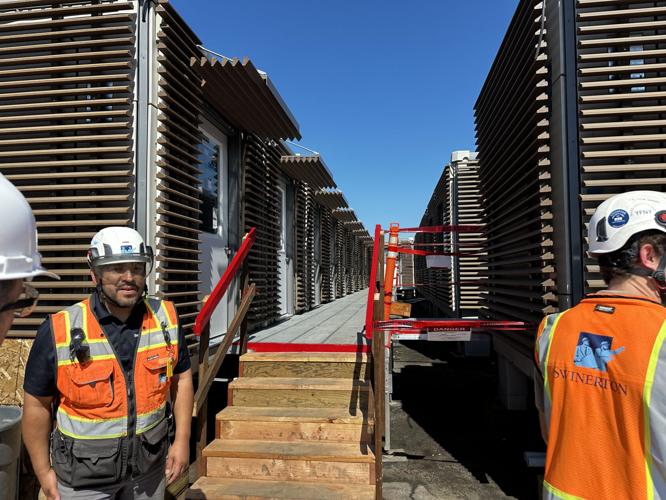
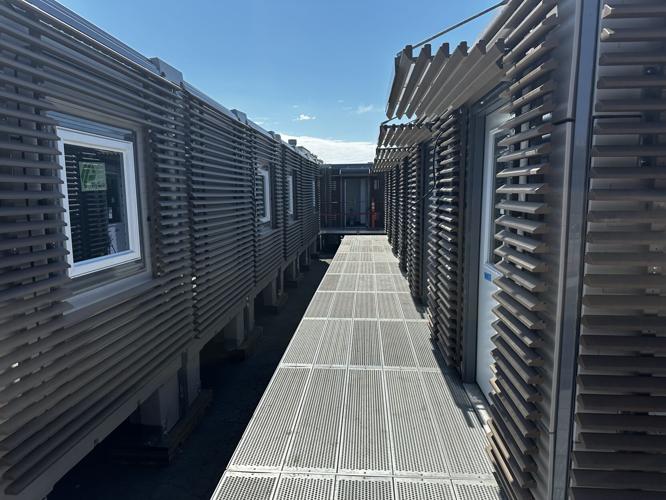

A chain-link fence is keeping people out for now, but within a few months the fence will come down and a new 32-unit tiny village will be open behind Westview Presbyterian Church in Watsonville, welcoming the people who have been living along the banks of the Pajaro River in tents and makeshift shelters for years.
On Friday, Sept. 19, the media and some homelessness service providers got a first look at the modular units in progress and got to hear some of the story behind how the “low barrier navigation center”—meaning temporary shelter with supportive services with a goal of placement in permanent housing—came to be as a collaboration between Monterey and Santa Cruz counties.
“This is her fault,” joked Westview Pastor Dan Hoffman in remarks before a hard-hat tour of the village, referring to church member Margo Loehr, who with other volunteers has been taking breakfast and bag lunches five days a week to the Pajaro River residents for 15 years.
Loehr started doing it as a member of a different church, until that church ended the program eight years ago. She took it over to the Westview just two blocks from the river, where she’s been a member ever since. The church invested $80,000 in a new kitchen after she arrived, she says.
“It was a God thing it was shut down [at the other church],” says Loehr.
Then a few years ago Loehr suggested the church become the site for housing the people they were serving. Hoffman encouraged the leaders of the small congregation “to be the first to say ‘yes in my backyard,’” he says. They prayed about it for a week and discussed it on a leadership weekend where they voted unanimously to use a back parking lot for what is now becoming the village.
“[Margo] helped me fall in love with our friends that live down there,” Hoffman told an audience of media and government representatives from Monterey and Santa Cruz counties, as well as local nonprofit organizations, and volunteers.
Hoffman said the church, which initially launched as a Japanese-American congregation over 127 years ago, has always been about welcoming those who feel alone or unwanted.
“That’s kind of the DNA of the church,” Hoffman said.
The village is being constructed in partnership between the counties of Monterey and Santa Cruz, the City of Watsonville and the Pajaro Regional Flood Management Agency. It was in the planning stages in 2023 when California awarded the project nearly $8 million, three months after the Pajaro River’s levee was breached, flooding the community and displacing the encampment’s residents.
The plan did not come without pushback from some Watsonville residents, which led to delays in getting the project approved.
Monterey County Supervisor Luis Alejo—who also serves as chair of the region’s Lead Me Home Leadership Council and the PRFMA board—applauded Watsonville’s leaders who also spoke that day, including Mayor Maria Orozco, for “taking hits” and criticism as they worked to make the village a reality. He said the project represented the best of what can happen when governments and local organizations come together.
“Homelessness, as we all know, cannot be solved alone. It cannot be solved overnight. But with partnerships like this, we can create a model rooted in hope and results, one that has an immediate impact, while building progress towards long-term change,” Alejo said.
The village is more than just buildings, said Monterey County Supervisor Glenn Church.
“It represents dignity, opportunity and community,” Church said. “Each door that will open here is a chance for someone to begin anew.”
The 32 units can sleep up to 34 people—two of the units are for couples. The individual units with heating and cooling are just 67 square feet, bathroom facilities onsite are shared. There is a community dining area, a pet relief area, care management office, laundry and an outdoor seating area. Because the property is in the river’s floodzone, the entire village was raised three feet.
The total cost to date of creating the village is approximately $10 million, according to a county spokesperson.
Wrap-around services will be provided by a collaboration of agencies from both counties, including Monterey’s Homelessness Strategies and Initiatives team, Santa Cruz’s Housing for Health Partnership and the Community Action Board of Santa Cruz. The services include links to medical services, employment, public benefits and education, as well as life skills and rapid re-housing navigation.
The construction and development of the buildings is overseen by nonprofit Dignity Moves, Swinerton Builders and LifeArk, the maker of the modular units that were constructed off-site and brought to the location to be linked together and connected to utilities.
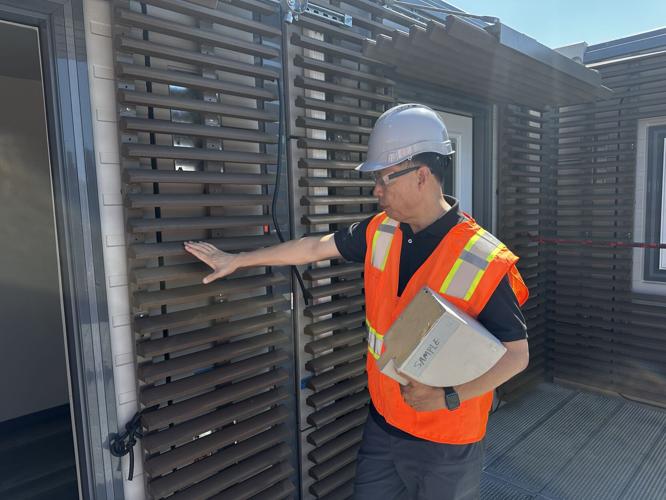
During the tour, LifeArk Chief Financial Officer Paul Cho held a cross-section of the units that are plastic-wall construction with six inches of foam insulation inside, much like a camping cooler. The plastic is made from recycled shopping bags, which diverts them from landfills where they can last for centuries, Cho said. And while the units each come with their own heating and cooling unit, he said the insulation will keep units comfortable.
Joanne Price, co-founder and chief real estate officer for Dignity Moves, said although the tiny village units are temporary housing, they are far more cost effective than the alternatives of jail, emergency rooms or hospital beds.
“When you criminalize homelessness it’s 200 bucks a night in jail with absolutely zero services,” Price said. “When I spend the night in the ER room, because I’ve got no place else to go, that’s $4,000 a night, and when I stay in-patient, an average of 6.7 days, it’s $29,000. That’s the cost of one of these beds for an entire year. So that’s why it makes sense.”


(0) comments
Welcome to the discussion.
Log In
Keep it Clean. Please avoid obscene, vulgar, lewd, racist or sexually-oriented language.
PLEASE TURN OFF YOUR CAPS LOCK.
Don't Threaten. Threats of harming another person will not be tolerated.
Be Truthful. Don't knowingly lie about anyone or anything.
Be Nice. No racism, sexism or any sort of -ism that is degrading to another person.
Be Proactive. Use the 'Report' link on each comment to let us know of abusive posts.
Share with Us. We'd love to hear eyewitness accounts, the history behind an article.