
The hype should be familiar to foodies.
A high-end chef, with a lot of backing, takes on a non-native cuisine and the blogosphere goes bonkers.
Think fancy ramen with sustainable, small-farm ingredients. Contemporary Mexican that costs a whole lot more than a taco shop. Locally, look no further than wildly anticipated—and high dollar—Cultura Comida y Bebida, from a decorated restaurant team, with major investors, inspired by travels in Oaxaca and beyond.
East Bay Express food editor Luke Tsai has been watching.
"These kind of issues have been on my mind for a while," he says. "They're the kinds of things that inform how I place my emphasis as a food reporter and restaurant critic."
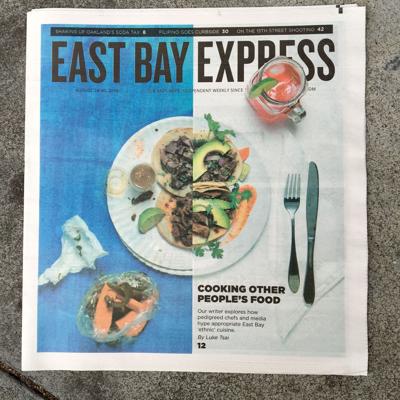
Those thoughts inspired him to navigate the slippery culinary climate in which ethnic foods receive a so-called “elevated” treatment—that so commonly draws breathless raves, fairly or unfairly, from media—with a great piece in the Express last week.
As he sets up why the phenomenon is important to analyze, the cover story, “Cooking Other People’s Food: How Chefs Appropriate Bay Area ‘Ethnic’ Cuisine,” hits an early zenith with zing:
We need to have a talk, then, about this matter of cooking other people's foods and whether it's possible for chefs to do so in a respectful manner.
Otherwise, the restaurant industry will always be rigged in favor of what Preeti Mistry, the chef-owner of Temescal's Juhu Beach Club, calls the "Iggy Azaleas" of the ethnic-dining scene: overhyped, culturally appropriative restaurants whose stories dominate the blogosphere and prominent food magazines, even as their white owners and chefs wonder why everyone always has to make a big deal about race.
The whole story is well worth a read. In the meantime, here are a pair of compelling passages.
•••
If you're a chef in Oakland or Berkeley, where even fine dining tends to be fairly casual, a stint at Chez Panisse — the mother ship of California cuisine — might be the best way to raise your stature in the public eye.
So, when Ramen Shop opened in Rockridge in 2012, with its uniquely Californian interpretation of ramen, almost every article about the restaurant led with some discussion of the Chez Panisse pedigree of the three non-Japanese owners: Jerry Jaksich and Sam White, who are white, and Rayneil De Guzman, who is of Filipino descent.
Peruse any roundup of best Bay Area ramen joints, and you'll find Ramen Shop at or near the top of the list.
Meanwhile, until recently, Berkeley's Comal was practically the only game in town when it came to high-end, regional Mexican cuisine. The chef, Matt Gandin, is a self-described fourth-generation Jewish American who has loved Mexican food since he was a kid.
Ramen Shop and Comal are both very good restaurants in their own right, and it's important to note that their chefs have been nothing if not respectful when discussing their passion for Japanese and Mexican cooking.
But this fact remains: You'd be hard-pressed to find a Japanese or Mexican eatery in the East Bay that got even a fraction of the pre-opening media hype both restaurants received, and both are often included when national publications do roundups of where to eat in Oakland or Berkeley — often to the exclusion of equally worthy immigrant-run spots.
•••
This being Alice Waters country, what you'll hear about more than anything is a restaurant's farm-to-table credentials: its use of local and sustainable ingredients, i.e. the amazing pasture-raised pork that the mom-and-pop takeout joint around the corner most certainly isn't using, or the locally sourced cabbage that's going to add a whole new dimension to a fancified Burmese tea leaf salad.
There is, of course, nothing wrong with any of this on its face. It's great to support local farmers who are doing things the right way. And no one expects a restaurateur to say, "We're serving a slightly less awesome version of this dish that we just learned how to make, but we're going to charge 30 percent more. Cool?"
But, as Taiwanese-American chef Eddie Huang pointed out in an interview with the Express this past June, a lot of times this business about a chef putting his or her own creative twist on a dish — or, in this case, using "higher-quality ingredients" — is code: "This is a better, safer version of this immigrant food."
And make no mistake: There are real financial implications to this, as well. It's why Ramen Shop can charge customers $18 or $19 for a bowl of ramen — compared to, say, $10 or $11 a bowl at one of the comparably esteemed Japanese-run ramen shops in the South Bay.
•••
Tsai believes many East Bay chefs who have found success with ethnic restaurants do a good job honoring the less monied places that inspired them.
That's certainly the case with Cultura, where consulting chef-partner John Cox takes pains to say they're not trying to replicate anything happening in Oaxaca.
Instead, he says, they're a "Carmel restaurant with Oaxacan inspiration."
He also points out a number of Oaxacan natives have approached them for positions because they feel Cultura's California take on their flavors hits closer than many other local Mexican restaurants.
For the record, Executive Chef Michelle Estigoy has roots in southern Mexico, where her grandma had a restaurant.
That brings to mind another thought from Tsai.
"No one is making a serious argument that chefs should only ever cook foods to which they have a direct ancestral connection," he writes. "But why is it that these mostly white, 'pedigreed' chefs attain such incredible fame and success when equally talented immigrant cooks might labor in obscurity for years?
"And what does it mean that food pundits are so quick to hail these chefs as authorities on their adopted cuisines?"
Part of what makes this conversation valuable—and California so fascinating—is the diversity of its cuisine.
One of the ironies that struck me in talking with Tsai is that many of my favorite cooks and chefs at local Italian or Afghani or even Japanese restaurants are Mexican-American.
But they're not exactly getting eager investment partners and food blog blather.


(0) comments
Welcome to the discussion.
Log In
Keep it Clean. Please avoid obscene, vulgar, lewd, racist or sexually-oriented language.
PLEASE TURN OFF YOUR CAPS LOCK.
Don't Threaten. Threats of harming another person will not be tolerated.
Be Truthful. Don't knowingly lie about anyone or anything.
Be Nice. No racism, sexism or any sort of -ism that is degrading to another person.
Be Proactive. Use the 'Report' link on each comment to let us know of abusive posts.
Share with Us. We'd love to hear eyewitness accounts, the history behind an article.