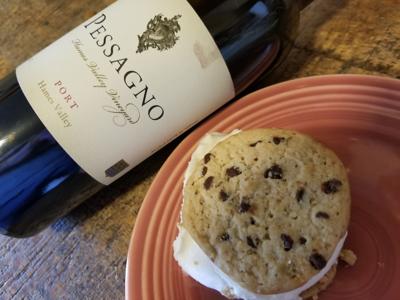

One day, somewhere, someone placed a scoop of ice cream between baked goods.
That’s pretty much as far as scholars who pore over dusty reams in order to understand the origins of the ice cream sandwich have gotten in their quest. The treat, after all, exists in many cultures and the lore can be murky.
Even tracing the story of the ice cream sandwich in this country can be challenging. There are references to New York street vendors in the late 1800s scooping vanilla between sheets of paper which, one, doesn’t count and, two, seems a bit messy. Invent the cone already.
By the turn of the last century, mentions of ice cream sandwiches in newsprint also addressed their growing popularity and curious ability to erase class distinctions. New York stockbrokers, it was said, happily munched on the treats next to day laborers and such.
One of the tales often passed around is of Jeremy Newberg, a vendor at Pittsburgh’s Forbes Field, inventing the rectangular sandwich of soft chocolate cookie and vanilla ice cream in the 1940s. However, in a 2019 Boston Globe article, his family admitted to placing the story on Wikipedia to make him feel good, as he often claimed to have assembled the now common version.
What we do know is that in 1928, a San Francisco merchant had the notion to layer ice cream between oatmeal cookies and created a sensation called It's It. Fifty years later, a New York company came out with the defining snack of the 1980s, the Chipwich, involving chocolate chips.
But we’re not really here to recount the history of the ice cream sandwich. They say Americans consume 48 ice cream sandwiches every second—and who are we to question statistics? Wine is equally popular, with Americans (presumably of legal drinking age) downing 3.18 gallons per person last year alone, according to the Wine Institute. Oh, to be invited to their convention.
With so much wine and so many ice cream sandwiches in circulation, why hasn’t anyone thought to pair the two? And just which wine would go well with such a treat?
“Ice cream pairings are common enough,” says Jeffrey Birkemeier, sommelier and owner of Amapola Kitchen & Wine Merchant in Salinas, looking for a starting point. He reaches for a Spanish dessert wine he suggests could readily be poured over plain vanilla.
The sandwich in question poses a few potential pitfalls, however—an inexpensive grocery store version with a dull chocolate chip cookie laced with equally tired cinnamon. Birkemeier notes that a sparkling wine would overcome the off-flavor challenges, but decides it’s too obvious as a solution.
“You’re looking to match sweetness with sweetness,” he explains, adding that the sugars will nullify each other.
Years ago, Birkemeier sampled a dessert wine from Passagno and had been impressed. So he recommends the available vintage—2010—Passagno Port, which is prepared with a blend of proper Portuguese grapes (yes, Tinta Cao, Tourga Nacinal and the like grow in Monterey County; Souzao can be sourced elsewhere in California).
Most new world winemakers producing port-style wines bow to European Union standards and label them as Tawny or some other recognizably port-related title. But Passagno clings to the Portugal-specific domain.
On the nose it offers reliably old world warmth, with cured cherries and dried berries alongside notions of tobacco leaf, weathered balsa and well-worn suede—a good start. It’s lighter in body than one might anticipate, yet on the palate the wine yields rich plum notes, dried blueberries and gentle milk chocolate. This is underscored by impressions of oak and brightened by a sensation of candied orange zest on the finish.
With the ice cream sandwich the Pessagno Port retains its composure nicely. The sweetness wavers, as Birkemeier promised, but it picks up a faintly bitter streak of Cafe Americano. While the citrus tone softens, a welcome toasted spice emerges, thankfully muting the stale cinnamon from the cookie.
The wine works just as nicely with a good vanilla ice cream, as would be expected. Clearly ice cream parlors should pursue liquor licenses. That’s the lesson here.


(0) comments
Welcome to the discussion.
Log In
Keep it Clean. Please avoid obscene, vulgar, lewd, racist or sexually-oriented language.
PLEASE TURN OFF YOUR CAPS LOCK.
Don't Threaten. Threats of harming another person will not be tolerated.
Be Truthful. Don't knowingly lie about anyone or anything.
Be Nice. No racism, sexism or any sort of -ism that is degrading to another person.
Be Proactive. Use the 'Report' link on each comment to let us know of abusive posts.
Share with Us. We'd love to hear eyewitness accounts, the history behind an article.