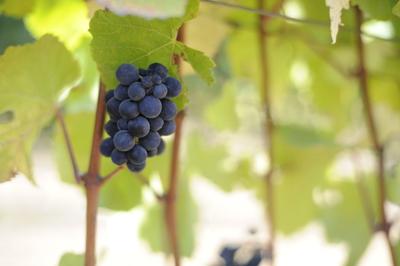
Don't look now, but there's a major new contender in the wine world.
OK, Monterey County had long ago asserted itself as a force in grape growing and wine making, at one point harvesting more fruit than any other county in the leading state for it and drawing the only stateside nod for Top 10 Wine Destinations in the World by Wine Enthusiast a couple of years back.
So it makes sense more and more winemakers are clearly calling out Monterey County on the labeling.
Nevertheless, today that labeling became law when Assembly Bill 394 was signed by Governor Jerry Brown.
The bill was authored by Assemblymember Mark Stone, D-Scotts Valley.
So-called conjunctive labeling laws are the norm in Sonoma, Napa Valley, Paso Robles and Lodi. From an industry perspective, it's a strong brand marketing move.
Which was Monterey County Vintners and Growers chief Kim Stemler's main takeaway.
"As much as anything else it's an industry statement," she says. "We're a big player here."
She goes into more detail as part of an official release:
“Conjunctive labeling makes it easier for consumers to choose the Monterey wine experience.
"Further, it brings extra value to tourism, agriculture, and other local industries aligned with brand Monterey.
"Every bottle on every shelf and on every wine list throughout the world becomes a positive messenger helping elevate Monterey."
She credits the cohesion of the local wine industry and local state representatives, especially Stone, for a process that went much smoother than it did for, say, Sonoma.
For his part, Stone adds this: “Winemaking is an important and unique sector of our local economy. It provides jobs, attracts tourists, and creates high-quality products that make our region special. It is reasonable and necessary to help these locally owned businesses keep running successfully.”
Appellations like Arroyo Seco, San Bernabe, Santa Lucia Highlands, San Lucas and little-known Hames Valley are technically in the Monterey appellation so they can add Monterey or Monterey County (if it wasn't already on the bottle).
Santa Lucia Highlands bottles can include Monterey or Monterey County. Appellations like Chalone, Carmel Valley and San Antonio Valley must add Monterey County.
Stemler thinks it's another road sign on Monterey's ongoing rise, citing the boom in bonded wineries, up from 56 to 83 since the last time she checked, the amount of quality small-batch producers and proliferation of young wine talents like Russell Joyce and Ian Brand.
"It's only a matter of time until we're the 'It' wine region," she says.
The measure, which passed with strong bipartisan support, will go into effect on Jan. 1, 2016.


(0) comments
Welcome to the discussion.
Log In
Keep it Clean. Please avoid obscene, vulgar, lewd, racist or sexually-oriented language.
PLEASE TURN OFF YOUR CAPS LOCK.
Don't Threaten. Threats of harming another person will not be tolerated.
Be Truthful. Don't knowingly lie about anyone or anything.
Be Nice. No racism, sexism or any sort of -ism that is degrading to another person.
Be Proactive. Use the 'Report' link on each comment to let us know of abusive posts.
Share with Us. We'd love to hear eyewitness accounts, the history behind an article.