
Freddy Menge knows a lot about apples. To be fair, he’s been learning about this widely cultivated fruit ever since he was a kid—that’s when he remembers finding old, abandoned apple trees growing in the forest near his home by La Selva Beach.
“They were weird, they were different,” Menge says now, of those mysterious forest apples. They didn’t taste exactly like what he expected an apple to taste like, and that intrigued the young Menge. “The thing that really got me into apples is…they are the most boring, innocuous fruit,” Menge says. “But when I found weird apples that were really good it was like oh, there’s another side.”
How those early explorations led Menge to become an apple grower, breeder and organizer of an annual apple tasting sponsored by the Monterey Bay Chapter of the California Rare Fruit Growers, well, “I’m sort of obsessive,” Menge admits.
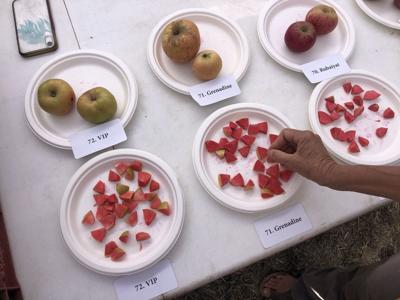
The 2022 edition of the apple tasting took place Saturday, Oct. 8 in conjunction with the Live Oak Grange’s fall festival in Santa Cruz. The tasting started promptly at 2pm—by 1:50pm a line was starting to form and by 3pm it stretched back into the Grange garden, winding its way past the musicians playing classic rock covers and around a garden bed growing corn. Laid out on tables formed in a large rectangle were small pieces of no fewer than 72 varieties of apple. Armed with a toothpick (to stab apple bits for tasting) and a clipboard (for notes), we set off.
Some of the apples bore names and flavors recognizable to apple laypeople—Fuji, Red Gala, Braeburn. Others were completely unfamiliar, and often quite evocative—Cinnamon Spice, Winter Banana, Rachel’s Mystery. Toward the end of the lineup, a section of apples bred by Jim Rider in Watsonville carried no names at all yet—just identifying numbers like A-1-45 and C-13-140. Menge says the numbers are because these aren’t established varietals yet, just experimental crosses. If people like them, Rider might consider going the commercialization route.
We chomped our way through tiny piece after piece of apple, making short tasting notes on our clipboards. (To be completely transparent, after about 30 small pieces of apple I started to get a stomach ache—it would have been smart to bring some water.) “Tart!” I wrote, after tasting the Mutsu apple. I deemed the Macoun “dusty” and the Pomme Gris “meaty.” “Name is too exciting” was my review of the apple dubbed Fiesta.
The lineup is arranged in a way that would be familiar to anyone who’s been to a wine tasting—tasters start with the mild, sweet, juicy apples and work their way toward the more complex, higher-acid apples. On the very last table were a few of Menge’s own apples—red-fleshed in beautiful, deep reddish-pink hues.
The tasting also has an electoral element. At the end of the line, tasters vote for their three favorite apples. Menge says there are two main voter blocs, if you will: People who like their apples straight up, with high sugar content and low acid, and people who are passionate about the high-acid, intense apples. An in-between apple—say, one that’s sweet but with enough acid to keep the acid-heads interested, like a Suntan or Karmijn de Sonnaville—now that’s a winner.
“When I taste an apple I go oooohhh, people are going to like this,” Menge says.
Ultimately, Menge was correct in his prediction—the Karmijn de Sonnaville “won” the tasting this year. (The runner-up this year, Stardust, is an apple Menge found growing in an abandoned orchard near Aptos. And yes, he got to name it—“We looked at it, tasted it, and it just suggested itself,” he says, of the name.)
The broader goal of the apple tasting is to educate people on the sheer variety of apples that can be grown in Santa Cruz, Monterey and San Benito counties. Another one of the Rare Fruit Growers’ most popular events is the annual scion exchange, where attendees can get the scionwood necessary to graft and grow these unusual apple varietals—and many other fruits—themselves.
When I ask Menge if he feels any responsibility to protect unusual heritage apple varieties, unbeloved by grocery stores and conventional farming, he shrugs. That’s out of his hands. “If [an apple] has merit then people will want it,” he says.


(0) comments
Welcome to the discussion.
Log In
Keep it Clean. Please avoid obscene, vulgar, lewd, racist or sexually-oriented language.
PLEASE TURN OFF YOUR CAPS LOCK.
Don't Threaten. Threats of harming another person will not be tolerated.
Be Truthful. Don't knowingly lie about anyone or anything.
Be Nice. No racism, sexism or any sort of -ism that is degrading to another person.
Be Proactive. Use the 'Report' link on each comment to let us know of abusive posts.
Share with Us. We'd love to hear eyewitness accounts, the history behind an article.