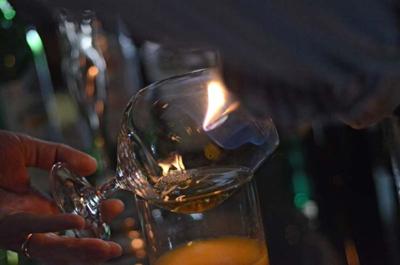

If we know anything about love, it’s that absinthe makes the heart grow fonder.
No, that can’t be right. Even though Groucho Marx—a man of great probity—said it, somehow the thought doesn’t ring true.
Human activity in the wake of an absinthe bender are legendary, yes. And Van Gogh slicing off an ear may have been in the interest of love. But there was the famous (at the time) “Absinthe Murder” of 1905, in which a man named Jean Lanfray killed his wife and daughters after a little spat over his desire for one more sip of the demented “Green Fairy.”
And of course there were tales of the spirit’s hallucinatory powers. Many worried that absinthe led to social decay, that a night hanging out with Toulouse-Lautrec caused otherwise God-fearing people to slink in wickedness and wanton ways. Indeed, the mayor of the pleasant Swiss town of Commugny declared that “Absinthe is the principal cause of a series of bloody crimes in our country.”
Yikes.
“I love the stories, people thinking they are going to trip out on two drinks,” says Michael Searles, bar manager at Carmel Valley Ranch. “That curiosity—that’s where you can create an experience as a bartender.”
In other words, Van Gogh did clip his ear and Lanfray did shoot up his family a bit. But neither act was a direct result of the mind-altering powers of wormwood, the key ingredient in absinthe.
Wormwood is just a leafy perennial bush—nothing threatening at all. Indeed, it has been used since ancient times in folk medicine remedies. Hippocrates recommended it as a cure for any number of maladies. Galen prescribed it as—ready for this?—a way to prevent swooning.
People swooned a lot after the fall of the Roman Empire, apparently. And things got much worse in the Middle Ages, when one “doctor” became convinced that “Wormewood voideth away the wormes of the guts.”
Just how a treatment for menstrual cramps—Hippocrates’ idea, not mine—swooning and gut worms became the most celebrated drink of La Belle Epoque France and gay ’90s New Orleans is...well, it’s just not all that exciting. Something about soldiers given wormwood to ward off fever steeping it in their wine. The other versions are equally meh, except for the bit about pestilence-ridden vineyards in the late 1800s cutting off the flow of French wine, forcing people to turn to absinthe instead.
But the green fairy was already popular by then—so much so that happy hour became the green hour. Artists, poets and libertines bathed in its supposed powers. “A glass of absinthe is as poetical as anything in the world,” Oscar Wilde exclaimed. “What difference is there between a glass of absinthe and a sunset?”
Um…yeah, there is at least a slight difference. No wonder people thought it caused visions.
Two brothers opened the famed Old Absinthe House (later the Absinthe Room) on a Bourbon Street corner in New Orleans in 1869, drawing the likes of Teddy Roosevelt, Mark Twain, William Howard Taft and, yes, Wilde to the green fairy.
That’s how the story goes, for a starter. Then came the backlash.
After the Franco-Prussian War started a brief tiff between France and Germany, some wild beliefs began to take hold—that French men were more sterile, were growing soft, were turning from the morals that defined the nation at its greatest. As Jesse Hicks points out in a thorough 2010 article in Distillations, absinthe became a scapegoat, even as its popularity continued to rise.
Then in 1890, psychiatrist Valentin Magnan published a piece of dubious research entitled The Principal Clinical Signs of Absinthism, in which he blamed absinthe for all of France’s presumed ills. The Lanfray murders and other sordid adventures also fell into the growing “absinthe did it” refrain.
Coupled with the general belief that it indeed caused drinkers to hallucinate—and suspicion among some who study the matter that winemakers frantically lobbied against absinthe as a way to recapture the slice of the market they lost during the blight years—the case against the green fairy seemed conclusive.
Wormwood does contain a chemical called thujone, however, which some claim carries a hallucinogenic wallop—a belief that held for well over a century. Just one problem: scientific studies (remember when people looked to those for advice?) don’t support a connection between the thujone in absinthe and a sudden urge to self-mutilate or paint sloppy portraits.
Or, as scientist and absinthe aficionado Ted Breaux told Liquor.com, modern tests of old absinthe “have demonstrated beyond doubt that pre-ban absinthes contained no hallucinogens, opiates or other psychoactive substances.”
Strong words. And yet, most of Europe slammed the door on absinthe in the first decades of the 20th century. The U.S. also banned the stuff in 1912, after an investigation by the Pure Food Board.
It wasn’t until the 1990s that countries began lifting the ban, often with restrictions—about 10mg per liter—on the amount of thujone involved. The U.S. demanded any food or drink containing wormwood must be thujone-free. However, when a margin of error rule was applied, 10mg/liter also became the standard—at least that’s how most people understand the ruling now.
As it so happens, most pre-ban absinthe contained far less thujone than the current threshold.
So—no mind-altering powers, no risk of absinthe-fueled mayhem. Some countries (like Spain) never even issued a ban. Why then all the fuss?
“People rarely have more than two,” observes Gabe de la Vega, manager of Rio Grill in the Carmel Crossroads, where they prepare an off the menu concoction called Absinthe Minded. “They know what they’re getting into with absinthe.”
What they are getting into is extreme doses of ethanol. It is said that wormwood will not remain suspended unless a liquid is about 50 percent alcohol. And most versions of absinthe pack much greater amounts.
“You get a population used to drinking wine, which is 12-14 percent alcohol and suddenly they’re drinking 80 percent—sure, they’re going to overindulge,” Searles points out.
The preferred method of preparing absinthe involves a slow drip of water—often over a sugar cube—to tame some of the burn. This also causes the spirit to louche, or change color and mouthfeel.
At Carmel Valley Ranch, however, Searles prefers blending absinthe into cocktail form.
“Anise is such a polarizing flavor that I tend to use it as a modifier,” he explains. “It’s also a fairly expensive spirit. I don’t want to treat a customer to a drip and find out they don’t like it.”
The louche effect may be the cause of some of that bad behavior of lore—at least indirectly. Studies of pre-ban absinthe has revealed that in the rush to meet turn-of-the-last-century demand, some producers added cupric acetate to improve the green hue. There are also suggestions that inferior batches were treated with antimony trichloride to aid in the louche.
It’s stuff that probably isn’t all that good. Maybe even downright poisonous—the sort of thing that might make you look at a night sky and paint big, ungainly swirls. Or to think, “you know, my ear needs to be shortened.”
But Searles is probably on point. Spend a night pounding a ton of alcohol and sugar and you’re bound to regret what follows.
So in answer to this week’s Burning Question, let’s just agree that none of this ever should have happened. But it does make for a good moral tale of the human willingness to point fingers when society’s ills are under scrutiny.
But now it’s back. “We’re seeing more options—local, different strains of wormwood,” Searles says. “But my favorite is still Kübler, an odd little business that continued to make absinthe after it was banned. They never stopped production.”


(1) comment
You know, every time I look at one of these types of articles on absinthe, I do it with the hope that it is well informed and reasonable. And almost always, I am disappointed. And the funny thing is that you seem to be reasonably well researched.
Now don't get me wrong here. I actually agree with your answer that "none of this ever should have happened". What I don't agree with is the that you have seemingly fallen into the same trap most other writers do in trying to come up with some other explanation of what is so uniquely dangerous about absinthe. And frequently, as in your piece, the answer is the amount of alcohol. Now believe me when I tell you that I get that it is probably easy to get sucked into that mindset, especially when it is supported by "experts". The problem is, and I can tell by the verbiage of your "experts", that they don't really understand absinthe, they don't know math, and they seem to still want to pander to the credulous thrill-seeker who wants to make the consumption of absinthe into some kind of bad-boy experience.
But here's the real deal. The alcohol percentage of absinthe, in bottled form, is relatively irrelevant. Why? Because it was never intended to be consumed undiluted. It is a concentrated drink. Properly portioned, a glass of absinthe contains no more alcohol than an average glass of wine, and less than a 12 ounce pour of an average IPA beer or an old fashioned cocktail.
The trouble with absinthe is the potential for abuse because this message isn't getting out. And many times that is because of people's various needs to be a part of perpetuating its bad-boy image. The fact is that in its heyday, it was consumed responsibly by millions of regular drinkers.
Any alcohol beverage can be abused. Just remember, that is a choice the drinker is making, not one the drink is making for them.
Welcome to the discussion.
Log In
Keep it Clean. Please avoid obscene, vulgar, lewd, racist or sexually-oriented language.
PLEASE TURN OFF YOUR CAPS LOCK.
Don't Threaten. Threats of harming another person will not be tolerated.
Be Truthful. Don't knowingly lie about anyone or anything.
Be Nice. No racism, sexism or any sort of -ism that is degrading to another person.
Be Proactive. Use the 'Report' link on each comment to let us know of abusive posts.
Share with Us. We'd love to hear eyewitness accounts, the history behind an article.