
You can order decaf in a hipster coffee joint, no problem. Ketchup on a hotdog? Outside of Chicago you can probably get away with it. Mention barbecue, however, and you’ll likely start a verbal brawl.
Barbecue buffs dig in their heels over just about everything grill-related. The bickering extends to sauce—vinegar, mustard, adamantly none at all—and what goes into a rub. Some insist barbecue is pork and nothing but, while others believe it refers to beef brisket. And even within these camps are little spats. Pork, for instance, should be either whole hog or a shoulder cut, depending.
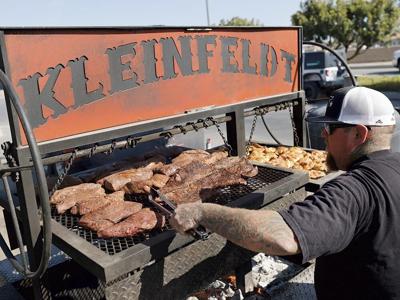
“A lot of people are closed minded when it comes to barbecue,” observes Justin Kleinfeldt, pitmaster at T&A Cafe, home of Kleinfeldt Family BBQ in Spreckels.
At the heart of all this friction are regional styles, whether Lexington, Central Texas, Memphis, Kansas City or the others. Eastern Carolina style, for instance, goes whole hog with a vinegar and pepper sauce. Lexington is made from shoulder and adds ketchup to the mix. In parts of neighboring South Carolina pit minders dab in mustard.
Alabama is famous—make that infamous—for its white sauce.
Barbecue places in Monterey County tend to borrow from two or more of the major regional genres, thankfully not from the Cotton State. At Salinas City BBQ—a long time favorite—they serve pulled pork, brisket (the Central Texas staple) and hot links, in addition to chicken and ribs. Bon Ton L’Roy’s Lighthouse Smokehouse in Monterey offers a similar lineup, but brings in andouille sausage. Big Sur Smokehouse can slather on a Memphis or South Carolina mustard sauce.
One meat that most have in common is tri tip, a cut that is rarely seen in barbecue outside the state. Kleinfeldt Family BBQ is known for this cut, cooked over an open flame Santa Maria style. Tri tip is the featured meat of California pits. But there’s a question mark hanging over the Santa Maria version of barbecue.
“They’ll say that’s grilling,” explains Todd Fisher of The Meatery in Seaside, referring to people from other regions. “I would say they’re not wrong. Barbecue is very different from grilling.”
Fisher made his name as a chef rather than a pitmaster. But his 18-hour brisket at The Meatery rivals anything from the sweltering pits of Lockhart, the temple of Central Texas barbecue.
Yes, there’s even a debate over barbecue itself. Perhaps that’s why as far back as the 1650s colonial Virginia’s House of Burgesses took the precaution of instituting a ban on the firing of weapons at barbecues. They apparently knew it might start a revolution or something.
Historians believe the word refers to a wooded grate that held meat above an open flame used by indegenous peoples of the Caribbean and elsewhere. It appears as “barbacoa” in a 1526 account of a Spanish explorer’s travels. And that resonates with Kleinfeldt.
“I define barbecue as anything cooked over a real fire,” Kleinfeldt says.
That is indeed its likely origin, so the Spreckels pitmaster has a point. But as the style developed and new utensils came into play, rifts developed. A big one is over the boundaries that define grilling, smoking and barbecue.
The most common explanation is that barbecue involves indirect heat applied low and slow—typically between 200 and 275 degrees fahrenheit over many hours. An even temperature through the entire span is essential, requiring someone to tend the smoke box. This is why it’s difficult to find decent brisket outside of the region where it is barbecue religion.
“It’s a time commitment,” Fisher explains. “Sixteen to 18 hours [for brisket] is fairly standard in the barbecue world.”
Smoking goes even lower and often slower, with temperatures in the comparatively chilly 125 to 175 range. In both cases, pitmasters essentially cook the wood while smoke and radiant heat drift through the meat.
What differentiates the two from grilling—and direct heat styles like pit beef in the Mid Atlantic and Santa Maria on the West Coast—is the emphasis on low, slow, smoke and a closed chamber. Or as Natasha Geiling jabbed in a Smithsonian article “the true definition of barbecue—imposters who grill take note.” The purpose of grilling is to peak at 400 or more degrees and get those burgers on the bun.
But try to settle all this definitively by, say, turning to a dictionary and you’ll find that linguists have stirred the pot even more. They remind us that barbecue can refer to any backyard gathering around a grill. And is it barbecue or barbeque?
Thanks a lot.
Apparently the spelling has evolved, especially after it entered the English lexicon. The Old English Dictionary lists past variations such as barbicu, barbacue, bar-b-q and the improbable babracot.
Yes, babracot. Its definition is the same as barbacoa. The word first appeared in English in 1697, although no one seems to know why. Because it can’t be used legitimately in Scrabble, babracot (and the others) can be readily dismissed.
So all that said, “what is barbecue?” is truly a burning question.
What we have so far is a wooden grate referred to by a Conquistador as a barbacoa. None other than Hernando de Soto also witnessed this style of open flame cooking with a wooden rig in 1540 near the Mississippi River delta. So the style was widespread.
Unknown is whether the indigenous peoples held fierce debates over barbecue. We do know, however, that colonists from Europe picked up on the style and did it up big. George Washington once took part in a three day barbecue bender.
No mention of the condition of his teeth after that one.
We can blame waves of immigration and the westward expansion of people of European origin for much of the later friction. As cited in Smithsonian, on the hardscrabble farms of the southern colonies, pigs could feed in the woodlands, so required little maintenance. In the ante-bellum south, pork was preferred over beef by a five to one margin.
Where colonists from England landed, vinegar became the base of the sauces used. The French and Germans brought mustard into play. When barbecue became a Memphis signature, molasses transported by merchants along the Mississippi was added to a tangy tomato sauce.
Cowboys plying the Texas range probably didn’t carry bottles of sauce along. And it was cattle country. So the tough brisket became their fare, with no dressing applied.
In The Grand Barbecue: A Celebration of the Places, Personalities and Techniques of Kansas City Barbecue, author Doug Worgul lays the credit for that city’s style on Henry Perry, a transplant from Memphis in the early 1900s.
Because Texas cattle ended up in Kansas City lots for shipment, the city’s version of barbecue became more inclusive. Memphis sauce could be dabbed onto beef as well as pork.
Alabama white sauce was likely the result of a grievous error.
“I think there’s a Salinas Valley style,” Kleinfeldt says.
No, no, no. We’ve managed to get this far without acknowledging styles representing smaller regions, so let’s keep it that way and just leave it as this: Barbecue can be defined generally as low and slow cooking with smoke. It can also defer to regional understandings. Like everything American, it is the result of different cultural inputs, appropriations and evolutions. A gathering—per the dictionaries—can be called a barbecue. The simple backyard grill cannot.
Could we have come to that conclusion 1,000 words ago? Yeah, sure. But…well, we’re already here.
Besides, as Fisher says of the arguments, “You can really get caught up in it.”
So we’ll leave the final answer with The Meatery master. “I love all barbecue,” he says. “The only bad barbecue is poorly executed barbecue.”


(0) comments
Welcome to the discussion.
Log In
Keep it Clean. Please avoid obscene, vulgar, lewd, racist or sexually-oriented language.
PLEASE TURN OFF YOUR CAPS LOCK.
Don't Threaten. Threats of harming another person will not be tolerated.
Be Truthful. Don't knowingly lie about anyone or anything.
Be Nice. No racism, sexism or any sort of -ism that is degrading to another person.
Be Proactive. Use the 'Report' link on each comment to let us know of abusive posts.
Share with Us. We'd love to hear eyewitness accounts, the history behind an article.