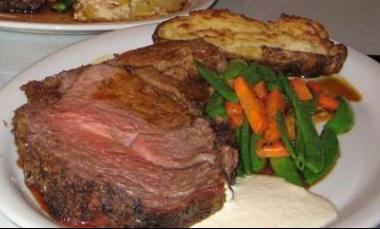

Controversy seems to follow prime rib, for some reason.
It shouldn’t be the case. Most meat-eaters love the occasional prime rib, and would order the dish more often if they had the means. When done well—and that’s definitely not well done—prime rib sits like a thick, glistening hunk of cashmere on the plate.
“We sell a whole one each night,” says David Stember, longtime chef at the Whaling Station Steakhouse in Monterey, attesting to the dish’s popularity.
Doesn’t sound like much? Keep in mind that these are ribs from a big, lumbering American cow. And the accepted definition of prime rib is not just a single slab, but ribs 6 through 12 of the animal.
Yes, they count them. Ribs 1 to 5, those are only worthy of pot roast and such. Number 13—who cares? Ah, but 6-12, those pack the most intense flavor and the richest marbling.
All good, until you realize the seething dissension that lurks in every mention of the cut. Isn’t it just a standing rib roast with a fancy name, some will say with a snort. Doesn’t it have to be graded prime, others insist with the slam of a fist against the table. One group digs in and shouts that the cut must include seven ribs. Others step in and say two or three is just fine.
And there’s more.
What the hell? Why is such a fine piece of meat the cause of verbal fisticuffs?
“I’ve done classes trying to make students understand, and they have the same questions,” says Bert Cutino, chef and co-founder of Monterey’s Sardine Factory. “It goes back to history.”
Yep—dig through the dusty tomes written by red meat historians and tucked away on forgotten library shelves and you will find a mention of prime rib on the menu of the famed Delmonico’s in New York as far back as the 1890s.
Or it’s probably a bit easier to Google it. Either way, these learned beef scholars point out that the U.S. didn’t look into a grading system—prime, choice, dog food—until 1916, and did not put it in place until a decade later. This should settle at least one point of dispute, that USDA prime has nothing to do with prime beef.
But writing on The Spruce Eats site, Danilo Alfaro claims, “Restaurants that serve prime rib must use prime beef. Otherwise, they’re required to call it a standing rib roast.” And in the more august Bon Appetit magazine contended back in 2008 that, “You will typically see rib roasts in two grades: choice and prime. Prime—otherwise known as prime rib—has more marbling.” Even the culinary saint Alton Brown said as much on his Good Eats program.
On the other side, however the staff at Cook’s Illustrated points out that, “Prime-grade prime rib is a premium-quality roast….Not surprisingly, we’ve found it more tender and flavorful than choice-grade prime rib.” And Paula Trites in Cooks Info calls it a “misconception” that the use of prime in prime rib refers to the USDA grading system.
Strong words, there.
If only there were a way to settle this Sharks vs Jets fracas and move onto the next—say a federal document or something, maybe like the USDA Food Standards and Labeling Policy Book.
Right there in a section on “Primal Parts and Subprimal Meat Cuts,” the feds address the matter in—for a government document—surprisingly concise terms. “Prime rib of beef or standing beef rib roast for prime rib: These products do not have to be derived from USDA prime grade beef.”
Seems pretty clear. Sharks and Jets separated. So what’s the difference between prime rib and standing rib roast?
“If you put standing rib roast on a menu, you wouldn’t sell it,” Cutino says with a laugh. “In restaurants we try to jazz it up a bit.”
He points out that ribs 6 through 12 that make up prime ribs represents the “primal cut”—hence the name. In other words, a standing rib roast could involve those dreaded numbers 5, 4. Great steaks such as the ribeye are hewn from the primal cut. Go below rib number 6 and you are in the less desirable chuck neighborhood.
No one likes Chuck.
“It’s a term for groceries verses a term for restaurants,” Cutino adds, again chuckling. “People have standing rib roast at home, they have prime rib at restaurants. That’s just the way it is.”
Cutino notes that if you advertise the dish as USDA prime, it had better be just that. But gives a nod to the top end of choice grade prime rib as the better option. It’s still from the primal cut, only for a smaller dent in the wallet.
At Whaling Station, however, Stember insists on serving only USDA prime grade prime beef. He echoes Cooks Illustrated saying “It’s much more tender, more flavorful.”
There is that matter of cost, though. Stember explains that the restaurant spends at least 25 percent more for prime prime beef, perhaps as much as 33 percent.
For customers prime rib wasn’t always so expensive. For decades in the dens along the strip in Las Vegas, Rat Pack wannabes were lured by cut-rate rib roasts.
In a 1997 article, HD Miller cited The Aladdin’s menu price at $5.95. The Sahara was more competitive, asking only $5.49. Meanwhile, the Gold Coast advertised a 16 oz. cut with all the trimmings for a mere $4.99.
In 2019 dollars, that would be...um...a little more.
Miller ended with a wonderful tirade: “The city is a paradise for the frugal carnivore. It’s one of the great beef-eating towns in these entire chicken-eating United States; a place of glorious, corn-fed, fattened-up, feedlot excess, where cholesterol and calories and clogged arteries aren’t mentioned and don’t matter. ‘Would you like another pint of sour cream and more bacon bits on that baked potato, sir?’ is the rallying cry for legions of waddling visitors, all intent on driving the entire Angus breed to the very brink of extinction.”
Sadly, that’s a world gone by. Damn Wolfgang Puck.
OK—it’s probably wrong to blame celebrity chefs. But prime rib did fall out of favor for a time, at least for many of the nation’s restaurateurs. The culprit? Frugality.
“Here’s the problem with prime rib,” Cutino says. “You…” Hang on—yet another controversy? And this from one of the rib roast’s biggest advocates.
Oh, sorry. Please continue. “You cook two prime ribs for the night, but you don’t sell it all. What do you do?”
Beef is not a resilient meat, you see. Let it rest too long and it begins to dry out, to toughen up, to lose all of that plush savor.
Fortunately, chefs from the past sorted that one with the French dip, the broth reintroducing some of the cushy tenderness and developing a more intense meatiness. Even more fortuitous, modern chefs push the leftover boundaries further.
“I do a prime rib egg roll, a prime rib Reuben, a prime rib French dip, a prime rib barbecue sandwich—all prime grade,” the Whaling Station’s Stember says.
Wow. So there’s really no need for all the confusion over prime rib. And there’s plenty to do with the stuff that didn’t sell.
That’ll do for the Burning Question. All prime rib is standing rib roast, but not all standing rib roast is prime rib. In this particular context, prime has nothing to do with the USDA grade, owing more to history.
The matter of rib count—two, three or all seven of the primal cut—can just sit. So we’re all done.
“Prime rib is the method of cooking the roast,” Stember interjects.
What the...! Back to the library for…
“That’s my definition,” he adds with a smile.


(1) comment
Well done (pardon the pun) Dave F.! Please get this in your print edition. The more people understand about what they are paying for the better. Nothing better than Mid-west raised, corn-fed, USDA PRIME Beef!
Welcome to the discussion.
Log In
Keep it Clean. Please avoid obscene, vulgar, lewd, racist or sexually-oriented language.
PLEASE TURN OFF YOUR CAPS LOCK.
Don't Threaten. Threats of harming another person will not be tolerated.
Be Truthful. Don't knowingly lie about anyone or anything.
Be Nice. No racism, sexism or any sort of -ism that is degrading to another person.
Be Proactive. Use the 'Report' link on each comment to let us know of abusive posts.
Share with Us. We'd love to hear eyewitness accounts, the history behind an article.