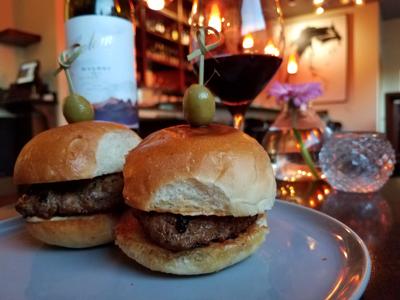

Oh, we are urged to think outside the box—sure. Push just a little too far, however, and societal norms crack down, and hard. You’re allowed to want pudding for lunch. Ah, but how can you have any pudding if you don’t eat your meat?
A philosophical Bill Murray lamented the rule of rules in Groundhog Day. Desperately seeking a break from the routine, he yanked his car in the path of a train while musing to his passengers “It’s the same thing your whole life: Clean up your room. Stand up straight...Don’t mix beer and wine—ever. Oh, yeah. Don’t drive on the railroad tracks.”
And so we’ve lived for decades confined by decrees. They even determine our wine pairing habits—and not just the beer and wine thing. Remember this hard and fast equation? Only red wine goes with meat; whites alone should be poured for fish.
But is that really the case?
“It’s an oversimplification of guidelines,” observes Stephen Caldwell, Cellar Master at the Sardine Factory in Monterey. “There are always exceptions to any rule.”
As it turns out, a number of subversives have been quietly testing the bounds of this axiom—and not just limiting their rebelliousness to the meat-fish thing. Caldwell, for instance, even challenges the cherished canon of Port with chocolate. Yes, he says, it works if you want to complement the flavors. But what about grabbing a white wine and layering the dessert with notions of orange?
“Some whites will really cleanse the palate after a rich chocolate,” he says.
Now, before we all start chanting “drain the sommelier swamp!”, keep in mind there are reasons the old guidelines were put in place. You see, big red wines are often loaded with tannins, and tannins are rather rigid in their politics. They support fats, but despise the needy lean meats. So a bold Cabernet Sauvignon pairs up well with well-marbled prime beef. But it will rail against meek, flaky sea bass, scrunching the clean flavors into an unwelcome metallic bite that cause diners to scrunch into Kavanaugh-esque grimaces.
But the culinary world is never as simple as the rules would have you believe. The amount of fat in a dish, the preparation, the seasoning, the sauces—a lot of things come into play.
“Every time I’m barbecuing a ribeye and I pull out a Cabernet, it’s so underwhelming, Michael Simons, the owner and winemaker at Comanche Cellars in Monterey points out.
Progressive sommeliers began pairing according to the mouthfeel of a wine against the qualities of a cut of beef and the way in which it was prepared. For ribeye flamed on the backyard grill, they reach for heavier, oily and mineralic whites. For a leaner cut, a white varietal left to hang on the vine and rest on its lees gives it the biceps to battle hearty red meat. For a burger, perhaps one of the big, oaky California Chardonnays. For fish, they recommend a Pinot Noir with salmon or tuna.
“Seasoning can completely change what it pairs with,” Caldwell adds. “Even if it’s a steak, with spicy Cajun seasoning, a white would go nicely.”
The trick is to pair the wine with sauce or seasoning. A piece of white fish does call for a white wine, but if it’s dredged in mushrooms or a tomato-based sauce, a light red becomes the norm. For good sommeliers, it’s a matter of bringing the fats and acids into some kind of balance, as well as understanding the level of tannins or fruit involved.
Red and white? Well, it hardly seems to matter.
Wine educator Kerry Winslow, who often works with Windy Oaks Estate in Carmel Valley, believes the rules made sense in the middle of the last century—that’s the 1950s—when wine options were often limited to Bordeaux varietals or Chianti, and it was considered daring to add a dash or Worcestershire or Tabasco.
Imagine Darrin Stephens and Larry Tate sitting down to a client lunch and ordering a nice Mourvedre and Korean street tacos? Endora would have...ooh, maybe it’s time for a Bewitched remake.
“We have so many more choices now—barbecued beef with Asian sauces,” Winslow says. “A slightly sweet Riesling will match up perfectly. Spicy dishes, a fruit-forward red will be fine.”
Throughout Europe, regional cuisine often matched the local wine. Red and wine didn’t always apply, but there were other rules. Winslow notes that as new world wines gained favor starting in the 1970s, the reds were more fruit forward and therefore more flexible when it came to pairing.
Wines have become the center of attention,” Winslow observes. “You have impressive white and red wines that can go with a lot of dishes.”
Wow—the answer to this week’s Burning Question is surprisingly easy. Yes, there are situations when the old rules still apply. For the most part, however—well, I’ll let Simons supply the answer: “There are so many flavors in a wine—saying white with one food, red with another doesn’t make sense.”
But the sommeliers do caution that there are other absolutes.
From Caldwell: “The most important factor [in selecting a wine] is the individual’s palate. The first question I ask at a table is to find out what they are used to drinking. Different people have different adventurousness levels.”
And from Winslow: “We drink sparkling wine with everything.”
That sounds like a pretty reasonable rule.


(0) comments
Welcome to the discussion.
Log In
Keep it Clean. Please avoid obscene, vulgar, lewd, racist or sexually-oriented language.
PLEASE TURN OFF YOUR CAPS LOCK.
Don't Threaten. Threats of harming another person will not be tolerated.
Be Truthful. Don't knowingly lie about anyone or anything.
Be Nice. No racism, sexism or any sort of -ism that is degrading to another person.
Be Proactive. Use the 'Report' link on each comment to let us know of abusive posts.
Share with Us. We'd love to hear eyewitness accounts, the history behind an article.