
The world nearly toppled off its axis in 2003.
That’s the year Starbucks introduced pumpkin spice latte to gullible masses. The corresponding rush to nearby shops might have tipped the earth from its orbital path and caused the kind of doom only Stephen Hawking could have foreseen.
At least that’s what a kinda scientific study—yeah, let’s use “study”—that should be submitted to The Journal of Irreproducible Results concludes. I based it on a paper published some years ago in the satirical journal proving conclusively that the weight of National Geographics hoarded in basements was causing tectonic shifts.
Fortunately in this case, because Starbucks exists on just about every street corner, the weight of hordes craving the new candied coffee flavor balanced out, averting disaster.
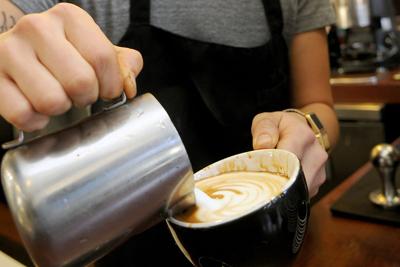
To put it another way, lattes are immensely popular. Americans sipped over 67 million of them last year, according to the merchant services and mobile point-of-sale firm Square. Their report goes on to suggest that regular old latte is on the outs. Not only have consumers switched from soy to almond and now to oat milk—yep, oat milk; and demand for the stuff is up 425 percent—they also call for at least two flavor add-ons.
Hence the seasonal peppermint latte or the—what have we become?—unicorn version.
And that’s if people even order lattes or cappuccinos anymore. There are plenty of coffee drink options, from frappuccinos to mochas. Square notes that sales of flat white coffee drinks jumped 41 percent in just one year.
Which leads one to wonder if people ever stoop to ordering a cup of unadulterated black coffee.
“Black coffee is a staple and has always been popular in my 25 years of experience,” observes Larry Thurman, the owner of Acme Coffee Roasting Co. in Seaside.
Sure, people drink it at home. But with 46 percent of coffee being sold outside the home last year—a number from the National Coffee Association and Specialty Coffee Association—and all those fancy flavorings, do Americans order black coffee from shops?
“It’s one of my biggest sellers,” reports Tyler Ellis of Captain + Stoker in Monterey.
Hmm. Not quite lost in the frenzy of coffee with some form or milk, foam and/or flavoring—known as coffee drinks—is a concurrent trend or two. According to the NCA, 59 percent of coffee sipped on a daily basis in this country last year qualified as gourmet. It’s the first time in the organization’s reporting that sales of beans in the gourmet category topped 50 percent.
And there’s more. The same study revealed that the number of Americans drinking specialty coffee on a daily basis climbed sharply, from 9 percent in 1999 to 41 percent a year ago.
Yeah, baristas could still be turning all this into coffee drinks...whoa. Hold up. Gourmet? Specialty? Just what does any of that mean? Oh, and it gets a bit more convoluted. Hip aficionados of black coffee now talk about “third wave” beans.
Why do seemingly simple Burning Questions always unravel?
It turns out the gourmet classification is meaningless—a mere marketing device. Specialty coffee, on the other hand, refers to beans that grade 80 or higher on a 100 point scale devised by the SCA and scored by qualified tasters.
Yes, there’s a definition for this process, too. It’s called “cupping,” because “judging” isn’t concise enough.
Third wave dives a bit deeper. Call it an awareness, a movement, a desire to learn or become one with the bean. Third wavers concern themselves with terroir, with farming methods and sometimes even the farmer, with processing, with brewing method (pour over is preferred)—it gathers and tells the story of each cup.
While Andrew Liddle, a barista at Cherry Bean in Salinas, notes that younger patrons still tend to order sweetened coffee drinks, a growing number head for the shop’s back wall, where the specialty grinds—18 single-origin options—are listed.
“I see a lot of young people now going straight for black coffee,” he says. “It’s really encouraging.”
So why do coffee roasters and baristas so reassured by the interest in specialty coffee? Well, depending upon such things as country of origin, elevation of the bushes and treatment of the beans, black coffee can show a surprising range.
“There’s tons of flavors—blueberry, raspberry, chocolate,” Ellis observes. “It’s just like wine.”
Captain + Stoker is a specialty coffee house, as is Acme. And they concern themselves with the intricacies of origin and roasting.
“The particular origin of a coffee determines what objective flavor profile it will have,” Acme’s Thurman explains. “Roasting can bring the flavor profile out. If you are a more traditional roaster like myself, meaning roasting a wider range of profiles, you will search for coffees to fit the profiles you want to serve.”
By that he means that a more gentler roast allows the bean to show more of itself. When it takes on a darker hue, the scorching comes to dominate, draping the coffee in swarthy bitterness.
Wow, that’s a long way from Juan Valdez.
In fact, coffee was merely a morning wake up, a diner pour or a pastime in this country for much of this country’s existence. During the Civil War, U.S. soldiers were provided a ration of beans, which they often traded across enemy lines for tobacco. Future president Teddy Roosevelt was ridiculed by cowboys when he stepped into a wild west saloon—where whiskey was de rigueur and using the phrase de rigueur could get you shot—and ordered a cup. World War Two, with its rationing and instant coffee, almost obliterated the American coffee palate for good.
Thurman believes the flavored latte trend that took off starting in the ’80s and ’90s served a purpose and is now driving the trend for specialty brews.
“It was a trend that was actually kind of a gateway for folks into the specialty coffee realm,” he says. “Flavors are still used, but not nearly in the quantities they were back in then.”
Specialty and third wave trends are even changing the way we address coffee. Percolate? Drip? French press? No—none of these are up to elevated standards. Pour over—which for once means just what it sounds like, and is a rather tedious method—is reputed to deliver coffee at its finest.
“While I totally agree that brewing—especially pour over—has become over-complicated, it is entirely subjective,” Thurman says in a consoling tone. “So, if you like to weigh your water, or grind it by running it over back and forth under your bicycle tires, knock yourself out. Personally my favorite method of brewing is pour over. Hot water and gravity.”
Got it. But there is one area where good old black coffee still falls short. Someone counted and about three million Instagram posts include the #latteart hashtag. Black coffee? Hardly worth checking.
So this week’s Burning Question wasn’t really that difficult, once you get past the vernacular. People still love their colorful unicorn or pumpkin lattes. But they also appreciate good black coffee—more so now than ever before.
Do specialty coffee fans cry when someone orders a pumpkin spice latte? Well, it turns out there’s no crying in coffee.
“We do make up drink specials from time to time that may have spices or rose water or some other type of flavor added to the coffee, but then it's more like a coffee cocktail at that point,” Thurman admits. And while he adds that it is fun to play around with classic flavors, there’s a limit.
“Sorry, no pumpkin spice in stock.” he says.


(2) comments
No idea. Never had a cup of coffee in my life.
people do. i do.
Welcome to the discussion.
Log In
Keep it Clean. Please avoid obscene, vulgar, lewd, racist or sexually-oriented language.
PLEASE TURN OFF YOUR CAPS LOCK.
Don't Threaten. Threats of harming another person will not be tolerated.
Be Truthful. Don't knowingly lie about anyone or anything.
Be Nice. No racism, sexism or any sort of -ism that is degrading to another person.
Be Proactive. Use the 'Report' link on each comment to let us know of abusive posts.
Share with Us. We'd love to hear eyewitness accounts, the history behind an article.