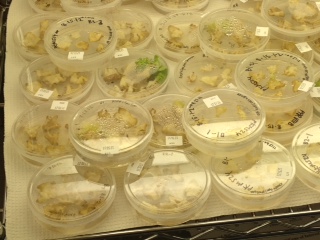
It felt a little like a time-warp to the future when a group of panelists introduced their discussion on Genetically Modified Organisms last Friday at the Plaza Hotel.
“Everybody on this panel is actually open to these technologies,” said Fred Kaufman, Harper’s contributor and CUNY English and journalism professor.
They’d saved the touchy subject for last in the Aquarium's two-day Sustainable Foods Institute (the academic part of the culinary festival Cooking For Solutions), perhaps because people don’t leave early when such a polarizing issue hits the stage.
But the reality Kaufman and fellow-panelists described, one in which GMOs dominate the food system, isn’t one of some hypothetical sci-fi future: It’s now. Their argument, in essence, was that it’s too late to reign in GMOs, so we should instead focus on minimizing their harm.
So instead of questioning whether GMOs have any place in the food system at all, the group parsed finer points, like where in the food chain they’re acceptable, and how—and whether—patents should apply to food.
In reporting on his 2012 book Bet the Farm: How Food Stopped Being Food, Kaufman spent a year traveling to GMO labs around the country. Kaufman talked about the bizarre pursuits of many biotech geniuses; heart- or curlicue-shaped tomatoes that could get kids to eat salad.
“They think if they own the patent, they can make a lot of money,” he said. “Why not pull a Linux on bioengineering?
“All of a sudden, we might be able to completely take out the profit stream, and we might be able to make some room for more creative production in a commons for the common good.”
Kaufman’s argument for why food is different when it comes to patent law: “Every time you roast a chicken, you don’t have to pay somebody who first roasted a chicken for this right.”
Kaufman was joined by Mitch Tuinstra, a professor of plant breeding and genetics at Purdue University where he genetically engineers cereal crops; World Wildlife Fund Senior VP Jason Clay; and Scott Nichols, director of Verlasso, a salmon aquaculture company with operations in Chile.
Clay, who you might’ve expected would be a clear voice of a popular environmental stance against GMOs, articulated some environmentally motivated reasons WWF is actually in favor: Food production is on the rise, and with it, deforestation of sensitive habitat across the globe.
“We don’t want the Serengeti to become a farm,” Clay said. “We want it to be what it is today, which is a wildlife refuge.”
All agreed that GMOs tend to be more palatable to skeptical consumers when the engineered ingredient is lower down the food chain than the food itself; engineer grain, not the cow, or microorganisms used to make food, like yeast for beer or rennet for cheese, and the public might be more tolerant.
“There’s a big difference between a Genetically Modified Organism and a Genetically Modified Microorganism,” Nichols said. “When GMMs are used in vitamins, cheese, wine and beer, we find those things all the be acceptable.”
What the panelists didn’t discuss or disclose, even as they praised GM feed for animals: Nichols’ company, Verlasso, relies on just such a model. A GM salmon, AquAdvantage, which is pending final regulatory approvals from the feds, wouldn’t get WWF’s blessing due to concerns about escape into the wild. But Verlasso’s salmon, which aren’t themselves GM but eat GM feed, are easier for some enviros to embrace.
Verlasso, which is a partnership between biotech firm DuPont and fish farm operators AquaChile, feeds its farmed salmon a pellet featuring GM yeast. Their engineered trait: high fish oil content. Thanks to that GM yeast, the salmon need four times less wild fish to eat than they otherwise would. That means less fishing for Anchovietta to feed the farmed fish.
“I think we’ve solved the single greatest problem in salmon aquaculture,” Nichols says.
The traditional ratio of fish oil to meal is 4:1; Verlasso’s taken that down to 1:1.
That could solve the issue that’s got WWF enthusiastic about GMOs to begin with: reducing agricultural sprawl, through deforestation for farms or plantations, or expanded seafood catches to feed fish farms.
“In the next 40 years,” Clay said, “we have to produce as much food as we have in the last 8,000.”


(0) comments
Welcome to the discussion.
Log In
Keep it Clean. Please avoid obscene, vulgar, lewd, racist or sexually-oriented language.
PLEASE TURN OFF YOUR CAPS LOCK.
Don't Threaten. Threats of harming another person will not be tolerated.
Be Truthful. Don't knowingly lie about anyone or anything.
Be Nice. No racism, sexism or any sort of -ism that is degrading to another person.
Be Proactive. Use the 'Report' link on each comment to let us know of abusive posts.
Share with Us. We'd love to hear eyewitness accounts, the history behind an article.