
“Rage-Goddess, sing the rage of Peleus’ son Achilles, murderous, doomed, that cost the Achaeans countless losses, hurling down to the House of Death so many sturdy souls, great fighters’ souls.” How is that for an opening sentence?
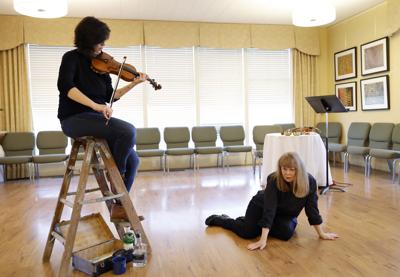
An Iliad by Lisa Peterson and Denis O’Hare features one actor's voice as the poet, retelling the events in Homer's The Iliad, the story of the Trojan War.
Only Homer could describe the glory of actor Patty Gallagher, who embodies it all—the wrath of Achilles, the pride of the king of Greeks and Agamemnon, the tragedy of Troy, the viciousness of gods and the lament of every woman in world history who asked her leaving-for-war partner, father or son: What is it good for?
“I told you so,” Gallagher yells to those who have been killed in battle. She plays the poet, a storyteller in the oral tradition of Homer, compelled to retell the narrative of the Trojan War—and to invoke the inner thoughts of those who fought and the loved ones of those who fought. "I told you so," she utters as the words of Andromache, who just learned of the death of her husband, Hector, the son of king Priam of Troy and brother of Paris, whose kidnapping of Helen of Sparta started a decade-long conflict we know as the Trojan War.
“Tens of thousands, hundreds of thousands of Greek men,” the poet recites. “Fighting on and off, fighting to the wall and back. Greeks win one day, Trojans win the next, like a game of tug-of-war, and nothing to show for it but exhaustion, poverty and loneliness.”
Gallagher embraces an endurance test, memorizing 90 minutes of detailed text, all the Greek names, Greek cities and finally—because that’s what the play is really about—all the wars since the Trojan War, listing violent conflicts from the Punic wars to modern Gaza, a list that puts the audience in awe and generates sense of disbelief. Is that what we have been doing for the last 3,000 years of recorded history of testosterone?
The story is inflected with contemporary examples of how rage shows up, a potent reminder that any of us could be capable of this violence. The contemporary parts are funny and relatable, even while revealing dark truths. The Greek army waiting for nine years outside the walls of Troy—is it not simply stubbornness, like waiting for 20 minutes in the grocery aisle to check out only to discover another line is moving faster, but to wait it out as if it's a heroic endeavor? Does getting cut off by a driver lead us to murderous visions of ramming their car? "We think, 'I'm not like that,' and it happens anyway," Gallagher says.
Gallagher is a seasoned and brilliant actress who has performed around the world, reciting this script on stages in Ireland, India and elsewhere. She used to serve as an artistic director at Santa Cruz Shakespeare. On the stage, she is accompanied by only one person, "the muse." Samatha Bounkeua is a young queer violinist-composer who delivers a breathing soundtrack for the tragic story of Troy. Their collaboration is smooth and touching. On violin, electric viola, chimes and singing bowls, Bounkeua is in dialogue with the poet, moving her story along, and providing also emotional response to the story.
The music, like the story, is somber and haunting, but there is lightness. Helen of Troy speaks (through Gallagher) with a southern twang, and is accompanied by Shania Twain music. In some of her darker moments, the poet reaches for a shot of liquor, "Athena Tequila," an homage to the goddess.
California's First Theatre in Monterey is an intimate venue for this performance, and the venue's first professional production in more than a quarter-century. It is the season opener for New Canon Theatre Co., directed by Noah Lucé.
Homer genuinely praising the war effort and sang the song of fallen heroes. An Iliad picks up the story with a modern lens, with a call for world peace and a sensitivity to the power of the art of storytelling itself, as the poet breaks down periodically during her retelling of the violence. As Lucé says: "Can't we stop telling this story?"
Sara Rubin contributed to this report.
Shows run 7:30pm Thursdays-Saturdays and 2pm Sundays until May 25. Tickets at newcanontheatre.org.


(0) comments
Welcome to the discussion.
Log In
Keep it Clean. Please avoid obscene, vulgar, lewd, racist or sexually-oriented language.
PLEASE TURN OFF YOUR CAPS LOCK.
Don't Threaten. Threats of harming another person will not be tolerated.
Be Truthful. Don't knowingly lie about anyone or anything.
Be Nice. No racism, sexism or any sort of -ism that is degrading to another person.
Be Proactive. Use the 'Report' link on each comment to let us know of abusive posts.
Share with Us. We'd love to hear eyewitness accounts, the history behind an article.