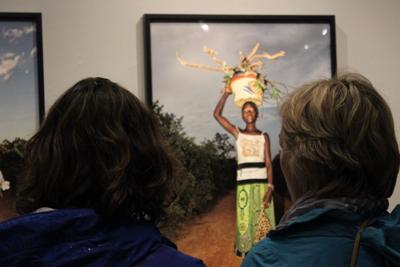

Last Saturday, at the Center for Photographic Art, photographer David Pace revealed an exhibit of color-saturated photos with interesting back stories. For 10 years he has been visiting a small village called Bereba, located in Burkina Faso, West Africa. While he is there he documents, in photographs, his trip, the landscape and the people he now calls his friends. Here are highlights from his lecture at CPA, which opened the photo exhibit West African Village Life Explored in Photographs by David Pace.
On the village of Bereba:
“The village is really in the middle of no where; actually it’s about 5 hours away from the middle of nowhere. I was really attracted to this place because I could see everything by just walking around in the village.”
On workers at the Karaba brick quarry:
“They look very serious in these photos because that's how they want to be portrayed, but in real life they are goofy and like to joke around.”
On a potent local drink:
“This is que m’a pousse, which lightly translates to 'Who pushed me?' And that's exactly what you say when you drink it.”
On the Friday night dance parties:
“Most of the work I do is premeditated, but Friday Night is just unpredictable so the photos are very natural.”
On the dangers of traveling to West Africa:
“There is a travel warning right now, but there's always a travel warning. Americans can’t go anywhere basically. I feel safer in the village though.”
On the main dirt thoroughfare, Sur la Route:
“Every night I would watch people constantly walk down this road and I found it so interesting. One day I realized that I should probably take photos. And that's what I do. I just stand there and take photos, people will pose for me and then be on their way.”
On the local traditions succumbing to globalization:
“The traditional fabrics that are in the background of these portraits are disappearing because a lot of people have started dressing more Western.”
On photographing the people of Bereba:
“I have a lot of photos that I take for them because they want photos of themselves holding bricks, standing on their hands, doing the splits, just doing silly or goofy things. I will get these printed out and bring them with me because most of the time these are the only photos they have ever seen of themselves.”
And now, a little story about an amazing funeral rite:
Pace happened to be on his annual trip the day that a beloved member of Bereba passed. The son of the man who passed pushed him up to the front of the funeral and told him “Take pictures because this is something that is very important, that will probably never happen again.”
The first day was the burial. This was the first time that Pace had seen anyone buried in a casket—apparently they only use a casket when you are a very important person to the community. After they lower the casket into the ground, they cover it with silk, wood, blankets, concrete and dirt. Then one by one each person will do a dance on the grave and try to jump as high as they can. They did that all night, drinking and dancing.
The next day one person would walk around the village collecting donations for the family of the one who passed and every time someone would donate money they would give a reason they were thankful. The person who was collecting the donations would yell out for everyone why the person was thankful. The funeral went on for five days and on the last day the deceased man's granddaughter walked around all day dressed exactly like her departed grandfather, did exactly what he would do and said exactly what he would say.
West African Village Life Explored in Photographs by David Pace is showing through April 16 at Center for Photographic Art, Sunset Center, San Carlos and Ninth, Carmel. www.photography.org.


(0) comments
Welcome to the discussion.
Log In
Keep it Clean. Please avoid obscene, vulgar, lewd, racist or sexually-oriented language.
PLEASE TURN OFF YOUR CAPS LOCK.
Don't Threaten. Threats of harming another person will not be tolerated.
Be Truthful. Don't knowingly lie about anyone or anything.
Be Nice. No racism, sexism or any sort of -ism that is degrading to another person.
Be Proactive. Use the 'Report' link on each comment to let us know of abusive posts.
Share with Us. We'd love to hear eyewitness accounts, the history behind an article.