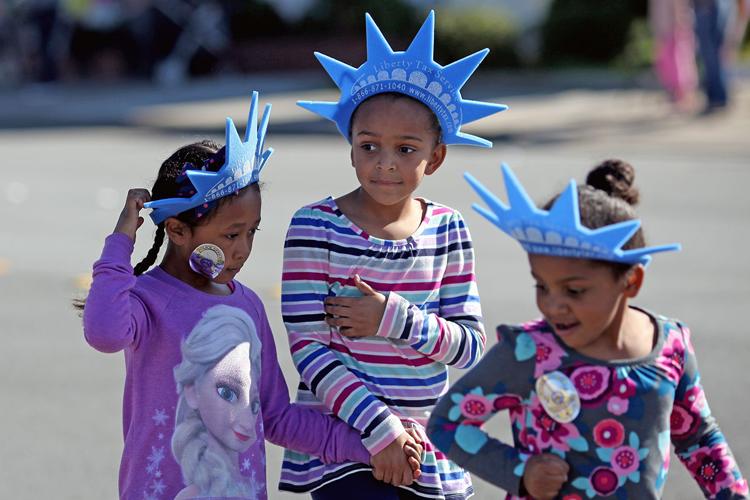
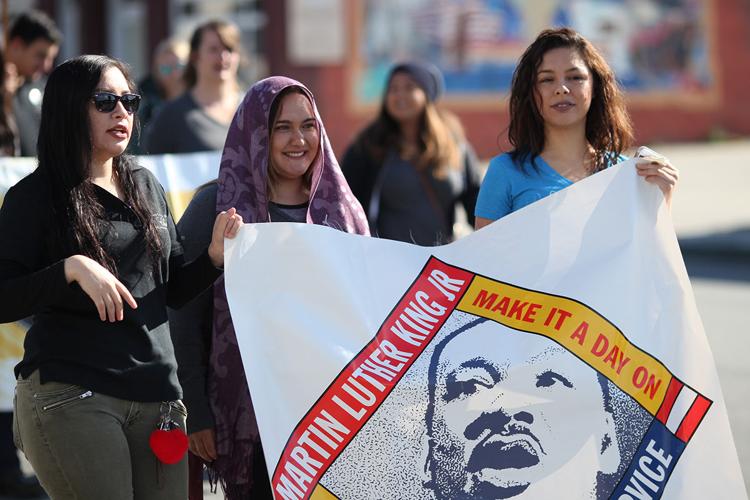


It was a beautiful day for a walk. Not too cold, not too hot. It was a day made for walking. Add the fact that it was the 31st Annual Martin Luther King Jr. March in Seaside, or that it seemed like people needed to come outside and band together, and it all added up to one of the seemingly biggest MLK Day marches in recent years.
There was the usual heartening array of progressive organizations, stalwart churches and faithful community folk.
The interconnected network of black fraternities and sororities that make up the mightily active Pan-Hellenic Council. The American Civil Liberties Union, which has vowed publicly to fight Donald Trump’s most destructive impulses. The vocal United Here: Local 483, clad in red and armed with signage, a bullhorn and rousing chants.
New this year, adding musical muscle and and percussive panache to the affair, the Seaside High School Marching Band (of which I’m proud to say I am an alum).
Churches and schools, unions and civic organizations, individuals and families, a rainbow coalition, assembled to demonstrate our readiness to follow in the footsteps of the many who followed Dr. King not so long ago.
As always the march began slowly, from the parking lot of the Monterey County Social Services office. This time, instead of a steady stream of bodies, organizers spaced the groups apart, like the traffic lights that moderate vehicles before they disembark from on-ramps onto highways.
This created more space between, which allowed for more individual visibility, but decreased the sense of cohesion. There seemed to be fewer onlookers in year’s past—many appeared to be Latino families—but that might have accounted for the bigger numbers of marchers.
It seemed the right time to join in instead of watch from the sidelines.
There seemed to be less a sense of joy and lightness than before, and maybe more anxiety and caution. Maybe people were thinking of the impending inauguration, of Donald Trump’s ugly and petty untruths tweeted at civil rights hero Rep. John Lewis, of the hordes of science deniers, corporate barons and unstable xenophobes getting ready to take over the government they despise so much.
But all of that impending reality seemed to evaporate in mid air during the march, the walk down Broadway/Obama Way, left onto Fremont and its panoply of independent small businesses, hair and nail salons, the Western clothing store, 99 cent stores, Mexican restaurants, used car lots.
At the next left onto Hilby—as marchers amassed and congregated outside Oldemeyer Center, greeted by funk music booming from the Harley motorcycles of the Order of the Eastern Star—it felt like the community block party this day can be.
Kids playing on the lawn, friends and colleagues finding each other, some staying to listen to the program inside Oldemeyer Center, others hugging and waving before heading elsewhere. Those staying moved from the gauntlet of progressive organizations tabling in the community center’s lobby, to find a seat, if they could, inside the always-packed auditorium.
Alice Jordan, who admirably coordinates the march year after year, gave a welcome. Rev. C. Garrett Sr. of Friendship Baptist Church in Seaside handled the invocation, harkening back to the time when black people had to drink from separate fountains and enter restaurants from around back. He gave thanks for those indignities for fortifying black people.
Seaside’s Mayor Ralph Rubio stepped to the podium and admitted he was confused. “It seems like I’ve stepped back into the ‘60s, a time full of rawness, emotion and rudeness.” It’s more disparaging because, he continued, “it’s coming from the top.”
He talked about being older, grayer, like many of the civil rights activists in the room, and about how they must recruit younger activists to take up the cause. He pointed out Mel Mason and said, “Mel, we’re not going to get a chance to rest.”
Congressman Jimmy Panetta was rousing, as someone who’s just won their first major election victory might be. He talked about the “righteousness and the rectitude” of Dr. King, about being in Washington, DC, and visiting the Lincoln Memorial with his daughters.
“Martin Luther King Jr. came to DC to cash his check, that promissory note to life, liberty and the pursuit of happiness. A lot of people are still waiting to cash that check,” he said.
He spoke about Rep. John Lewis, who told him that when he knew he would be arrested in one civil rights action in the South, he bought the nicest suit he could find for the occasion. It cost $5.
“I saw the picture. It was a nice suit!”
Sen. Bill Monning thanked a round of people before delivering a meaningful quote by King: “True peace is not merely the absence of tension; it is the presence of justice.”
Then, ever the fighter, he encouraged people to attend the People’s Rally for Unity and Equality at Window on the Bay on inauguration Friday, exhorting peace achieved in negotiations instead of on battlefields.
Assemblyman Mark Stone, a large man, brought up and dismissed social media speculation that Dr. King would have stood next to Trump in the interest of keeping some semblance of peace during the inauguration.
“King would not have asked oppressed people to support their oppressor,” he surmised.
Supervisor Jane Parker acknowledged the “uncertainty, fear and anxiety” about the future, and reassured the audience that those emotions were wholly appropriate, but implored “We need to hear from you. The future is not yet written. It depends on your actions. There are many good organizations here today. Join one.”
Regina Mason, recently appointed the president of the NAACP-Monterey County Branch, invoked past civil rights marchers who were bitten by police dogs, the Black Panther Party’s 10-point plan, the 85th year of the NAACP, and “new strange fruit,” referencing Billie Holiday’s song about Southern lynchings.
“Instead of hangings and mutilation then, it’s the killing of black and brown men now,” she said.
She introduced a ray of future light in former NAACP Youth Council president, Erica Sterling, who is now a Ph.D candidate at Harvard, which elicited big applause.
Mason went on to promote a platform of black self-determination, suggesting that African Americans are becoming “extinct” in some communities.
“African Americans have been relying on systems in Monterey County to bring us equitable distribution of services. It’s not working.”
One of the few voices of cross-cultural coalition came next in Francisco Lopez, president of LULAC 2895 Council. He seemed nervous about his public speaking engagement, but sounded a positive, saying “I am honored to speak among the many fine people who came before me.”
Which seemed to cast into relief a potential fault line. Seaside is vastly comprised of Latino and Caucasian residents, with a median age of 30 (according to the 2010 census). But one of its seminal events, predicated on multiracial coalitions, is organized primarily by black folks who, as Rubio alluded to, are aging.
Where is the next generation? And what will that next generation look like? One speaker name checked schools where young people might be tapped, like Monterey Peninsula College, but an audience member had to yell out “Hartnell” to add it to the mix. And no one mentioned CSU Monterey Bay, the university located in Seaside.
Next up was Seaside Police Chief Robert A. Jackson, who gamely said he started his job in November, and was proud of Seaside. He promised that under his leadership, the department’s response to the community will be based on “ethics, legality and morality.”
“We’re here to be your guardians,” he said. “We’re here to keep things safe.”
He left with an open invitation to “come see me.”
Next came two tributes to Dr. King. First from Geneva Snell of Seaside High School, then from Sabria Henry-Hunter, 15, of Everett Alvarez High School. Snell did admirably. But Henry-Hunter brought the house to its feet.
She started by conjuring a metaphor on sneakers.
“I’m baffled by the lack of concern by my fellow young people for history, for politics, for current events. It’s like they are satisfied with their Air Jordans,” she mused.
Then she asked, “What are your Air Jordans? What keeps you satisfied?”
She cited stats like the 40 percent of eligible voters who didn’t in the last election. She recounted the five previous times—like a greatest hits—she’s given a tribute at the MLK Day program. She recited “We Shall Overcome” in the past tense, projecting a future time in which long-sought victories are finally achieved. She quoted “a wise woman” [Michelle Obama] as having said “When they go low, we go high.” She pledged, this year, to love.
She got the biggest applause of the two-hour program, a standing ovation. Two people sitting next to each other remarked how we would likely hear from this young person in the future. Just wait.
Former Mayor Pro Tem Ian Oglesby came up next and demurred to the force of that speech by saying “I think we can all go home now.” But it wasn’t to be. Instead, he introduced the featured speaker.
Perry Tarrant is the Assistant Police Chief of Seattle and President of NOBLE (National Organization of Black Law Enforcement Executives).
He greeted the audience cordially, and said that he’s had the opportunity to “fellowship” with some of the pastors in our area earlier in the morning.
He said that Seattle had been one of 94 police departments under investigation by the Justice Department for discrimination and abuse before he arrived there.
He described his work in NOBLE—founded in 1976 address crime and policing in black communities—in terms of an African proverb.
“A wise man plants seeds for a tree, knowing he will never enjoy the shade of the tree.”
But then he relied on bait that seemed more suited to a high school audience than the one seated before him.
“How many people want police reform?”
Most every hand went up.
“How many of you want to be police officers?”
Not a single hand. But understand, the audience was much older than prospective police applicants. The message of “Be the change you want to see” was a noble one (pardon the pun) but misapplied here.
A dark complexioned man, he pointed to his face, saying “I was this before I carried a badge.”
He recounted how he had been stopped by police without just cause when he was younger, and it made him incensed enough to change majors from physics and engineering to political science to prepare for a career in law enforcement.
“I bet I’ve been stopped driving [by police] more times than anyone in here,” he challenged. “And this is knowing that I have a gun.”
Which seemed more like more evidence of racial profiling than comfort about it.
But his message about changing systems from within contained a powerful message. One that Rep. John Lewis has embodied. But the Assistant Chief jumped around from message to message too often and abruptly to capitalize on it.
He brought up having met with the mother of Philando Castile, and having conversation so civil that they have since exchanged Christmas cards. He spoke about spending time in Ferguson, and providing BART a list of changes following the shooting of Oscar Grant at the Fruitvale light rail station.
He brought up a stunning and disheartening statistic, that of the murder rate in Chicago, which surpassed 700 in 2016. He said that when his organization, NOBLE, was brought in to Chicago in 2013, the murder rate dropped from 500 to 267, but that the crime simply segued out into the outskirts.
“You tell me how effective is adding more police to a problem?”
He said that police deaths by ambush surpassed that of collisions in 2016. When he called the Tulsa police department following the shooting on an unarmed black man, he asked them what is not seen on the video that might explain what happened? The response came back that they simply did not know why it happened.
He talked about the Great Recession having drained funds out of police training. He talked about how the Seattle police department, which is under a Justice Department consent decree to abide by their rules, has reduced shootings of people under emotional duress. He talked about how President Obama convened a meeting of heads of various police departments to figure out why so many police shootings were happening. He was also part of the Trump transition team on 21st century policing, and says he got them to keep transparency, de-escalation and training “on the table.”
“Education is power,” he said.
“Your job is to create discomfort,” he said.
He regretted only being able to visit the community for the day before having to leave, but he said “I will come back when I have more time.”
Then he received proclamations by Rubio and Monning.
Except for a couple of references to King to keep it in conformity with the day, it was an weirdly police- and crime-centric address. But it’s been a weird week. A weird year. At least we can walk toward 2017 and beyond together, arms locked, chanting and singing of hope, like King taught us.


(0) comments
Welcome to the discussion.
Log In
Keep it Clean. Please avoid obscene, vulgar, lewd, racist or sexually-oriented language.
PLEASE TURN OFF YOUR CAPS LOCK.
Don't Threaten. Threats of harming another person will not be tolerated.
Be Truthful. Don't knowingly lie about anyone or anything.
Be Nice. No racism, sexism or any sort of -ism that is degrading to another person.
Be Proactive. Use the 'Report' link on each comment to let us know of abusive posts.
Share with Us. We'd love to hear eyewitness accounts, the history behind an article.