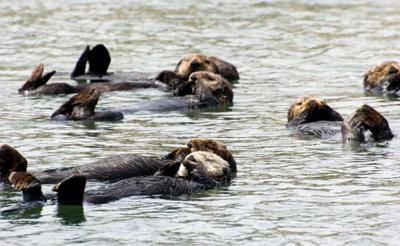
Late last year, California’s sea otters finally gained the freedom to travel south. The Fish and Wildlife Service (FWS) eliminated the no otter zone, which stretched from Point Conception to Baja. The change was largely celebrated, especially by sea otter conservation organizations. But now, the FWS is under attack.
A few weeks ago, the California Sea Urchin Commission filed a notice of intent to sue the FWS for eliminating the no otter zone. According to the notice, the Commission feels that the FWS failed to consider the conservation of endangered black and white abalone, which also inhabit the zone, in its decision. But Jim Curland, Friends of the Sea Otter Advocacy Program Director, disagrees.
“We think they did take it into account,” says Curland. “The fishermen just aren’t satisfied with the result. If they had their choice, they wouldn’t want any sea otters in Southern California.”
Sea otters are infamous picky eaters. Because they lack blubber - the fat that keeps most marine mammals warm - they must eat almost continuously to maintain their metabolism. Urchins, crabs, clams and abalone are common prey items.
The Sea Urchin Commission’s argument seems reasonable: If otters eat abalone, an increase in sea otters will result in a decrease in endangered abalone, right? But a scientific paper indicates this may not be the case.
“Southern sea otters eat only about 5% abalone,” he states. “Of that 5%, it’s mostly red abalone.”
A U.S. Geological Survey article goes further: It’s possible that otters may have actually helped the abalone population recover in recent years. Both abalone and sea urchins feed on giant kelp. But of the two, the urchins are by far the favored prey of the sea otter. By eating the urchins, the otters have preserved a healthy kelp forest for the abalone. This relationship may explain why California’s abalone divers come up with 12-inch specimens, while their counterparts worldwide rarely find 4-inch abalone.
The FWS has 60 days to resolve the notice in a way that’s satisfactory to the Sea Urchin Commission. If they fail to do so, the Commission can file a lawsuit. At that point, Curland says, conservation groups like Friends of the Sea Otter will step forward to support the FWS.
“The sea otters need to expand their range,” Curland explains. “The population is not moving in a sustained positive direction right now.”


(0) comments
Welcome to the discussion.
Log In
Keep it Clean. Please avoid obscene, vulgar, lewd, racist or sexually-oriented language.
PLEASE TURN OFF YOUR CAPS LOCK.
Don't Threaten. Threats of harming another person will not be tolerated.
Be Truthful. Don't knowingly lie about anyone or anything.
Be Nice. No racism, sexism or any sort of -ism that is degrading to another person.
Be Proactive. Use the 'Report' link on each comment to let us know of abusive posts.
Share with Us. We'd love to hear eyewitness accounts, the history behind an article.