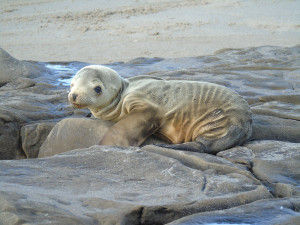

The Sausalito-based Marine Mammal Center counted 170 sea lion pups in its care earlier this month. (In a normal year, they have about 12.)
They're among some 1,200 sea lions sent to rehab facilities in California this year, MMC reports:
"We have never seen so many sea lions stranding this early in the year at such a young age and in such poor condition. This is especially concerning because California sea lions are considered sentinels of the sea; their struggles are often an indication that something more complex is happening in the ocean environment."
This is the third consecutive year that starving sea lion pups have stranded along the state's coastline in high numbers. But scientists aren't totally sure why.
One likely factor: Warm water patches along the U.S. West Coast. Unusual wind conditions are suppressing the natural cold-water upwelling that, in a normal year, brings lots of fish (read: sea lion food) to the surface.
Compounding the warming: El Niño conditions, which the National Oceanic and Atmospheric Administration made official March 5. Climatologists are measuring some of the warmest ocean temperatures on record in parts of the tropical Pacific, at 2-5 degrees Fahrenheit above normal for the season. That means warm coastal waters could stick around through the summer or longer, redistributing the forage fish sea lions depend on.
As a result, MMC reports, sea lion mothers are taking longer to forage for prey while their nursing pups wait for them, hungry. Some pups lose patience with the wait and set off on their own, washing up weak, thin and alone on California beaches.
But marine conservation nonprofit Oceana, which has a California office in Monterey's Heritage Harbor, connects another dot to the scarcity of sea lion food: sardine fishing. The Pacific Coast sardine population is at its lowest level in 15 years, Oceana reports.
“Any fishing on Pacific sardine right now is overfishing,” said Geoff Shester, Oceana California campaign director.
Oceana's argument: When natural ocean conditions drive down the sardine population, fishing pushes it even lower, making it harder and slower for the population to rebound when ocean conditions become favorable to sardines again.
"While federal officials are quick to blame ocean conditions for the declines in [sea lion] prey, they have turned a blind eye to the effects of sardine fishing and even voted to increase harvest rates on sardines," states an Oceana press release.
To some extent, Oceana's pressure worked: On March 10 the Pacific Fishery Management Council, a federal agency that manages fisheries on the West Coast, banned new commercial fisheries for seven forage species in federal waters from Washington to California.
The protected fish species include herring and squid, but not sardines or anchovies, the food some very hungry sea lion pups would probably like to snack on right about now.


(2) comments
The government AND Oceana should stop encouraging people to eat sardines and other animals.
All of the nutrients we need to thrive can easily be obtained more healthfully, humanely, and environmentally responsibly from plant sources, including vegan seafood.
See Fish Feel for vegan seafood recipes and products, and more information on why we should genuinely respect and protect aquatic animals rather than harmfully exploit them.
There was a study a few years back, plants feel pain when you cut them or pick the fruit, nuts and berries.
So, I guess you are going to starve.
Welcome to the discussion.
Log In
Keep it Clean. Please avoid obscene, vulgar, lewd, racist or sexually-oriented language.
PLEASE TURN OFF YOUR CAPS LOCK.
Don't Threaten. Threats of harming another person will not be tolerated.
Be Truthful. Don't knowingly lie about anyone or anything.
Be Nice. No racism, sexism or any sort of -ism that is degrading to another person.
Be Proactive. Use the 'Report' link on each comment to let us know of abusive posts.
Share with Us. We'd love to hear eyewitness accounts, the history behind an article.