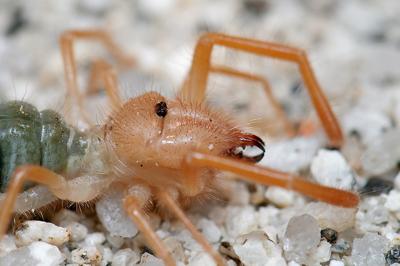
The Camel spider raises its translucent spindly, fuzzy forearms in defense. As it scuttles its large, dark scorpion-like body backwards in retreat, it opens its muscular black pronged mouth, creating a scene right out of science fiction.
With its crazy, almost extraterrestrial appearance, one would think it would be more notorious than it is.
However, due to its mostly nocturnal habits, high speed, and affinity for shadows, this interesting yet freakish cousin of the spider has remained relatively under the radar in Monterey County. Despite many names, including: camel spider, roman spider, wind scorpion, and sun spider, it is a member of the arachnid order solifugae, more closely related to scorpions than spiders.
Juan Landazuri of Jurassic Pets in Salinas explains that the camel spiders elusiveness and short lifespan in captivity, the average life expectancy is six months for zoos and two months for private collections, makes it difficult to understand, especially when it comes to the local species found in Northern California.
Information about Monterey’s native species is scarce, and much of the facts that do exist are derived from that of its exotic counterparts. Unlike the Middle Eastern species that can grow up to 8 inches long, native camel spiders usually max at about 2-3 inches, they also tend to be slower in speed and metabolism than their Middle Eastern relatives due to the cooler climate.
Although it isn’t certain why they fare so poorly in captivity, Landazuri speculates that it might have something to do with their need for larger areas of land to roam and the amount of food they eat, explaining that “they need to eat close to their bodyweight each week. They’re considered the shrews of the arachnea world because of their huge need of food for their size.”
The sheer amount of food they consume isn’t the only interesting aspect of their diet, it’s also how they hunt and consume their meals, capturing and devouring their prey while it is still alive. Their strong, muscular jaws—which are some of the largest relative to their size of any animal on the planet—paired with their blistering speed, reaching up to 10 mph, allows them to hunt, as Landazuri explains, “almost like how a cheetah uses its speed to bring down a gazelle.”
Although they may not always be as aggressive as they are while hunting, they prove to be resilient and relentless in their attack and technique, preying on lizards over twice their size and often turning cannibalistic and eating each other. Camel spiders have a similar diet to tarantulas, eating insects, small rodents, spiders, and small reptiles.
This prowess gives them the label of “aggressive feeders”; however, the line between being an aggressive feeder and an aggressive species is blurry, as Landazuri explains “it’s really hard to tell if they are just aggressive during hunting or in general.”
When it comes to how many Camel Spiders are actually present in Monterey County, Landazuri says it’s uncertain to say the least. One of his personal inquires about the species, is just how much space they really need in captivity. The answer could provide a better understanding about how to take care of them, in turn, resulting in a longer life expectancy and more opportunities to study these unique creatures.
Photo Courtesy of M Hedin via Flickr


(0) comments
Welcome to the discussion.
Log In
Keep it Clean. Please avoid obscene, vulgar, lewd, racist or sexually-oriented language.
PLEASE TURN OFF YOUR CAPS LOCK.
Don't Threaten. Threats of harming another person will not be tolerated.
Be Truthful. Don't knowingly lie about anyone or anything.
Be Nice. No racism, sexism or any sort of -ism that is degrading to another person.
Be Proactive. Use the 'Report' link on each comment to let us know of abusive posts.
Share with Us. We'd love to hear eyewitness accounts, the history behind an article.