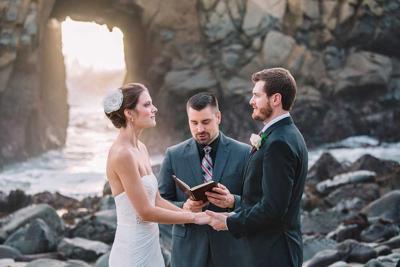

It wasn’t the first time I officiated a wedding. But it was the first time I’d shown up to finalize the ceremony details with the bride and groom, only to discover they hadn’t even started their vows.
The wedding was a couple of hours away, tops.
Turns out, despite the ring bearer burning his hand on a curling iron and the ceremony being delayed more than an hour, and one toast-maker getting the microphone snatched away, the getting-hitched part went off without a hitch – even splendidly – mainly because the vows were so moving.
Here are the simple guidelines used to make it happen. Basic ceremony templates are also easy to find online.
1. Involve a ritual.
Officiants everywhere: Take time in the proceedings to welcome everyone, a minute tell a short but heartfelt story, and don’t forget the actual exchange of rings after the vows. Also, having the marrying spouses combine two symbols of themselves, like candles, water or wine. At the aforementioned wedding, it was sand from where he proposed, poured together with sand from where they married. The simple ritual helps structure and ground the ceremony.
2. Be specific.
The vows, like any compelling piece of information, should have details. Don’t just say you love your partner’s compassion; say you love the way she invests so much time at the after-school clinic and makes warm soup for the neighborhood bum. It makes for much more meaningful content.
3. Look ahead.
This is a most sacred promise. Explore all the sweet moments you want to enjoy in your lifetime together, especially the small but vital things. “I will make you breakfast in bed – and not burn the toast. I will pick up the dog doo. I will be there to pick you up too.”
4. Embrace structure.
It helps to start the first set of vows with a consistent opening (“I love you because… ”), and the second set too (“I will… ”). Bride and groom can alternate vow for vow, making them easier to follow and more poetically symmetrical.
5. Compare notes.
Some couples prefer to keep their vows semi-secret from one another until the ceremony. But it’s a unique brand of awkwardness when the groom’s vows go 10 minutes longer than his better half’s, or the bride’s are notably deeper. Couples can avoid this – even without revealing all of what will be said – by swapping rough drafts of what they plan on saying.
6. Build the drama of the kiss.
Officiants: Take all the time and poetic license you can to facilitate the final I do’s, set up the kiss and pronounce the couple husband and wife (or husband and husband, or wife and wife). The moment more than merits it. Then get the party started.


(0) comments
Welcome to the discussion.
Log In
Keep it Clean. Please avoid obscene, vulgar, lewd, racist or sexually-oriented language.
PLEASE TURN OFF YOUR CAPS LOCK.
Don't Threaten. Threats of harming another person will not be tolerated.
Be Truthful. Don't knowingly lie about anyone or anything.
Be Nice. No racism, sexism or any sort of -ism that is degrading to another person.
Be Proactive. Use the 'Report' link on each comment to let us know of abusive posts.
Share with Us. We'd love to hear eyewitness accounts, the history behind an article.