
When a forest fire breaks out, the state incident management team kicks into gear, assessing its potential and putting out a call for support – for any combination of a strike team of firefighters, a bulldozer crew, air support – depending on the size and scope of the fire. Ryan Walbrun, a Monterey Peninsula resident for 16 years and staff meteorologist for the National Weather Service in Monterey, got the call after the Soberanes Fire started, and joined the team as the incident meteorologist at the command post at Toro Park. The Weekly spoke with Walbrun on day 11 of his 14-day shift, during which he’s been working from 6am to 10pm.
Weekly: Do you always have a bag packed and ready to go for emergencies?
Walbrun: Yes, it’s called the red bag, a standard Forest Service bag. It has my fire gear, clothes, fire boots, even winter hats, in case it’s a cold climate.
I can be ready to go in an hour or so. I could be 40 to 50 days on-site for a wildfire, or much less. I been to fires in Idaho and Montana. The national response system could also assign us for hurricane support, wherever we are needed.
What does the incident meteorologist do?
The incident meteorologist drives a lot in the firefight. We work with the fire analysts and are constantly looking at fuels, topography and the weather. Fuels, particularly after a long-term drought, and the topography, they both are static. But the weather changes hour by hour. In a big fire like Soberanes, there are complicated fire behavior models we’re working with, analyzing the changing temperature, humidity, if there is stability or not with the weather, trying to determine and predict where the fire will go.
Our analysis impacts the fire commander’s decisions on if, when and where to send resources. That starts with the weather.
You’ve lived in Carmel Valley for a decade. Is it unusual to be assigned to a fire so close to home?
I got assigned to the Basin and Pfeiffer fires in Big Sur, but otherwise I usually travel much further away to incidents.
Does being a resident of Carmel Valley make it easier to predict this fire?
Living here helps. Call it home-court advantage. If you don’t live in the area, people expect sunny California, all the time. They don’t anticipate the impact of the marine layer, they don’t know the terrain, or local conditions.
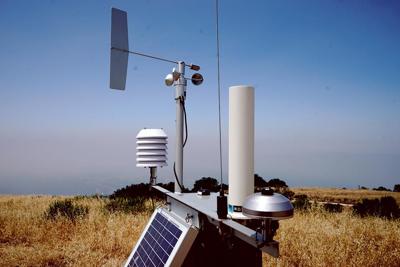
You’ve installed eight portable weather stations around the Soberanes Fire, at Blue Rock, Chews Ridge, White Rock, Pinyon Peak, Carmel Highlands, Bottchers Gap and Tassajara. How do they work and what information do they generate?
They are called RAWS (remote automatic weather systems). Each comes with a wind mast, fuel moisture sticks that measure moisture over 10 hours, plus instruments to measure temperature and relative humidity. The data of RAWS goes to Boise, Idaho, the national dispatch center for this data. There are 60 incident RAWS in total, eight of which are now at this fire.
The highest RAWS station is on top of Chews Ridge at 4,869 feet, and the lowest at Tassajara Zen Center at 1,826 feet. On Aug. 1 at 6pm, the humidity on Chews Ridge was 27 percent. At 6am, it was 6 percent. That’s unusual around here. Most fires are driven by wind, but here they’re driven more by how steep the slope is and the impacts of a five-year drought, plus the dry air.
When did you decide to be a meteorologist?
I was 12 and watched the weather for entertainment on TV. In the weather world, that’s pretty normal. Growing up in Midwest, I always loved winter weather, snow storms, even thunderstorms.
Were you a storm chaser?
At the end of college, I chased a few thunderstorms.
When did you discover you had a knack for predicting the weather?
I’m not sure I can say that. I just spent a lot of time trying to understand as much as I could.
What keeps you up at night?
My hope that I was able to drive home to the crew that the conditions are not typical, that above the clouds, the fire will not behave as they are used to. It’s hard to get to all 5,000 fire personnel to understand that. If the wind changes in some little drainage, that’s when the fire will spot or change direction. That’s nerve-wracking.
Have you ever made the wrong call?
I’m sure I have.
What’s a motto you live by?
Those that talk the most, say the least.


(0) comments
Welcome to the discussion.
Log In
Keep it Clean. Please avoid obscene, vulgar, lewd, racist or sexually-oriented language.
PLEASE TURN OFF YOUR CAPS LOCK.
Don't Threaten. Threats of harming another person will not be tolerated.
Be Truthful. Don't knowingly lie about anyone or anything.
Be Nice. No racism, sexism or any sort of -ism that is degrading to another person.
Be Proactive. Use the 'Report' link on each comment to let us know of abusive posts.
Share with Us. We'd love to hear eyewitness accounts, the history behind an article.