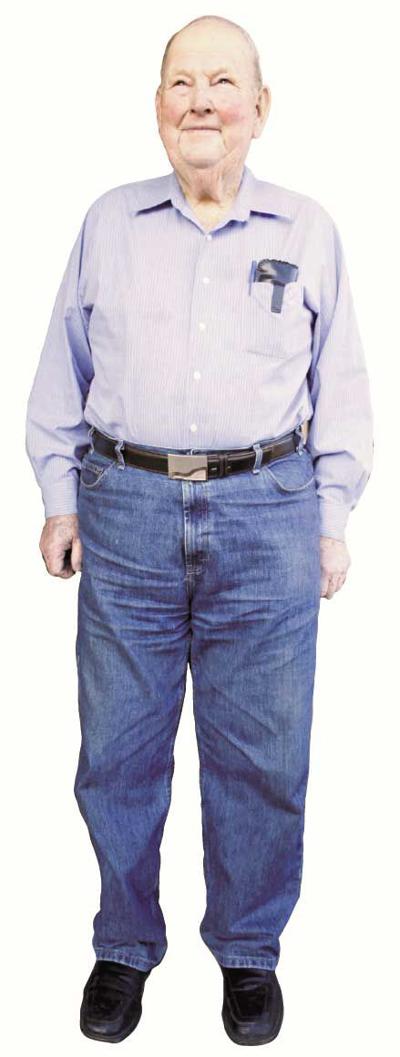

Stan Harlan, 91, has spent most of his adult life in Monterey – he and his wife Irene, in 1970, moved into a house they built themselves on an empty lot in New Monterey – but Big Sur still courses through his veins. Harlan is the grandson of Wilber Judson Harlan, who started homesteading near Lucia in 1885, and Ada Amanda Dani Harlan, whose parents – the Danis – began homesteading in the same area in 1876 on land that is now home to the New Camoldoli Hermitage. Harlan grew up a few miles west-northwest of those homes, on a ranch owned by his parents, George and Esther Harlan, on Lopez Point.

Harlan says homesteaders set controlled burns every winter when conditions were right: “That’s where they’re making a big mistake right now.”
Harlan recently self-published a book about the trials and tribulations of his parents, My Mom and Dad on the Coast South of Big Sur, that is filled with stories about how they carved out a life on the rugged coastline and, through hard work and some ingenuity, were able to enjoy amenities like a thriving vegetable garden and strawberry patch, running water – and hot water – and windmill-created electricity that could power a washing machine and lights in the home. They would have been completely off the grid had it not been for a telephone line to King City that one of Harlan’s relatives installed in 1910 that connected with the homes of 20 Big Sur families.
Harlan tells of his mother, who arrived to the area from San Jose in 1913 to become a school teacher at the Redwood School, and her journey with Harlan’s grandfather Wilber, who picked up Esther at the King City train station and led her to the coast on a two-day trip on horseback that included an overnight stay in a cave in the San Antonio River valley.
Little of Harlan’s own life after Big Sur is in the book, except in the author’s note: He graduated from Pacific Grove High School (while staying with family) in 1946, joined the Army that same year and met his future wife Irene, a Polish national, in Germany. They married in 1948 and Harlan enrolled at UC Santa Barbara in 1949 and graduated in just three years. Upon graduation, he was hired to teach industrial arts at Watsonville High, which he did for 32 years before retiring. He has since written a number of books about his family’s history, some with Irene (who passed away in 2015), and only published My Mom and Dad – which is available on Amazon – after one of his neighbors read it and insisted that he must.
Weekly: What did you enjoy most about growing up in such a wild place?
Harlan: Freedom, primarily. Our parents were pretty strict on what we did and how we did it. But when the highway was being built, even with our parents’ cautions, we would go along and find an unexploded dynamite cap on an electric wire about six feet long, and when the people weren’t working there, we’d twiddle it over our head by the steam shovel, and when the cap hit the steam shovel, it would explode.
You had a miles-long walk to school, up and traversing a mountain. What did you do in the winter rains?
Slush, slush, slush.
Did you do much hiking and adventuring in your youth?
We were hiking every day for one reason or another, usually connected to work. When you’re raising cattle, you’re hiking over the country. Dad used a horse when he went out. [My brothers and I] went out on the shanks’ mare (on foot). And we had a lot of pleasurable things. We’d hike in the backcountry and go trout fishing, and we’d hike down to the beach and catch abalones.
Why did you decide not to move back to Big Sur?
There was no way to make a living. My brother and I worked there after the service about a year in the timber industry. We were working hard every day and making good money, but that doesn’t go on forever.
How did the telephone line work – you mention that each house could know it was being called by the pattern in which the phone rang. Would everyone’s phone on the line ring?
Yeah, and everyone’s listening on the wire too. That was standard procedure. When you’d be explaining something to another person, if you made an error, you would be politely corrected right on the line by someone. My aunt Lulu was a great one for that. She would listen, and if things were not quite copacetic, she’d let you know.


(0) comments
Welcome to the discussion.
Log In
Keep it Clean. Please avoid obscene, vulgar, lewd, racist or sexually-oriented language.
PLEASE TURN OFF YOUR CAPS LOCK.
Don't Threaten. Threats of harming another person will not be tolerated.
Be Truthful. Don't knowingly lie about anyone or anything.
Be Nice. No racism, sexism or any sort of -ism that is degrading to another person.
Be Proactive. Use the 'Report' link on each comment to let us know of abusive posts.
Share with Us. We'd love to hear eyewitness accounts, the history behind an article.