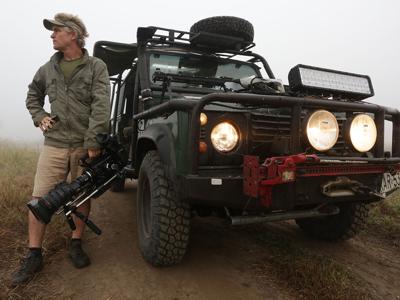

National Geographic cinematographer Robert Poole grew up deep in East Africa, so you’ll have to forgive him if he takes issue with the first question.
“What is your earliest memory of a ‘wow experience’ with nature?” he says. “That’s like asking, ‘What’s your first memory?’”
But he relents. The year is 1963. He was on a trip from Malawi to Kenya with his dad, a director in the Peace Corps. They stopped at the bank of a river to inspect the crossing, and when pops got out of the Land Rover, Poole went down to play in the water. A giant crocodile, sleeping on branch extending over the bank, awoke and dove over his head and landed with a huge splash in the muddy river.
“It was quite a fright,” he says, “and one of those family stories.”
Many of the stories he tells now – of armies hunting Mozambique’s elephant populations to the brink of extinction for ivory to swap for weapons – aren’t as fun. But he has hope, and plenty of uplifting tales too, which he’ll share at the Golden State Theatre in Monterey as part of the National Geographic Live series at 7pm Wednesday, May 18 ($23-$36, 649-1070, www.goldenstatetheatre.com).
The Weekly spoke with him the previous week from his Idaho home.
Weekly: How do you approach the challenge of war’s effect on the environment?
Poole: It’s a complicated answer. Africa and a lot of wild places are being destroyed at a phenomenal rate. A lot of that is settlement: farms, shopping centers, residences. That’s most destructive. When you have armed conflict, the logging, the mining, the extraction halts. The real problem with wildlife during war is it’s being eaten by soldiers or the population because there aren’t protections.
How does growing up with wildlife shape the way you view humans?
Growing up with abundant wildlife makes it important to me. My heroes are the people who are out there working hard to save it. There are so many people dedicating their lives to wildlife conservation in Africa and that gives me hope.
What surprises people most about elephants?
They are so much like us. They’re individuals. They’re all so different. They share a lot of the emotions we do. You can see them being joyful, like a dog, but much, much more intelligent. They grieve, you see that, and you can film it. They’ll come back to a body again and again and move the body around. They grow up in families that are dependent on each other, they live long lives, and they show empathy.
What are the conversations you and your sister, renowned elephant zoologist Dr. Joyce Poole, can have that other siblings cannot?
Joyce and I spend time talking about the subtle nuances of individual elephants.
What’s one of the most intense – and dangerous – moments you’ve experienced on the job?
Working with the elephants in Gorongosa [National Park] can be quite intense because they were traumatized by years of war and poaching. The few that are left really don’t like people. My sister and I set out to habituate the elephants not to charge by spending a lot of time in their presence, not running away, showing we came in peace. We’ve made huge progress.
Speed round. Where do you feel most at home?
In my tent. Doesn’t matter where.
Best way to bribe an elephant?
You can’t. And you shouldn’t. Truth is, domesticated elephants do almost anything for food, but we don’t do that with wild ones.
Coolest thing about Africa?
It’s so immense. You can put all of Asia and India and the U.S. in Africa. And everywhere you go, it’s different.
Biggest misperception about elephants?
That there are too many. They flock to places where it’s safe, like refugees. They’re smart enough to travel thousands of miles to get there, and it seems like there are more than there are.
Favorite microfauna?
This seems silly, but I love everything. Except mosquitoes.


(0) comments
Welcome to the discussion.
Log In
Keep it Clean. Please avoid obscene, vulgar, lewd, racist or sexually-oriented language.
PLEASE TURN OFF YOUR CAPS LOCK.
Don't Threaten. Threats of harming another person will not be tolerated.
Be Truthful. Don't knowingly lie about anyone or anything.
Be Nice. No racism, sexism or any sort of -ism that is degrading to another person.
Be Proactive. Use the 'Report' link on each comment to let us know of abusive posts.
Share with Us. We'd love to hear eyewitness accounts, the history behind an article.