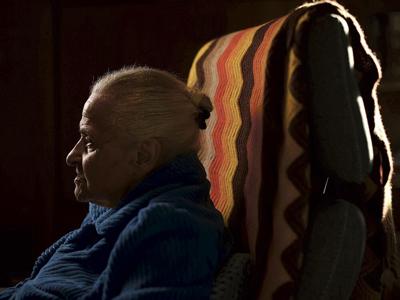

Her life started like a horror movie that became more and more like a fairytale. Sitting in her sunny home office, at the top of a hill in the Carmel Highlands, surrounded by books and provided with an ocean view, Lotte Marcus, 94, cannot believe her luck in life.
Marcus was born in 1927 in Vienna, the heart of a multicultural Central Europe that attempted to self destruct in 1914, then again in 1939 – when it actually succeeded. Lotte was 11 when Adolf Hitler’s armies marched into Austria and her family had to flee, diamonds sewn into coat linings, looking for a country that accepted Jews.
Troubled China – at war with the Japanese and itself – was one of a few places that kept the door open, and thanks to one Chinese consul, who just decided to issue thousands of visas, the family arrived in Shanghai. There, Lotte’s father, whom she describes as her hero, died suddenly of cancer and the 14-year-old became “the man of the house” because her mother was a “very protected, middle-class, sweet woman.”
Marcus worked teaching English to Japanese officers after she picked it up herself. The fact that today, despite being well into her 90s, she kicks herself for – as she puts it – not having enough sense to study Mandarin Chinese at the same time, is telling. She is nothing if not persistent.
Her life “changed on a dime,” she says, when she came to the U.S., originally to Mobile, Alabama, where a relative established himself as a Viennese pastry chef. But she fell in love with L.A. Marcus, then 22, was throwing nickels into a photo booth until she got a job at MGM. There, she met her husband, writer Alan Marcus, moved to Monterey County and eventually earned a PhD in psychology at the age of 56. Until she turned 75, she saw around 1,700 patients – and she continues to see two.
Weekly: What do you remember from childhood?
Marcus: I have wonderful memories. I think that if I didn’t have those happy 10 years, I would not have recovered. Each of my parents had three siblings. I remember Sunday brunches. My mother loved to cook, and she would always surprise us, with goose or something. It all broke up, we never became a family again. They took away my father’s brother to work on the road. He died six months later. My father had another brother that married a rich woman in Prague. They didn’t make it and were gassed. That’s trauma. There’s still… [a] shadow when I think about that.
I didn’t feel antisemitism around me. But when Hitler crossed the Alps, suddenly we saw thousands of swastika flags everywhere. As if they were sold to people overnight. I felt betrayed, as if we didn’t know where we were.
Tell us about Alan and the family you built with him.
We were the loves of each other’s lives. That’s serendipity. We were married 63 years. He died five years ago and I miss him terribly. We have three wonderful, now adult children: David, who is a professor of Arabic and a musician; Naomi, who is a writer and tutor; and Anina, who is a physical therapist and will miss me the most when I die. We live across [from each other] and, you know, she brings me apple strudel.
Speaking of apple strudel, did you get a chance to ever return to Vienna?
I did. I wanted to show it to my husband. I wanted to show him the house where I was born. We went on a European tour. I had such a panic attack when I came to that house, he had to take me away. We spent a week in the Alps somewhere instead. Austria is stunningly beautiful, but I never went back.
You and your husband met in L.A. What brought you to Monterey County?
Somebody sent us for a two-week vacation here. We didn’t know where we were, but decided we needed to live right by the ocean. We bought this property 60 years ago so that Alan could write and so I could see my patients here. I remember having a 6-month-old baby and taking her to the beach every day while Alan wrote. And then we would come home and have lunch and the baby would go to sleep. It was lovely. We were extremely happy. And then, I guess when I was really safe, I started to wake up at night, my teeth shattering, hearing bombs. And Alan would be there and would keep repeating: “Lotte, the war is over,” over and over again, until I was again asleep.


(1) comment
Thank you--Lotte and Agata--for this stirring and warming profile memoir. I kept saying to myself while reading, "How can I meet this woman, to sit and listen some more?" My wife (of fifty years) and I have just redefined our lives by moving into the Park Lane here in Monterey . . . and have discovered a community of people many of whom are going to be our Lottes for the years to come. Listen to your elders, folks. They are irreplaceable; they don't want much from you; and what they have to give, you're not going to experience in the same way by other means.
Welcome to the discussion.
Log In
Keep it Clean. Please avoid obscene, vulgar, lewd, racist or sexually-oriented language.
PLEASE TURN OFF YOUR CAPS LOCK.
Don't Threaten. Threats of harming another person will not be tolerated.
Be Truthful. Don't knowingly lie about anyone or anything.
Be Nice. No racism, sexism or any sort of -ism that is degrading to another person.
Be Proactive. Use the 'Report' link on each comment to let us know of abusive posts.
Share with Us. We'd love to hear eyewitness accounts, the history behind an article.