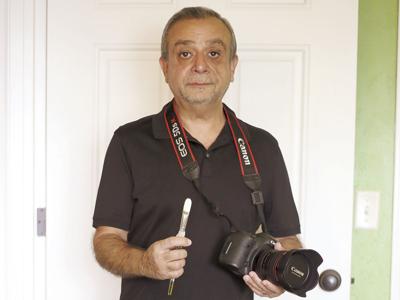

When Kayhan Ghodsi was a kid, all he wanted in life was to become a naval officer. He was the son of a two-star Iranian general in pre-revolution Tehran, Iran, but in what he calls the “funny events of life,” he had flat feet and failed the physical exam. Rejected from the navy, Ghodsi pursued filmmaking in Paris, which led him to eventually study filmmaking in the U.S., where he decided to stay.
Although he’s not making many films these days, Ghodsi, 62, is still active in the arts scene, particularly in Sand City, where he lives. His first show, titledPortrait of An Artist, displayed his photographs of 27 Sand City artists posing with their work. His second show, Painting With Words, is hanging at Sweet Elena’s until Aug. 31, and pays homage to his Iranian roots through calligraphy layered with colorful pastels. The Weekly caught up with Ghodsi in the middle of his two-month-long show to chat about life, poetry and art.
Weekly: How did you end up studying filmmaking in Paris?
Ghodsi: My brother is a painter and he had a scholarship to study for a year there. He told me the schools are free and it’s an awesome place. I didn’t speak a word of French, but I went to Paris anyway in 1973 when I was 19. At that age, you don’t know what the hell you want to do, but you have to be a student [in France]. It took me about a year to learn the language. I studied architecture, then science.
That was OK until I saw an advertisement hanging on the door of the library for the school of filmmaking. At the time I was a fan of [Pier Paolo] Pasolini’s work and I wanted to be his assistant. That was my plan. So I dropped everything and went to filmmaking school and after a year, Pasolini got murdered. These are the funny events of life! But I graduated anyway.
How did you end up in California?
I met this freelance producer making Iranian television about European culture. I went to work for him and did these little short films about theaters in Paris and festivals in Southern France. This was before the [Iranian] revolution and there was a lot of interest at the time about becoming like Europe.
When I went back, [Iran] was pretty bad. Well – not too bad – but everybody who had a mustache now had a beard. I didn’t like living there. So I went back to Paris and went to the American embassy and asked for a list of filmmaking schools in the United States. The first one I wrote to that responded and accepted me was San Francisco Art Institute.
I came to San Francisco in 1978. That was a culture shock. It was right in the middle of the punk rock movement. Everyone was wearing blue boots and they had pink hair.
American or French filmmaking?
In Paris, everything was very structured. My teachers said that if you wanted to shoot in a room, there was only one correct way to put the camera. In America, you put the camera anywhere and it’s fine. That was kind of shocking to me in the beginning, but they were basically telling me to use the camera as a paintbrush. All that structure in Paris became a technical tool, and I learned to just throw it away.
How did you fall in love with Iranian poetry? More specifically, the Ghazal?
As kids they made us learn Arabic because [Iran] was a Muslim country, but I just couldn’t learn the damn thing. The more they tried, the more I hated it. So I made a deal with my teacher: If I memorized 10 Farsi poems from the beginning to the end, he would give me a pass.
Ghazal is a love poem. It’s very romantic, it’s very emotional and it’s sometimes very political. It’s this kind of poetic conversation that affects me so deeply, I have to digest it, I have to read it, I have to mix it with music, I have to write it a hundred times until it just becomes the way I breathe.
What is an artist’s job?
It’s to express oneself. If you break that down into two words, it means to push out. It’s like any relationship: You see a side of yourself you did not know existed. It’s the same reason I fell in love with Pasolini’s work. All my life there were mythologies about my culture, like One Thousand and One Nights. Suddenly, I’m sitting in a theater in Paris and Pasolini’s work is showing me a part of my culture that I didn’t know could exist. That is art. He showed me to myself.


(0) comments
Welcome to the discussion.
Log In
Keep it Clean. Please avoid obscene, vulgar, lewd, racist or sexually-oriented language.
PLEASE TURN OFF YOUR CAPS LOCK.
Don't Threaten. Threats of harming another person will not be tolerated.
Be Truthful. Don't knowingly lie about anyone or anything.
Be Nice. No racism, sexism or any sort of -ism that is degrading to another person.
Be Proactive. Use the 'Report' link on each comment to let us know of abusive posts.
Share with Us. We'd love to hear eyewitness accounts, the history behind an article.