
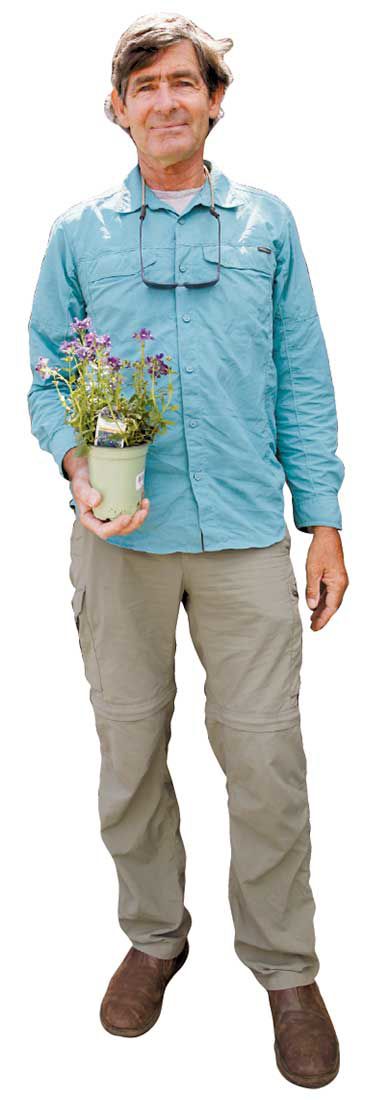
“Teaching inmates was a great way to learn the limits of your power and control,” Kern says. “The illusion breaks down very quickly.”
John Kern of Pacific Grove is an adjunct faculty member in the Life Science Division at Monterey Peninsula College where he teaches ornamental horticulture. For 27 years he taught it in prison – 25 years in the Correctional Training Facility in Soledad and two years at Folsom State Prison – as part of vocational and educational programs.
The inmates learned irrigation and sustainable landscaping, ran a nursery, maintained the prison grounds and provided plants for public projects, all of which Kern says expanded their sense of the world, boosted self-esteem and gave them highly employable skills.
When he first started in 1985, Kern says Soledad was 212 percent over its design capacity and the culture inside was “quite rough and violent.” He says Soledad kept getting better and better in culture, respect, hope, programs and participation. He retired in 2017, and is now writing a book about his experiences.
Weekly: What did you teach inmates?
Kern: Landscape horticulture. Within that, maintenance, construction, nursery or plant propagation, turf management. Sometimes arboriculture, but trees are sometimes hard to find in prison. Basically a complete two-year program in ornamental horticulture.
What was it like when you first started?
I was learning the ropes. I had never taught anything before. At the height of the overcrowding, there was a tendency to incarcerate for the sole purpose of punishing with little regard to what will happen when they were released. It created a cynical attitude toward rehab programs, that they were useless or window dressing. I’ve [told] the legislature that rehab exists because an inmate without hope is impossible to manage.
Where have seedlings from the program been planted?
We had all the beaches, from Monterey to Moss Landing. In recent years, Fort Ord Dunes State Park. Since 1992 we probably produced several hundred thousand seedlings of native plants with State Parks. [Inmates] liked that it helped the community, it gave them consciousness. When one inmate was picked up by his family [upon release], his first stop was going to be Marina State Beach to show [them] the results of his handiwork.
Was there a therapeutic aspect to ornamental horticulture?
Yes. It was not state policy to provide therapy. But there’s an aspect to working in landscaping that we feel is therapeutic and a wonderful way to spend your life: work with your hands outside, manage the aesthetics of our environment, and get paid.
Did inmates grow fruits and vegetables?
Inmates don’t get the best food and don’t have fresh produce, so there was a certain amount of growing fruits and vegetables. It became part of the prison underground economy.
How were you and other instructors protected?
If you are contributing to the betterment of inmates, the population works to protect you – and the program – from harm. I’ve had inmates tell me where weapons stock had been secreted.
What was the difference between teaching inmates and teaching college?
Teaching is teaching. The principles are the same. Especially with adults. You need to get their hands busy, not just stand in front and lecture.
Could inmates earn certificates?
Yes. All the education programs in the prison system are accredited by the Western Association of Schools and Colleges. We arranged for industry certification to be offered when possible. I was training students [to get] their Qualified Applicator Certificate. The credentials help them get over the stigmas of being an ex-offender.
Did you ever come to trust inmates and like them, and vice versa?
Inmates can be likable. A professional hazard is to get too comfortable. Once in a while you go to the records room and read their file, to be reminded of what they have been. I read the file of this young man who had been so sunny and helpful. He’d been incarcerated for assault with a deadly weapon.
What did you learn from being in the prison environment for so long?
The lessons of dealing with inmates are the lessons for dealing with all people: fairness, firmness, good boundaries. A sense of humor is prerequisite number-one for making it through this thing called life.


(0) comments
Welcome to the discussion.
Log In
Keep it Clean. Please avoid obscene, vulgar, lewd, racist or sexually-oriented language.
PLEASE TURN OFF YOUR CAPS LOCK.
Don't Threaten. Threats of harming another person will not be tolerated.
Be Truthful. Don't knowingly lie about anyone or anything.
Be Nice. No racism, sexism or any sort of -ism that is degrading to another person.
Be Proactive. Use the 'Report' link on each comment to let us know of abusive posts.
Share with Us. We'd love to hear eyewitness accounts, the history behind an article.