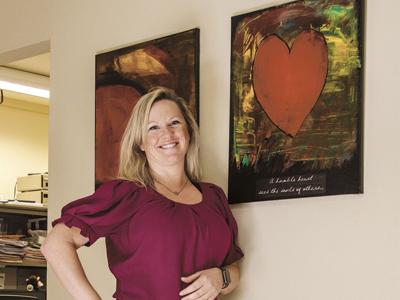

Hanging on the sterile walls inside the Central Coast Cardiology Clinic at the Salinas Valley Memorial Hospital, more than a dozen brightly colored paintings depict hearts and inspirational messages. The acrylic and mixed-media works were created by an artist who knows those halls well, physician assistant Jennifer Carlquist.
While painting is a recent endeavor that balances her work in cardiology and emergency medicine, the 43-year-old has had a multifaceted career path that brought her from journalism to a decade working in ambulances as a paramedic in South Central Los Angeles and Salinas.
After getting a degree from UC Davis in 2007, Carlquist joined cardiologist Dr. Robert Wlodarczyk at SVMH and has continued to moonlight in emergency rooms at SVMH and the Community Hospital of the Monterey Peninsula. Her broad skill set and eye for detail have not gone unnoticed: On July 11, Gov. Jerry Brown appointed Carlquist to the California Physician Assistant Board.
Throughout her four-year term, she will meet with the board – consisting of five PAs, one physician and three public members – every three months to look after the interest of patients, while both advising and enforcing rules and regulations applying to physician assistants in the state.
The Weekly met up with Carlquist at SVMH to talk about her profession, her passion and her recent appointment.
Weekly: It seems more and more people are seeing physician assistants instead of medical doctors these days. What’s behind the growth of the profession?
Carlquist: The profession really has expanded. Forbes recently ranked it as the number-one growing profession in the country. The physician shortage is a real thing, and physician assistants have been able to fill that gap. We can bring a lot to the table.
Physician assistants are basically a physician extender. Whatever the doctor I’m working under can do, I can do, as long as I have been trained. For example, when I’m in the emergency room I can pretty much do anything under the scope of my ER doctor, so if they’re tied up and something critical comes in I can step in and do the same thing.
What will your role be on the California Physician Assistant Board?
The board’s mission is to protect the consumer, to serve the physician assistant profession and to oversee licensure. We also monitor laws relating to physician assistants coming down the pipe. The board works closely with the State Senate and the Assembly on legislation, as well as providing expert opinion to the governor on healthcare-related bills.
Now you’ll have a say in policy. What is your experience with the Affordable Care Act (aka Obamacare) and other changes in healthcare policy?
One of the great things we’re seeing locally in the county is more and more low-income patients coming in for screening and preventative care who wouldn’t have come in before. Patients who used to have trouble seeing great cardiologists before now no longer have any issues. We see people from all backgrounds. Underserved patients are not so underserved anymore.
Is there something about the adrenaline brought on by emergency situations that has you hooked?
I always knew that I was good under pressure, and I knew that was a skill that’s hard to find. When you combine that with loving medicine it’s just a natural fit. What was really fun was delivering patients to our ER docs, and then eventually working under them. It was such a neat experience.
There is no other feeling like being there for somebody in their time of need and rescuing them from their emergency. The job satisfaction is tenfold. Everyday I know I’m making a difference. It’s an interesting shift to cardiology because I’m getting to the patient before they have their heart attack. We can talk about changes they can do so they don’t have to go to the emergency room.
How does your art influence your work in medicine?
I picked up a paintbrush and the first thing I painted was a heart. It became this journey on finding where my true passion really is and that was with hearts and heart patients. I went home after a long day and I felt like I wanted to give my patients more; I wanted to give them hope because lots of patients feel helpless. The patients really connect to the paintings, it gives them hope that they will heal and they will get better.


(0) comments
Welcome to the discussion.
Log In
Keep it Clean. Please avoid obscene, vulgar, lewd, racist or sexually-oriented language.
PLEASE TURN OFF YOUR CAPS LOCK.
Don't Threaten. Threats of harming another person will not be tolerated.
Be Truthful. Don't knowingly lie about anyone or anything.
Be Nice. No racism, sexism or any sort of -ism that is degrading to another person.
Be Proactive. Use the 'Report' link on each comment to let us know of abusive posts.
Share with Us. We'd love to hear eyewitness accounts, the history behind an article.