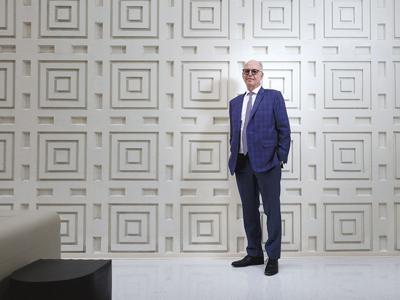

After completing a pulmonary fellowship at UC Irvine, Dr. Steve Packer moved to Monterey County in 1985 for a job at Community Hospital of the Monterey Peninsula as a pulmonary critical care physician. It’s a role he held for 15 years, working his way up to chief of staff by 1998, when the former CEO announced plans to retire. As chief of staff, Packer expected to participate in a search committee but instead, board members approached him and suggested he throw his hat in the ring himself. He did, and in 1999, he became CEO of CHOMP.
At the time, it was a 150-bed hospital; today it has 250 beds. And at the time, CHOMP was just CHOMP – now Montage Health includes a range of entities such as Montage Medical Group (now approaching 100 physicians), MoGo Urgent Care, Ohana and Aspire Health Plan. The organization has grown from 1,200 employees to 2,800. “Over time we’ve changed our focus from just acute care inside the hospital to a more integrated system to meet the need,” Packer says.
Packer spoke to the Weekly about some changes and challenges in health care, and his own health habits.
Weekly: One of the big public-facing events in health care in the past 25 years is the Affordable Care Act, aka Obamacare. Has it led to major changes?
Packer: The most impactful thing is it has expanded Medicaid membership, in California, Medi-Cal. In Monterey County, Medi-Cal enrollment post-ACA more than doubled, to 228,000 members.
The fact that we are seeing fewer uninsured is a heckuva lot better than having patients who have no insurance when they come to the hospital. It boggles my mind that there are still some states that have not expanded Medicaid; they are leaving a lot of federal funding on the table.
What’s the thing that keeps you up at night?
It depends on what day of the week it is. Two years ago, during the middle of the pandemic, it was staffing and ensuring safety of our staff. Like everyone in health care, we experienced a higher turnover rate.
Today, it’s the increasing gap between the expenses we incur to provide care and what Medi-Cal and Medicare pay us – continued inadequate government reimbursement. In California last year, 50 percent of hospitals operated in the red. It’s a slow-moving train wreck. I worry simply because as we receive less and less government reimbursement and more and more mandates on things like staffing ratios; it’s problematic.
You got into hospital administration from the medical side. Do you miss the clinical work?
I don’t think you’d want me to be your pulmonologist today – the names of the medications have all changed. That said, I was in the ICU yesterday, discussing a case. I do enjoy hearing about and discussing clinical cases. For me, the value of having a clinical background is it provides me with insight into how we support our physicians.
I’m curious about your own habits for wellness. What do you do to take care of yourself?
I try to play golf once a week with friends. Once or twice a year, my wife and I go on a trip. Japan is our next big trip. Travel is broadening and improves your mental well-being, which is tied to your physical well-being.
And I am about eight months into intermittent fasting and I absolutely love it. I thought I could benefit from losing 10 percent of my body weight, and I did. Now it’s become a habit; I don’t eat until noon, and then I stop at 8:30pm.
Do you have an exercise routine?
Three mornings a week, I do an hour of cardio and weights. I should do it five days (laughs). I really like it. And I have a Peloton at home.
Who’s your favorite Peloton instructor?
I’m not going to tell you, it’s embarrassing.
We’ve talked about changes and expansion at Montage in the past 25 years. What about the next 25 years?
I think we don’t really understand how impactful AI will be on health care. Think of Siri or Alexa listening in a physician’s office, then synthesizing the visit so a physician doesn’t have to type it all – AI can generate a lab order or an X-ray order, and a physician can look at you, allowing more meaningful human-to-human interaction.
Today, 40 percent of the time a physician spends with a patient is not really interacting with them. It’s an exciting time to be in medicine.


(0) comments
Welcome to the discussion.
Log In
Keep it Clean. Please avoid obscene, vulgar, lewd, racist or sexually-oriented language.
PLEASE TURN OFF YOUR CAPS LOCK.
Don't Threaten. Threats of harming another person will not be tolerated.
Be Truthful. Don't knowingly lie about anyone or anything.
Be Nice. No racism, sexism or any sort of -ism that is degrading to another person.
Be Proactive. Use the 'Report' link on each comment to let us know of abusive posts.
Share with Us. We'd love to hear eyewitness accounts, the history behind an article.