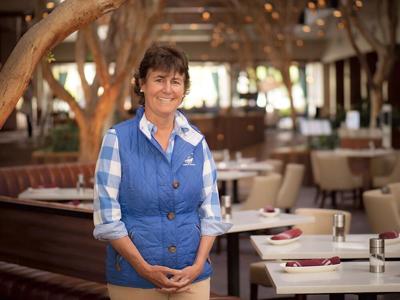

Janine Chicourrat is so important that geographic boundaries give way.
In June, the managing director of Monterey’s Portola Hotel & Spa was honored as one of the 100 Women of Influence by the Silicon Valley Business Journal. She gained recognition in part because of her role in directing a Leadership in Energy and Environmental Design (LEED) renovation of the space, working to reduce the 379-room facility’s use of water and electricity. And Chicourrat indeed wields influence. She sits on the board of directors for the Monterey County Hospitality Association and the Monterey County Convention and Visitors Bureau. She was instrumental in guiding local hotels and restaurants through the pandemic.
The list of accolades for Chicourrat’s work could fill a page. While she appreciates the recognition, Chicourrat says they are not a priority. “I’m outgoing and I don’t mind public speaking,” she adds, “but I don’t actually like getting awards. How they found me in Monterey County I still don’t know,” she observes with a chuckle.
Her role can at times put Chicourat at odds with city officials and others. The hotel has been involved in litigation recently with the city of Monterey due to a dispute over a fee charged during the pandemic.
Chicourrat has been at Portola Hotel since 2008. Before that, she served in several leadership roles for the Pebble Beach Company, including general manager of The Lodge at Pebble Beach.
Weekly: The hospitality industry has been through a lot in the past two years. What was the low point?
Chicourrat: The low was the very beginning. I’m a realist. I knew there was a freight train coming at me. We had to shut down the hotel. The lowest of the low was telling employees that they don’t have a job. But you think about health and safety. And we were in the middle of a room renovation. Our elevators were getting a $1.3 million upgrade. You’re writing all those checks. Fortunately, most of our staff came back, but it was a slow ramp up.
Do you think changes made during the pandemic will become permanent?
I think some of the changes are permanent. People have gotten strategic about menu planning. We clean on departure now. A lot of hotels are going to stick with that model. Why clean rooms every day? We’ve always been a green hotel. There’s an environmental aspect that makes sense – save textiles, save water, save electricity. With climate change, every hotel is going to have to take a hard look at how they operate.
Access to water credits is obviously important to hotels. What was your involvement in the desal discussion?
I recused myself from that because my husband [Carmel Mayor Dave Potter] was on the [Monterey Peninsula Water Management District] board. It’s unfortunate Cal Am became the big, bad industry giant it is. We just need a solution. People say “we need housing,” but they’re the same people who aren’t helping with water. People don’t understand what’s coming. As I understand it, rationing will hit residents first. Our industry has done everything it can – drip irrigation, reclaimed water, low-flow shower heads.
It must be interesting to have a working relationship with local government.
It’s a small community. It’s in everybody’s best interest to work together. We went down an unfortunate road [with the lawsuit]. I was a little sad over it. The public and private sector are sometimes pitted against each other because they don’t know how the other operates. When you take a job in hospitality, you’re not taught how to work with government. But I’m also married to a politician, so I had a coach. When we were trying to get the Conference Center approved, I went home one night and said “what’s an ARC?” [The ARC is the Architectural Review Committee.]
You are responsible for bringing tourists to the area. But some residents don’t appreciate tourists.
Any community that has tourism also has that group of people who don’t like tourists. Maybe they retired here and are looking for quiet. On the flipside are the taxes generated by tourism and the jobs. They don’t understand how valuable it is. It creates jobs for young people. Hospitality is a great way for people to figure out a path in life. You learn life lessons – teamwork, responsibility.


(0) comments
Welcome to the discussion.
Log In
Keep it Clean. Please avoid obscene, vulgar, lewd, racist or sexually-oriented language.
PLEASE TURN OFF YOUR CAPS LOCK.
Don't Threaten. Threats of harming another person will not be tolerated.
Be Truthful. Don't knowingly lie about anyone or anything.
Be Nice. No racism, sexism or any sort of -ism that is degrading to another person.
Be Proactive. Use the 'Report' link on each comment to let us know of abusive posts.
Share with Us. We'd love to hear eyewitness accounts, the history behind an article.