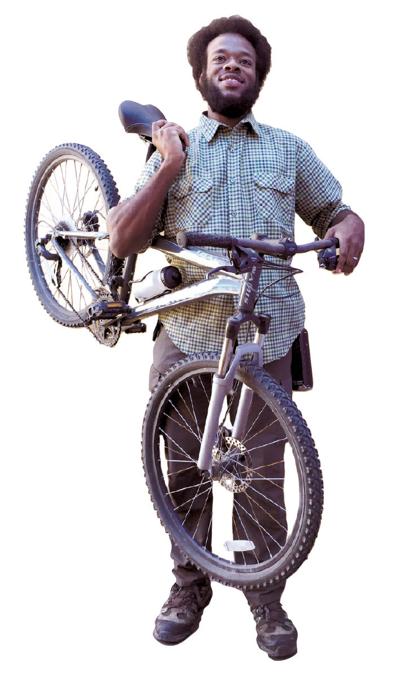

Bernard Green isn’t going to tell you to ride your bike. He’d rather devote himself to making that option safer and more enticing.
A senior communications major at CSU Monterey Bay, Green – who split his youth between Dallas, and later Compton – had a revelation in his teens that set him on his current path: make whatever world he lived in more bikeable and walkable.
He works part-time for Monterey-Salinas Transit in CSUMB’s planning department. Representing the city of Marina, he sits on a committee for the Transportation Agency for Monterey County that provides advice on bike – and pedestrian-friendly infrastructure.
Bikeability and walkability have become buzzwords in Marina of late, as the city struggles to overcome sprawl that has defined it for decades. With respect to Scott Negri’s proposed restaurant project in The Dunes, the subject of this week’s cover story (p. 22), Green has attended Marina City Council meetings in the past few months to advocate for both of those things.
After the Sept. 20 city council meeting, before the council reached a decision on the proposed restaurants, Green, who opposed the project, said the council’s vote would represent a “turning point” for the city. He spoke to the Weekly about what makes transportation so important to him personally and to communities more broadly.
Weekly: How did you become so passionate about biking infrastructure?
Green: I used to always ride as a child. I had that $100 Walmart bike that would break down every year. Then I stopped riding in my teenage years until found my dad’s old ’80s road bike, which was in the garage but I’d never seen it in there. So I put some air in it, and was riding around the neighborhood, and I remember having this feeling of freedom that I experienced as a child: “I feel so free, I can go anywhere.” So I did. I started realizing that on the same streets I had driven down for years, I was having a completely different experience on a bike, seeing shops I never noticed. Waving to people, starting conversations with the bus driver at red lights. I felt like a human again; I was able to interact with my urban environment. It was powerful. Then I thought to myself: I’d really love to ride to school but there’s no safe way for me to do that.
What brought you to CSUMB?
The fact that the school is so new, so fresh, there’s so much the school hasn’t done. What I was thinking was, at a new place, if you propose a project, people think to themselves, “Well, that’s interesting,” and they’re probably more likely to say, “Yeah, let’s try it out,” as opposed to an institution that’s been around for centuries.
What made you get involved with TAMC?
It was a really interesting opportunity to influence change and to inform the community about bike infrastructure – what’s happening around the world, what the best practices are. And how we can bring those seemingly radical but actually very doable bike and pedestrian mobility improvements to Monterey County.
If we’re supposed to be prioritizing biking and walking, why are [cities] only spending 1 percent or less of the transportation budget on bicycle facilities?
What Peninsula city is best in terms of bike friendliness?
(Laughs.) I don’t think any city is doing an exceptional job. I think Monterey, compared to the rest, happens to be the most bikeable because it’s more urban and traffic moves more slowly. But beyond the coastal trail, all cities on the Peninsula could see some improvements in “biking for transportation” infrastructure. The coastal trail can’t be the entire region’s claim to bicycle-friendliness. You have to get to the coastal trail from your house, and that’s usually a harrowing experience for the majority of residents.
Why do you think your generation champions alternative transportation?
It’s become a livability issue. Who actually enjoys driving to get to work? It’s a tedious experience, and it can be stressful. When given an option that gives them the same kind of comfort and convenience as driving, people will always choose another option. That’s what this generation is realizing: There are options.


(0) comments
Welcome to the discussion.
Log In
Keep it Clean. Please avoid obscene, vulgar, lewd, racist or sexually-oriented language.
PLEASE TURN OFF YOUR CAPS LOCK.
Don't Threaten. Threats of harming another person will not be tolerated.
Be Truthful. Don't knowingly lie about anyone or anything.
Be Nice. No racism, sexism or any sort of -ism that is degrading to another person.
Be Proactive. Use the 'Report' link on each comment to let us know of abusive posts.
Share with Us. We'd love to hear eyewitness accounts, the history behind an article.