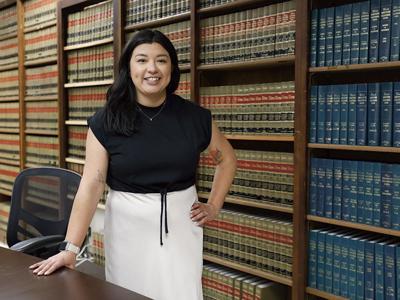

Carla Lopez knows firsthand what it feels like to live a lie. She was born in Mexico and raised in the Central Valley of California, undocumented for over 20 years. “I lived with the fear of, ICE is going to knock on our door between 4-7am, don’t tell anyone where you are from,” she says. After college, she watched with awe as DACA recipients went public: “It was strange to see DREAMers and DACA recipients telling people, ‘be out and proud.’”
Similarly, Lopez was slow to publicly share her sexual orientation. Raised in a Catholic family, she was reluctant to tell her parents she was queer, and when she eventually did during her college years, it caused a rift.
After graduating from UC Davis, Lopez landed a summer internship at the National Center for Lesbian Rights. There she met Lisa Cisneros, a legend for her leadership in organizing Salinas’ LGBTQ+ community. Cisneros, now a federal judge, created the LGBTQ+ Program at California Rural Legal Assistance in 2007. She helped inspire Lopez to attend law school, and Lopez now is the legal director of the LGBTQ+ Program for CRLA, based in Salinas and serving the tri-county area. The program offers legal advocacy, education and training for queer clients.
Weekly: You commute from San Jose to Salinas every day. The drive sounds like a slog.
Lopez: It can be rewarding. I see fieldworkers – my purpose is in front of me, I’m driving through it, gearing up for the day. I really love it, actually. It’s the best way to start my day.
What do you listen to while driving?
Tons of true crime. And there’s a lot of time to think on those drives, there’s a lot going through my head, like: Am I listening to the community and what they need, or am I basing our services on what my thoughts of those needs are?
What are the biggest needs today, and are they different than when you started at CRLA in 2018?
LGBTQ 101 is the most pressing need, and it’s been constant. There’s so much misinformation and an unwillingness to seek out correct information. There are still myths and misconceptions around what sexual orientation and gender identity are. There are still beliefs you can catch it, whatever “it” is.
What we’ve been hearing in the last two or three years is access to gender-affirming care. Many clients are having to go through black market avenues in order to get hormone injections or have certain surgeries. Health plans are still seeing surgeries as cosmetic and not medically necessary to improve or save someone’s life. It’s been a battle. There are no words to describe it other than infuriating.
I am surprised LGBTQ+ 101 is still the biggest need.
It is disappointing, definitely. There’s this thought that, “Oh we live in California, it’s more liberal, these things aren’t happening here.” But we really feel what’s going on outside of California. These last few years have been rough, very rough.
I realize I’ve been pessimistic. It can be especially hard during Pride Month.
What do you do to celebrate Pride?
Get out hiking, celebrating myself and how far I’ve made it. I have really just been trying to get outside and celebrate existence. Mount Madonna is amazing.
Was it difficult coming out in your own family?
At the time, there was no Spanish word for “queer” [now cuir is used], and the closest I could get for my parents was “bisexual,” which didn’t feel right. We had that TV-like moment where they said, “We don’t want you in our family.” There have been many learning moments since then.
I felt like my entire college career, I was living a double life. In some spaces I was out as being queer, but not as undocumented, or out as being undocumented but not queer – in some spaces, I was not out about either thing and pretending to be someone I was not. It was these lives built on safety, and what I thought I needed. It’s something many of our clients face, living double lives.
How do you rest your mind when you need a break from it all?
I wish I had something more profound to say, but I watch trash TV, dating shows – anything that will get me away from real-life issues.
That seems important to do, resting your mind, given the work you do.
A lot of us identify as part of the community. A lot of what our clients are feeling and what our clients fear are also our fears. It makes this work incredibly heavy.


(0) comments
Welcome to the discussion.
Log In
Keep it Clean. Please avoid obscene, vulgar, lewd, racist or sexually-oriented language.
PLEASE TURN OFF YOUR CAPS LOCK.
Don't Threaten. Threats of harming another person will not be tolerated.
Be Truthful. Don't knowingly lie about anyone or anything.
Be Nice. No racism, sexism or any sort of -ism that is degrading to another person.
Be Proactive. Use the 'Report' link on each comment to let us know of abusive posts.
Share with Us. We'd love to hear eyewitness accounts, the history behind an article.