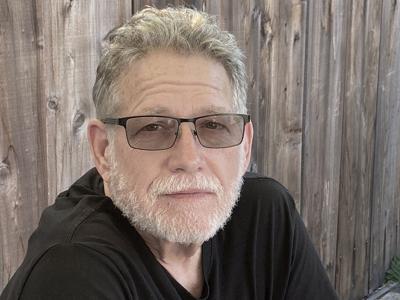

Himself a photographer, Richard W. Gadd is known in the Monterey County community mainly as a curator and photography consultant. Originally from Ohio, Gadd was exposed to the California Central Coast photography tradition soon after taking a basic course in 1974, at the University of Dayton.
His interest and research in photography deepened and soon after college – and “one too many snowy winters in Ohio” – Gadd moved to San Francisco, where he spent seven years working for two different art galleries. In 1987, he accepted a job at the Monterey Museum of Art. He remained with MMA for 18 years, starting as an art installer and ending up as executive director.
Between 2005 and 2023, Gadd served as director of Weston Photography in Carmel, narrowing his work to his main interest. In that period, Gadd had an opportunity to travel with exhibitions, including to Fondazione Fotografia in Modena, Italy, where he delivered a talk about Ansel Adams in 2011. Gadd did commercial work, worked for a newspaper and did his own photography all along, but never did anything with it. Now, retired, he can do more of it. “We’ll see how it goes,” he says.
Weekly: Is photography about hard work or a great eye?
Gadd: It’s a combination of work and talent, for sure. The work can develop your style and you can get better over time. The technical part you can learn; the other part is more inherited. When I was taking photography in my second year of college, I didn’t know that my mother had a darkroom growing up or that my grandfather was artistic.
You said that Central Coast photography was an influence right away.
Early on, New York was the mainstay. Alfred Stieglitz was the godfather of photography. Ansel Adams and Edward Weston would go to see him. But even Stieglitz admired “the roots and rocks of California,” so different from the street photography of New York. But I always appreciated Edward Weston’s work from Ohio [six photographs of the tall smoke stacks at the nearby Armco steel mill; 1922].
So there was a connection there. I was familiar with Ansel Adams, just for the Zone System [based on a technical understanding of how the tonal range of an image is the result of choices made in exposure, negative development and printing] and I took a lot from that.
My first teacher was from back east, Rhode Island School of Design. So both East Coast and West Coast influence.
Would Ansel Adams have been a very different photographer if he wasn’t a Californian ?
Good question. I definitely think the location helped his work a lot. Ansel as a kid was growing up in San Francisco and was going to Yosemite every winter or summer. He was a mountaineer, involved in the Sierra Club. Then I think about Edward Weston and the importance of Point Lobos for him, photographed over and over again.
Are there similarities in the Westons’ work through generations?
There seems to be something in the genes. It runs through the family. There are similarities, but each went in their own direction. Edward Weston’s two sons were photographers. The oldest son, Brett Weston ended up doing abstract photography, something Edward started on but never followed through. And now, Edward’s grandchild is a photographer.
What will you do with all the free time you have now?
Some organizing of my collection, cataloging my own material. And my own work. Take more of it and exhibit more. I will stay in touch with the [Weston] gallery.
What is the pride of your own photography collection?
It’s still the first daguerreotype I bought in 1974. I’d never collected anything else before.
Will fine photography survive the avalanche of images we deal with everyday?
It will. I’ve been through many transitions [in photography]. Different things rise to the top at different times. Right now, it’s large contemporary color work. But there are enough people who are ready to pay a million dollars for rare vintage prints. There’s a gap between generations. I see people in their 30s starting to collect photography; people in their 50s? Not that much.
Will it survive AI?
Hmm. I am afraid of AI.


(1) comment
I just want to wish Mr. Gadd a long, healthy, and happy retirement : )
Welcome to the discussion.
Log In
Keep it Clean. Please avoid obscene, vulgar, lewd, racist or sexually-oriented language.
PLEASE TURN OFF YOUR CAPS LOCK.
Don't Threaten. Threats of harming another person will not be tolerated.
Be Truthful. Don't knowingly lie about anyone or anything.
Be Nice. No racism, sexism or any sort of -ism that is degrading to another person.
Be Proactive. Use the 'Report' link on each comment to let us know of abusive posts.
Share with Us. We'd love to hear eyewitness accounts, the history behind an article.