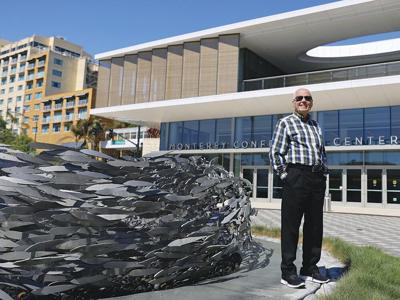

Rick Johnson was a 19-year-old soldier from Minnesota when he first stepped off the plane in Monterey for his assignment at the Defense Language Institute in 1968. It was 20 degrees back home and 60 degrees here, and he remembers thinking: “I’m home, this is the home I was meant to have.”
But his military career and French skills next took him to Ethiopia; somehow, he avoided assignment in Vietnam. After his military service, Johnson lived off and on in Montreal. Then he heard a song about California on the radio, boarded a Greyhound, and returned to the place he thought of as home.
Thanks to the G.I. Bill, he enrolled at Monterey Peninsula College and landed a job as a bartender at The Sardine Factory. After his restaurant gig, he worked for 10 years for the California Restaurant Association.
In 2000, Johnson became executive director of the Old Monterey Business Association, one of five business improvement districts in Monterey that is funded by an add-on to business license fees. (The job also includes serving as administrator of the smaller New Monterey Business Association.) The 74-year-old is set to retire on July 31, and plans to stay involved with veterans issues and St. Angela’s Church in Pacific Grove.
Weekly: Tell me about The Sardine Factory back in the day.
Johnson: [Owners] Ted [Balestreri] and Bert [Cutino] had a pretty amazing impact on me. I never thought of hospitality as anything more than a job. Working for them, I realized it was a profession.
You talk about loving your job at OMBA. Was that a gradual thing, or a sudden realization?
It was on 9/11. It was a Tuesday, farmers market day. Vendors still came, and people just flocked to Alvarado Street. They were hugging and crying. Shops stayed open. People wanted to be with people, they wanted to be embraced by community. That’s when I fell in love with the job. It became a responsibility.
The next big event was the Alvarado Street fire [in 2007]. I got a call from Monterey Police, and the officer said: “The downtown is on fire.” I think difficult times make people stronger.
When I arrived here in 2010, the big downtown story was still about recovery from the fire, and also the recession. Downtown felt dead.
The recession was hitting, we were losing businesses. In many ways, we had hit bottom. Now we like to talk about the Alvarado Street Renaissance. The city’s [downtown specific] plan was bold. Downtown found its pace again; Monterey’s pulse increased.
We rode that until Covid. And then Monterey had to again decide how it could survive with all these external forces.
One of those external forces is the shift to e-commerce. Will downtowns survive that trend?
Yes, downtowns will survive. They will survive because online shopping is convenient, there’s no doubt – but downtowns are our soul.
People aren’t going to downtowns anymore to buy a hot water heater, we can’t compete with the big box stores. We have boutiques; we say you can travel the world in 26 square blocks, as far as restaurants. We reflect what the residential community wants. You can’t buy a hot water heater, but I am incredibly optimistic about downtowns.
Downtown Salinas business owners right now are in a struggle with their farmers market, and say it actually has a negative impact on business. There’s discussion about whether the market should drive business to the bricks-and-mortar stores. So I want to ask you: What is the purpose of a farmers market?
The Old Monterey Marketplace was started in the early ’90s to get people downtown, to remind people that there was a downtown. In the worst times, [a farmers market] helped the downtown remain relevant. If you want to keep your downtown relevant, have markets and events. When you do, people celebrate their town. It gives joy to residents.
I also want to ask you about MPC, where you got a degree in philosophy and anthropology, and later served on the board from 2011-2020.
I needed to pay MPC back. They changed my life. I also needed to be around young people, to have enough energy to finish this job. I’m more than just a cheerleader for MPC. I am optimistic about the future of this country because of community colleges.


(1) comment
Congratulations, Rick. We first met when you were at the Sardine Factory. Fast forward to around 2006 and we met again at our neighborhood voting precinct. What a delight to see you again in this article. Am sure you will continue to have a positive impact on the Peninsula! We are fortunate that you decided to return.
Welcome to the discussion.
Log In
Keep it Clean. Please avoid obscene, vulgar, lewd, racist or sexually-oriented language.
PLEASE TURN OFF YOUR CAPS LOCK.
Don't Threaten. Threats of harming another person will not be tolerated.
Be Truthful. Don't knowingly lie about anyone or anything.
Be Nice. No racism, sexism or any sort of -ism that is degrading to another person.
Be Proactive. Use the 'Report' link on each comment to let us know of abusive posts.
Share with Us. We'd love to hear eyewitness accounts, the history behind an article.