
New mothers know the morning routine well: Wake up (usually before the crack of dawn), change the baby’s diaper, feed and dress the baby, throw on some clothes, run out the door to drop off the baby at day care, go to work. In a perfect world of working moms, it would be that simple. But new mothers know it’s not simple. And new teen-aged mothers have more than a few other obstacles.
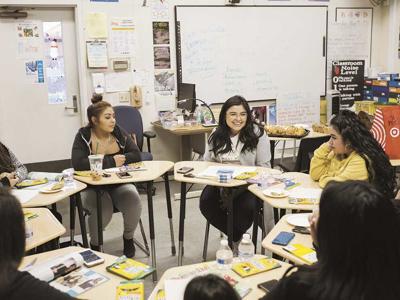
At around 5pm on a Friday, five teen girls are in a classroom at Mount Toro High School, Salinas Union High School District’s alternative high school. It looks like any other classroom, except half of the class functions as a nursery and all of the students have babies, some only a few months old.
One baby crawls on the floor between a mother’s legs. Another musters a wobbly walk, picks up a ball and plops down to play. Another younger baby gives a disgruntled but short wail from mother’s arms, reminding her it’s nap time.
It’s not a typical learning environment, but nonprofit Harmony At Home’s Teen Success Program’s lead advocate, Corina De La Torre, says that’s the point.
“Teen mothers often aren’t getting the support they need to succeed,” she says, especially emotionally and academically. This classroom is one of the few places they can get that support.
In a meeting, they’ll discuss one of four topics: emotional well-being, parenting skills, reproductive health or academic success. They’re also fed a meal during and are encouraged to ask questions anonymously on pieces of paper like, “What happens when I have my period?”
“It’s a safe place,” says one girl who used to attend Salinas High School. (The Weekly has agreed not to publish student names to protect their privacy.)
Her friend, who also attended Salinas High School, chimes in: “I definitely learned more here than in [health class].”
Both say their high school health classes addressed reproductive health for maybe one week. One of them jokes, “That obviously didn’t work.”
What was missing in their high school health classes, the girls agree, was a comprehensive understanding of safe sex: why it’s important to use protection, what the consequences could be in becoming young parents, what a healthy relationship should look like, what kind of birth control is available.
“You know the banana thing?” one of the girls ask referring to a typical condom use demonstration. “I don’t even think they even did that part right.”
It’s not just retrospective jokes. They all face a reality that they didn’t plan for: mothering while being students. All Teen Success participants have to be enrolled in either high school or college; one of the mothers is enrolled in Hartnell College.
All of the high school-aged girls plan on enrolling in Hartnell and want to either find work or seek a higher degree. The one college-aged Hartnell student says she’s had to realize that it will definitely take longer for her to finish school compared to her classmates because she has a baby.
“I’m hopeful,” she says in Spanish. “I do it for my son.”
She says she wants to become a social worker, which makes De La Torre smile.
These teenage mothers do a lot for their children, like most mothers would. But one theme that separates them is an additional layer of isolation and even discrimination.
The college-aged girl says she didn’t tell her landlord that she had a baby because she was afraid they wouldn’t rent to her. Three of the girls said once administrators at their former schools found out they were pregnant, they were presented with options to re-enroll to other schools – like Mount Toro High School – even if they were not interested in transferring out. (They all eventually re-enrolled in different schools.) All of them say that their families offered no sympathy or support.
Then there is also ostracization from peers and the cycle of poverty that is likely to run through generations of teen mothers. According to De La Torre, teen pregnancy is the number-one reason why teenage girls dropout out of school. In their program, 99 percent of the girls are living in poverty.
“Seventy percent of all our members were born from teen mothers,” De La Torre says. “It’s a continuous cycle, which is why we have this program.”
And it seems to be working. Only four months into the program, all of the students are all on birth control, they know how to recognize red flags in relationships and they take their own self-care seriously.
“I have to take care of myself to take care of him,” one girl says. She smiles at her son’s tiny figure. He wakes up, eyes wide, and looks up at his mother.


(0) comments
Welcome to the discussion.
Log In
Keep it Clean. Please avoid obscene, vulgar, lewd, racist or sexually-oriented language.
PLEASE TURN OFF YOUR CAPS LOCK.
Don't Threaten. Threats of harming another person will not be tolerated.
Be Truthful. Don't knowingly lie about anyone or anything.
Be Nice. No racism, sexism or any sort of -ism that is degrading to another person.
Be Proactive. Use the 'Report' link on each comment to let us know of abusive posts.
Share with Us. We'd love to hear eyewitness accounts, the history behind an article.