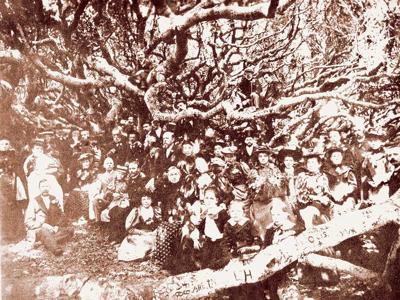

As recently as the early 1900s, Seaside was said to have the largest oak tree in the world.
A picture of it graces the cover of the book Images of America: Seaside by Carol Lynn McKibben and the Seaside History Project. In the image, circa 1890, a massive, gnarled oak tree has at least two dozen people – all wearing their Sunday finest – sitting around and on the branches of a sprawling oak tree.
In its heyday, it was just called “Big Tree,” but was later named Roberts Oak after Seaside’s founder John “Doc” Roberts.
The first thought that struck upon seeing the photo was the irony: Seaside, the same city whose City Council in 2016 approved (before later revoking that approval) Monterey Downs, a mega-development that would have razed 30,000 oak trees – once had the world’s largest oak? Where exactly was it? How old was it, and when and how did it die?
But the book provided no details, just a one-sentence caption.
A few weeks later, in the California History Room at the Monterey Public Library, while eyeing the book titles on the stacks and looking for nothing in particular, my eyes stop on the three-volume set Seaside… 1835-1955 by Donald M. Howard.
I pull all three volumes – each about an inch-and-a-half thick of bound office paper – off the shelves.
On page 124 of Volume III, there it is, the jackpot: “Roberts Oak – A History.”
“The saga of the oak is as diverse as its branches,” Howard writes in his 2003 book. “The arboreal wonder was one of the principal points of interest of Hotel Del Monte guests…
“The tree was purported to have been 480 feet in circumference by 1899.”
“The tree was purported to have been 480 feet in circumference by 1899,” he continues. “It is this author’s opinion that the tree was dying even this early, as years of drifting sand had covered much of the sprawling limbs, and prevented light from entering vital points.”
Furthermore, he writes, “carved doodlings on major limbs” affected the tree’s health, and that Army maneuvers around the tree after the establishment of Fort Ord may have also had an impact. By the time Seaside incorporated in 1954, only “dead limbs” remained, which were later bulldozed in 1973 to make way for a K-Mart shopping center.
The depth of research Howard went to in order to pinpoint the exact location of the oak is impressive: “Most ‘old-timers’ related it was growing somewhere ‘back of K-Mart,’” he writes, referring to the site now occupied by Home Depot. “So to solve this enigma, I had to go to the land title record.”
Howard tracked the land titles of parcels known to be adjacent to the oak, and eventually honed in on the location on an old map.
But the problem was, while later studying the map at length, I still can’t tell where exactly the tree had been – Howard’s map of reference is the 1887 “Map of East Monterey,” on which all of the street names have since changed, and Howard could not be located for comment.
So the city of Monterey’s archivist, Dennis Copeland, agrees to help. A few weeks later, he has the expansive 1887 map laid out on the table in the library’s history room.
At the crux of the problem is that the tree was adjacent to Monte Street – was that Del Monte Avenue? It didn’t appear to be, as it crossed over the railroad tracks. Further confusing things is another street named Railroad, which also crosses the tracks, denoted by “S.P.” (for Southern Pacific).
Copeland then pulls out a 1960s-era map for cross-reference, as well as other sources, including one book that says the tree was at the end of what is now Olympia Avenue, which does not appear on the 1887 map.
“What’s throwing me off is this Olympia business,” Copeland says. “That’s not quite true that it was at the end – maybe they hadn’t yet put Olympia all the way through [the railroad tracks]…
“Monte in a way becomes Broadway, it’s a little jagged,” he continues, poring over the maps, talking things through.
Copeland has the appearance of a consummate historian, wearing a dark blue sweater pulled over a white collared shirt, and his beard is neatly trimmed.
“Well you got me going on this,” he says, before pulling out a more recent map. “If Seaside and Sand City hadn’t started changing names, this would be so much easier.”
We start to realize that even the location of where there were once streets has also changed slightly, but finally, we reach a consensus: The tree’s trunk was located at – or immediately adjacent to – The Home Depot’s Garden Center.
It’s ironic, but apt.


(1) comment
Great column. I was reminded of it when I got a penny postcard of the oak in the mail from eBay.
Welcome to the discussion.
Log In
Keep it Clean. Please avoid obscene, vulgar, lewd, racist or sexually-oriented language.
PLEASE TURN OFF YOUR CAPS LOCK.
Don't Threaten. Threats of harming another person will not be tolerated.
Be Truthful. Don't knowingly lie about anyone or anything.
Be Nice. No racism, sexism or any sort of -ism that is degrading to another person.
Be Proactive. Use the 'Report' link on each comment to let us know of abusive posts.
Share with Us. We'd love to hear eyewitness accounts, the history behind an article.