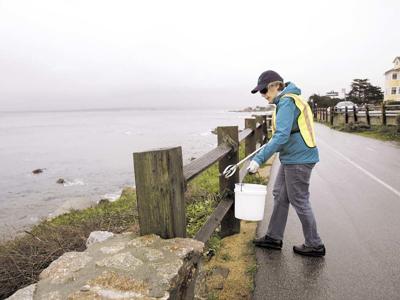

It was the cigarette butts that convinced Lynn Mason, Susan Pierszalowski and Lila Selden to make a public plea before the Pacific Grove City Council. Shocked at how many butts they were picking up on their daily morning walks along the Rec Trail, the three friends took in three large, clear plastic bags of cigarette butts to a July 2018 meeting. They were bags of butts they’d collected since November 2017. They estimated the bags contained more than 25,000 butts.
“It was so strong smelling, we took them outside right away,” Mason says.
Their point was made: Coastline litter including cigarette butts present a serious threat to wildlife and the ecosystem of the Monterey Bay National Marine Sanctuary. Their filters are a microplastic, and the butts may contain more than 150 different toxic substances.
The three became official P.G. volunteers and donned neon green and orange vests to wear during their litter patrols, but in fact the women had already been picking up trash almost daily on their own for 30 years.
It started with Mason, an art researcher, and Pierszalowski, now a retired school nurse, who would meet up for daily walks near Lovers Point. Disturbed by the trash they saw, they brought along bags to snag litter before it made its way into the ocean. Later, Pierszalowski and Seldin, a speech and language pathologist, met at work and started “plogging” – a combination of picking up trash and jogging – years before the concept made its way from Sweden to the U.S. as a fitness craze. Seldin joined in on the morning walks between 7am and 9am, seven days a week.
“It’s almost meditative to walk and grab trash,” Pierszalowski says.
The women wear plastic gloves and use grabbers to pick up even the tiniest bit of plastic. On a recent winter afternoon, Mason and Pierszalowski have their gear for another session of picking up litter, while Seldin is away for the birth of a new granddaughter.
“See this tiny piece here,” says Pierszalowski, a shiny silver corner from a chip bag in the grabber’s grasp. “This is our favorite. One piece of trash always leads you to another.”
Mason acts as recordkeeper, carrying a small notebook to track their progress. She’s also the main dog poop picker-upper; one day she scooped up 20 piles of poop. Other items they regularly find include beer cans and liquor bottles, diapers, used tissues, leftover food and lots of plastic bags. There are the items they’d rather not talk about, like syringes and what gets left behind after late-night love trysts.
Their work has been noticed beyond P.G. to the Monterey County Health Department and its Monterey County Collaborates program, which focuses on chronic disease prevention. They are also working with Steven Kim, PhD, assistant professor of statistics at CSU Monterey Bay. Kim is using the data the women collect for research, and hopes to involve students in picking up cigarette butts elsewhere along the county coastline.
So far, the data shows a weekly average of between 546 and 798 butts collected along the 1-mile stretch of trail from Lovers Point to Hopkins Marine Station, between September and December in 2018. Based on that, the annual average is calculated between 28,474 to 41,626 butts. Seldin notes it does not include the summer months when a high number of tourists are present. They plan on capturing that data this summer.
“If the trend indicates an increasing cigarette butt pollution problem, then Pacific Grove might want to consider ‘smoke-free’ city measures,” Seldin says. Other cities that have taken that step include Huntington Beach, Carpinteria, Dana Point, Laguna Beach and Santa Barbara. (It is already illegal to smoke along Pacific Grove’s coastline. New signs have been posted by the city along the Rec Trail, in part thanks to the trio’s lobbying.)
Pierszalowski says they once tried to estimate the total volume of trash they’ve collected in gallons, based on using 5-gallon buckets, but they gave up: “Suffice to say, it’s a huge, huge amount.”
Mason often strikes out on her own collecting trash. One morning a new resident asked if Mason worked for the city. “When I moved here from Newport Beach I couldn’t get over how clean it is here,” Mason remembers the woman saying.
The women also get stopped along the path by people who ask questions and want to thank them for volunteering. They are quick to say, “Join us!” One man didn’t join officially, but they routinely see him out picking up trash.
It’s a gratifying effect of their ongoing efforts.
“This is our home and we want to keep it beautiful,” Pierszalowski says. “It’s a way to give back to our home.”


(0) comments
Welcome to the discussion.
Log In
Keep it Clean. Please avoid obscene, vulgar, lewd, racist or sexually-oriented language.
PLEASE TURN OFF YOUR CAPS LOCK.
Don't Threaten. Threats of harming another person will not be tolerated.
Be Truthful. Don't knowingly lie about anyone or anything.
Be Nice. No racism, sexism or any sort of -ism that is degrading to another person.
Be Proactive. Use the 'Report' link on each comment to let us know of abusive posts.
Share with Us. We'd love to hear eyewitness accounts, the history behind an article.